Record display
 PROTA4U Homepage
| Select translation pop-up: |
|
|
PROTA4U Record display |
PROTA4U Homepage
|
| Fruct. sem. pl. 2: 219 (1791). | |||
| show more data (11) | comments (0) |
| Portulacaceae | |||
| show more data (12) | comments (0) |
| 2n = 24 | |||
| show more data (1) | comments (0) |
| Talinum patens (L.) Willd. (1799). | |||
| show more data (36) | comments (0) |
| Flameflower, jewels of Opar (En). Herbe onze heures, gros pourpier (Fr). Língua de vaca, beldroega miúda, maria gombi (Po). | |||
| show more data (9) | comments (0) |
| Talinum paniculatum is native to tropical America, but is now a pantropical weed. It occurs scattered throughout tropical Africa, and is locally cultivated as a vegetable in Ghana and Nigeria. | |||
| show more data (14) | comments (0) |
| The shoots and leaves of Talinum paniculatum are added to stews and soups, e.g. in Ghana, Nigeria and DR Congo. They are also eaten as a vegetable in tropical America. Talinum paniculatum is cultivated as a garden ornamental and potplant. | |||
| show more data (7) | comments (0) |
| There is no information on the nutritional composition of Talinum paniculatum leaves, but it is probably comparable to that of Talinum triangulare (Jacq.) Willd. | |||
| show more data (0) | comments (0) |
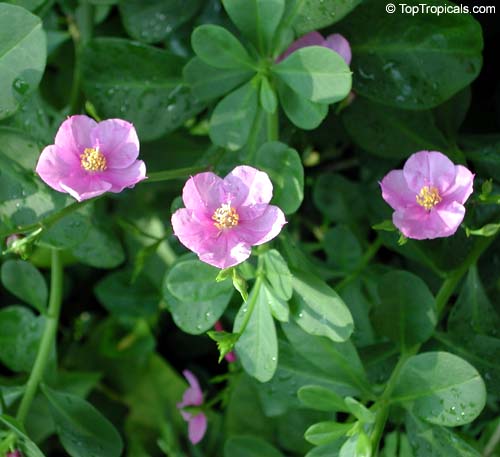
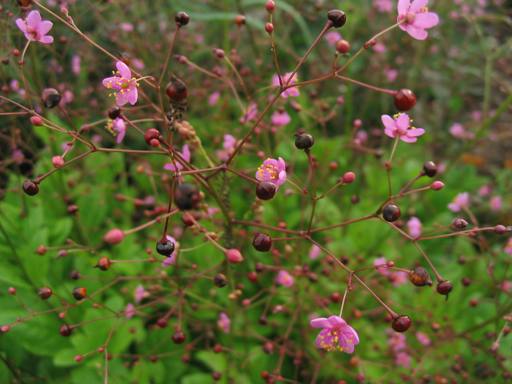
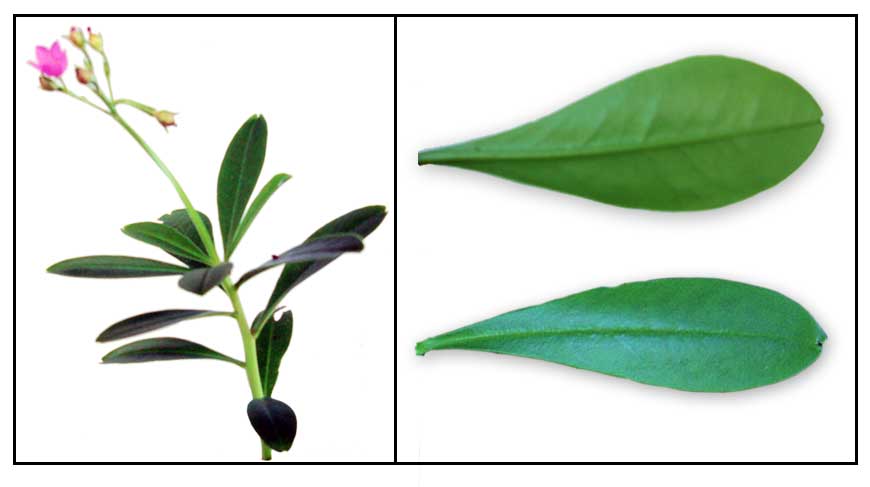
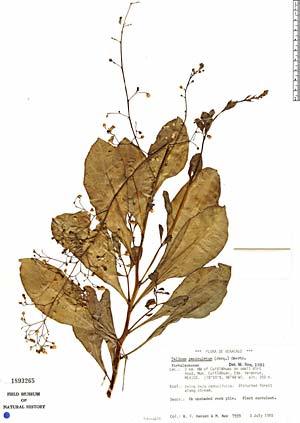
| Erect, glabrous perennial herb up to 100(–120) cm tall, not branched or sparsely branched at base; roots swollen and fleshy; stem succulent, slightly woody at base, dark purple to brownish black. Leaves alternate, simple, almost sessile, succulent; stipules absent; blade elliptical to obovate, 3–12 cm × 1.5–5 cm, base cuneate, apex acute, entire, venation pinnate, indistinct. Inflorescence a large, many-flowered terminal panicle up to 40(–60) cm long. Flowers bisexual, regular, c. 1 cm in diameter; pedicel c. 1 cm long, slender; sepals 2, rounded, 1–2 mm long; petals 5, free, obovate to orbicular, pink; stamens 15–20; ovary superior, 1-celled, style slender, with 3-branched stigma. Fruit a globose capsule 3–5 mm long, 3-valved, elastically dehiscent, many-seeded. Seeds lenticular to reniform, c. 1 mm long, smooth or tuberculate, shining black. Talinum comprises about 40 species, most of them found in Mexico and southern United States, and 7 species in tropical Africa. | |||
| show more data (0) | comments (0) |
| Leaves of Talinum paniculatum may be replaced by those of Talinum triangulare, which have a similar but slightly less sharp taste. | |||
| show more data (0) | comments (0) |
| show more data (20) | comments (0) |
| show more data (3) | comments (0) |
| show more data (4) | comments (0) |
| In tropical Africa Talinum paniculatum occurs locally naturalized, usually in cultivated land and roadsides, sometimes in forest edges, up to 2200 m altitude. In cultivation it prefers well-drained, moist soil rich in organic matter, and full sun. It is drought and shade tolerant. | |||
| show more data (3) | comments (0) |
| show more data (2) | comments (0) |
| Talinum paniculatum is mainly collected from the wild, but is cultivated in Ghana and southern Nigeria. It is propagated by seed or cuttings. There are about 5000 seeds per g. Seeds are sown in the field under light shade or in a nursery. Seedlings appear after 1 week and should be transplanted within 5 weeks. Cuttings are taken from slightly woody stems, from which tops and leaves are removed. They require ample watering. Cuttings are planted at a density of about 5 per m2. The crop responds well to fertilizer. A first harvest can be taken about 6 weeks after planting cuttings, or 8–9 weeks after sowing. Young shoots are picked when the plants are 30 cm tall and leaves are fully developed. Inflorescences should be removed regularly. Although plants remain productive longer, they should be removed after one year as they become woody. | |||
| show more data (0) | comments (0) |
| Talinum paniculatum is widespread and not in danger of genetic erosion. A few accessions are held at the National Germplasm Resources Laboratory, Beltsville, Maryland, United States. | |||
| show more data (0) | comments (0) |
| In tropical Africa Talinum paniculatum is currently mainly collected from the wild. It is poorly known, but deserves more attention as it is easy to grow and productive. | |||
| show more data (0) | comments (0) |
| • Bola, M. & Szafranski, F., 1991. Plantes spontanées à feuilles-légumes de Kisangani et environs (Zaïre). Belgian Journal of Botany 124(2): 222–234. • Mosango, M. & Isosi, W., 1998. Edible plant species used by the human population around Kisangani (Democratic Republic of Congo). Fragmenta floristica et geobotanica 43(1): 109–115. • Phillips, S.M., 2002. Portulacaceae. In: Beentje, H.J. (Editor). Flora of Tropical East Africa. A.A. Balkema, Rotterdam, Netherlands. 40 pp. • Steyn, E.M.A. & Smith, G.F., 2001. Portulacaceae - Talinum paniculatum, a naturalized weed in South Africa. Bothalia 31: 195–197. • van Epenhuijsen, C.W., 1974. Growing native vegetables in Nigeria. FAO, Rome, Italy. 113 pp. | |||
| show more data (36) | comments (0) |
| • Burkill, H.M., 1997. The useful plants of West Tropical Africa. 2nd Edition. Volume 4, Families M–R. Royal Botanic Gardens, Kew, Richmond, United Kingdom. 969 pp. • Mosango, M., Maganyi, W. & Namaganda, M., 1999. A phytosociological study of Talinum paniculatum plant community in Kampala (Uganda). In: Proceedings of the 16th international botanical congress, St. Louis, United States, August 1-7, 1999. Abstract 1484. p. 540. • Mosango, M., Maganyi, W. & Namaganda, M., 2001. Talinetum paniculati, a new synanthropic association of tropical Africa. Polish Botanical Journal 46(1): 99–107. • Schippers, R.R., 2002. African indigenous vegetables, an overview of the cultivated species 2002. Revised edition on CD-ROM. National Resources International Limited, Aylesford, United Kingdom. • Shimoda, H., Nishida, N., Ninomiya, K., Matsuda, H. & Yoshikawa, M., 2001. Javaberine A, new TNF-alpha and nitric oxide production inhibitor, from the roots of Talinum paniculatum. Heterocycles 55(11): 2043–2050. | |||
| show more data (16) | comments (0) |
| |||||
| |||||||
| |||||||
| |||||||
| |||||
| Mosango, M., 2004. Talinum paniculatum (Jacq.) Gaertn. [Internet] Record from PROTA4U. Grubben, G.J.H. & Denton, O.A. (Editors). PROTA (Plant Resources of Tropical Africa / Ressources végétales de l’Afrique tropicale), Wageningen, Netherlands. <http://www.prota4u.org/search.asp>. Accessed . | |||
| There are 100 book citations related to Talinum paniculatum (Jacq.) Gaertn.. Click on "show more" to view them. | ||
| show more data | comments (0) |
| There are 100 citation in web searches related to Talinum paniculatum (Jacq.) Gaertn.. Click on "show more" to view them. | ||
| show more data | comments (0) |
| There are 87 citation in scholarly articles related to Talinum paniculatum (Jacq.) Gaertn.. Click on "show more" to view them. | ||
| show more data | comments (0) |
| There are 25 news article citations related to Talinum paniculatum (Jacq.) Gaertn.. Click on "show more" to view them. | ||
| show more data | comments (0) |
| There are 3 citations in Afrirefs related to Talinum paniculatum (Jacq.) Gaertn.. Click on "show more" to view them. | ||
| show more data | comments (0) |
| There are 5 Wikipedia citations related to Talinum paniculatum (Jacq.) Gaertn.. Click on "show more" to view them. | ||
| show more data | comments (0) |
| General importance |  |
| Geographic coverage Africa |  |
| Geographic coverage World | |
| Vegetables | |
| Ornamental use | |
| Medicinal use |  |
| Climate change |  |
| Food security | |



 Comments (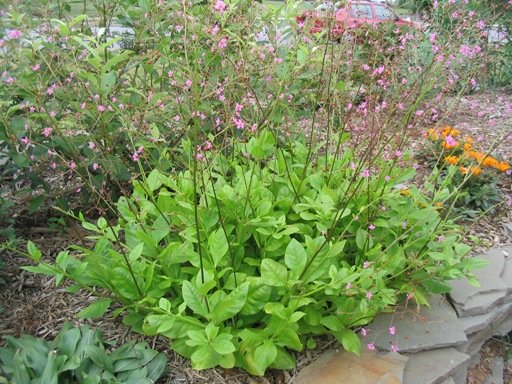



.065.JPG)