
Record display
 PROTA4U Homepage
| Select translation pop-up: |
|
|
PROTA4U Record display |
PROTA4U Homepage
|
| Bull. Jard. Bot. Etat 19: 404 (1949). | |||
| show more data (2) | comments (0) |
| Caesalpiniaceae (Leguminosae - Caesalpinioideae) | |||
| show more data (6) | comments (0) |
| show more data (7) | comments (0) |
| Bois de rose d’Afrique (Fr). | |||
| show more data (3) | comments (0) |
| Guibourtia tessmannii occurs in Cameroon, Equatorial Guinea and Gabon. | |||
| show more data (4) | comments (0) |
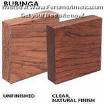
| The wood of Guibourtia tessmannii, known as ‘bubinga’ or ‘kevazingo’, is used for flooring, joinery, decorative panelling, furniture, cabinet work, mine props, vehicle bodies, boxes, crates, musical instruments, tool handles, brush backs and carvings. It is suitable for ship building, toys, novelties, turnery, veneer and plywood. In traditional medicine, bark decoctions are administered for the treatment of gonorrhoea and hypertension, and for preventing abortion. They are also taken as an anthelmintic and applied as a cleanser for washing wounds. In the markets of Yaoundé (Cameroon), stem bark is for sale to cure many complaints: convulsions, diarrhoea, lumbago, hernia, malaria, anaemia and female infertility. A survey among villagers yielded claims that use of bark, leaves or fruits also controls typhoid fever, haemorrhoids, cancer, sexually transmittable diseases and hepatitis. Bark extracts are used in southern Cameroon as a pesticide, often in mixtures with other plant species, to control the ‘black pod disease’ in cacao cause by fungi. The bark is much sought after and has often been removed at the base of the bole of standing trees. | |||
| show more data (4) | comments (0) |
| The wood is traded from Gabon as ‘kevazingo’ in mixture with that of Guibourtia pellegriniana J.Léonard. In 1997 about 55,000 m³ of logs were exported at an average price of FCFA 350,000/m³. | |||
| show more data (0) | comments (0) |
| The heartwood is reddish brown, often with violet-brown or purplish streaks, and distinctly demarcated from the whitish, up to 7.5 cm wide sapwood. The grain is straight or interlocked, texture fine and even. The wood is lustrous and scented when freshly cut. The wood is heavy, with a density of 860–930 kg/m³ at 12% moisture content, and hard. It air dries slowly with high risk of distortion. The rates of shrinkage are quite high, from green to oven dry 5.2–8.1% radial and 6.3–10.5% tangential. At 12% moisture content, the modulus of rupture is 166–195 N/mm², modulus of elasticity 15,100 N/mm², compression parallel to grain 66–73 N/mm², shear 9.5 N/mm², cleavage 20–27 N/mm and Chalais-Meudon side hardness 7.9–9.0. The wood is fairly easy to saw and work with both machine and hand tools, and it planes to a good finish. It polishes well and varnishes satisfactorily. It holds nails well and has good gluing properties. Good-quality veneer can be produced by slicing. The wood is durable and resistant to termites, Lyctus and other wood-boring beetles. The heartwood is resistant to impregnation with preservatives, the sapwood moderately resistant. The wood of Guibourtia tessmannii contains flavanols of leucofisetinidin and guibourtacacidin, tannins and sugars. Some stilbene glycosides have been isolated from the bark, as well as asebotin, a dihydrochalcone glucoside. Pharmacological screening showed antifungal activity. | |||
| show more data (0) | comments (0) |
| Medium-sized to large tree up to 40 m tall; bole branchless for up to 20 m, straight, cylindrical, up to 200 cm in diameter and often with large, slender buttresses up to 3 m high; bark surface greenish grey to reddish brown, scaly with small, rounded scales leaving orange to red depressions, inner bark brittle, reddish to brown, often with a gelatinous reddish exudate; crown dense, rounded. Leaves arranged spirally, paripinnately compound with 1 pair of leaflets; stipules small and early caducous; petiole 1.5–3 cm long; leaflets nearly sessile, obliquely ovate or elliptical, 6–15 cm × 3–6 cm, base cuneate, apex acuminate, glabrous, without translucent dots, pinnately veined with up to 10 pairs of lateral veins. Inflorescence an axillary or terminal panicle c. 10 cm long, with thick branches, reddish hairy; bracts small, very early caducous. Flowers bisexual, nearly regular, whitish, fragrant, sessile; sepals 4, slightly unequal, up to 6 mm long, hairy inside; petals absent; stamens 10, free, up to 8 mm long; ovary superior, broadly ellipsoid, c. 2 mm long, hairy, 1-celled, sessile, style c. 5 mm long. Fruit an obliquely ellipsoid pod 3–4 cm × 2–2.5 cm, slightly flattened, glabrous, densely striped, dark copper-brown, dehiscent with 2 leathery valves, 1(–2)-seeded. Seed kidney-shaped, c. 1.5 cm long, slightly flattened, completely covered by an orange-red aril. The seed is eaten by monkeys, chimpanzees and hornbills, which may serve as dispersers. Guibourtia comprises about 14 species, all African, but a single species occurs in tropical America. The genus is related to Hymenaea and Peltogyne. Guibourtia pellegriniana J.Léonard occurs from south-eastern Nigeria south to Cabinda (Angola). It is a tall tree, with a straight bole. In Gabon it is locally harvested for the commercial timber trade from secondary forest where okoumé (Aucoumea klaineana Pierre) is the dominant species. The wood, with a density of about 940 kg/m³ at 12% moisture content, is quite similar to that of Guibourtia tessmannii. | |||
| show more data (0) | comments (0) |
| show more data (4) | comments (0) |
| show more data (1) | comments (0) |
| Guibourtia tessmannii occurs in evergreen forest, usually in primary forest on well-drained localities. | |||
| show more data (1) | comments (0) |
| Guibourtia tessmannii generally occurs scattered in the forest. In Gabon the average wood volume of Guibourtia tessmannii and Guibourtia pellegriniana together is 1.4 m³/ha, and in 1995 the standing stock was estimated at 13 million m³. The minimum bole diameter for exploitation is 90 cm in Gabon. In Cameroon a tree with a bole diameter of 80 cm yielded 5.6 m³ of wood, one of 100 cm 8.6 m³ and one of 150 cm 19.1 m³. Freshly harvested logs do not float in water. | |||
| show more data (0) | comments (0) |
| Although Guibourtia tessmannii has a limited geographical distribution and usually occurs scattered in primary forest, there are no indications that it is under threat of genetic erosion at present. However, it is advisable to monitor populations because the species may easily become liable to genetic erosion. | |||
| show more data (0) | comments (0) |
| The wood of Guibourtia tessmannii is in demand on the timber market, but research is needed to be able to determine its possibilities for commercial exploitation on a sustainable basis. There is no information available on growth rates, propagation and planting, and suitable management measures. Slow growth has been reported for some other Guibourtia species, and could also be a serious drawback for Guibourtia tessmannii because long cutting cycles would be necessary for sustainable exploitation. The common application of the bark in traditional medicine warrants more research on phytochemistry and pharmacological properties. | |||
| show more data (0) | comments (0) |
| • Bolza, E. & Keating, W.G., 1972. African timbers: the properties, uses and characteristics of 700 species. Division of Building Research, CSIRO, Melbourne, Australia. 710 pp. • Burkill, H.M., 1995. The useful plants of West Tropical Africa. 2nd Edition. Volume 3, Families J–L. Royal Botanic Gardens, Kew, Richmond, United Kingdom. 857 pp. • CIRAD Forestry Department, 2008. Bubinga. [Internet] Tropix 6.0. http://tropix.cirad.fr/ afr/ bubinga.pdf. Accessed October 2010. • CTFT (Centre Technique Forestier Tropical), 1977. Bubinga. Bois et Forêts des Tropiques 173: 23–35. • Vivien, J. & Faure, J.J., 1985. Arbres des forêts denses d’Afrique Centrale. Agence de Coopération Culturelle et Technique, Paris, France. 565 pp. | |||
| show more data (4) | comments (0) |
| • ATIBT (Association Technique Internationale des Bois Tropicaux), 1986. Tropical timber atlas: Part 1 – Africa. ATIBT, Paris, France. 208 pp. • Aubréville, A., 1968. Légumineuses - Caesalpinioidées (Leguminosae - Caesalpinioideae). Flore du Gabon. Volume 15. Muséum National d’Histoire Naturelle, Paris, France. 362 pp. • Betti, J.L., 2002. Medicinal plants sold in Yaoundé markets, Cameroon. African Study Monographs 23(2): 47–64. • Coulibaly, O., Mbila, D., Sonwa, D.J., Adesina, A. & Bakala, J., 2002. Responding to economic crisis in Sub-Saharan Africa: new farmer-developed pest management strategies in cocoa-based plantations in southern Cameroon. Integrated Pest Management Reviews 7(3): 165–172. • de Saint-Aubin, G., 1963. La forêt du Gabon. Publication No 21 du Centre Technique Forestier Tropical, Nogent-sur-Marne, France. 208 pp. • Jiofack, T., Ayissi, C. Fokunang, F., Guedje, N. & Kemeuze, V., 2009. Ethnobotany and phytomedicine of the upper Nyong valley forest in Cameroon. African Journal of Pharmacy and Pharmacology 3(4): 144–150. • Nkengfack, A.E., Van Heerden, F.R., Fuendjiep, V. & Fomum, Z.T., 2001. Asebotin, a dihydrochalcone glucoside from Guibourtia tessmannii. Fitoterapia 72: 834–836. • Nyemba, A.M., Mpondo, T.N., Kimbu, S.F. & Connolly, J.D., 1995. Stilbene glycosides from Guibourtia tessmannii. Phytochemistry 39(4): 895–898. • Takahashi, A., 1978. Compilation of data on the mechanical properties of foreign woods (part 3) Africa. Shimane University, Matsue, Japan. 248 pp. • Wilks, C. & Issembé, Y., 2000. Les arbres de la Guinée Equatoriale: Guide pratique d’identification: région continentale. Projet CUREF, Bata, Guinée Equatoriale. 546 pp. | |||
| show more data (1) | comments (0) |
| show more data (1) | comments (0) |
| |||||
| |||||||||
| |||||
| Obeng, E.A., 2011. Guibourtia tessmannii (Harms) J.Léonard. [Internet] Record from PROTA4U. Lemmens, R.H.M.J., Louppe, D. & Oteng-Amoako, A.A. (Editors). PROTA (Plant Resources of Tropical Africa / Ressources végétales de l’Afrique tropicale), Wageningen, Netherlands. <http://www.prota4u.org/search.asp>. Accessed . | |||
| There are 61 book citations related to Guibourtia tessmannii (Harms) J.Léonard. Click on "show more" to view them. | ||
| show more data | comments (0) |
| There are 100 citation in web searches related to Guibourtia tessmannii (Harms) J.Léonard. Click on "show more" to view them. | ||
| show more data | comments (0) |
| There are 54 citation in scholarly articles related to Guibourtia tessmannii (Harms) J.Léonard. Click on "show more" to view them. | ||
| show more data | comments (0) |
| There are 2 news article citations related to Guibourtia tessmannii (Harms) J.Léonard. Click on "show more" to view them. | ||
| show more data | comments (0) |
| There are 13 citations in Afrirefs related to Guibourtia tessmannii (Harms) J.Léonard. Click on "show more" to view them. | ||
| show more data | comments (0) |
| There are 1 Wikipedia citations related to Guibourtia tessmannii (Harms) J.Léonard. Click on "show more" to view them. | ||
| show more data | comments (0) |
| General importance |  |
| Geographic coverage Africa |  |
| Geographic coverage World | |
| Timber use |  |
| Medicinal use | |
| Essential oil and exudate use | |



 Comments (




.jpg)


