Record display
 PROTA4U Homepage
| Select translation pop-up: |
|
|
PROTA4U Record display |
PROTA4U Homepage
|
| Fl. ind. ed. 1832, 2: 362 (1832). | |||
| show more data (12) | comments (0) |
| Caesalpiniaceae (Leguminosae - Caesalpinioideae) | |||
| show more data (21) | comments (0) |
| 2n = 24 | |||
| show more data (2) | comments (0) |
| Caesalpinia bonducella (L.) Fleming (1810), nom. ill. | |||
| show more data (43) | comments (0) |
| Bonduc nut, fever nut, guilandina seed, nicker nut (En). Bonduc, cadoque, cadoc, cassie (Fr). Inimbo, inimboja, nogueira de bonduque, olho de gato, silva da praia (Po). Mkomwe, mnamu, mburuga (Sw). | |||
| show more data (7) | comments (0) |
| Caesalpinia bonduc is pantropical. It is commonly found in coastal areas of tropical Africa. | |||
| show more data (59) | comments (0) |
| Throughout the distribution area of Caesalpinia bonduc in Africa its leaves, bark and roots are used to cure fever, headache and chest pain and as an anthelminthic. In West Africa it is used as a rubefacient and as a tonic in the treatment of jaundice, diarrhoea and skin eruptions. At the Kenyan coast the seed and decoctions of the leaves and roots are taken to treat asthma and complications during menstruation, to avoid miscarriage, and as eye-drops to treat internal blood clots in the eye. In Tanzania the powdered kernel of the seed is taken with water to treat diabetes mellitus. In Somalia the oil from the seeds is used to treat rheumatism. A bitter extract from the seeds is known as ‘poor man’s quinine’ and is used against malaria e.g. in India, but its use in Africa as a malaria cure has not been documented. In tropical Asia and the Pacific Ocean islands Caesalpinia bonduc is an important medicinal plant as well, with largely similar uses as in Africa. In large doses it is believed to be poisonous. In Sierra Leone and Ethiopia Caesalpinia bonduc is planted as a live fence. In Equatorial Guinea the oil from the seeds is used for cooking. The seeds are widely used as beads, as weights and as counters in board games. | |||
| show more data (17) | comments (0) |
| Local trade of Caesalpinia bonduc seeds for medicinal use is common in tropical Africa. | |||
| show more data (0) | comments (0) |
| The seeds of Caesalpinia bonduc contain the isoflavonoid bonducellin and several cassane diterpenes, including caesaldekarin A, caesalpinin B, bonducellpins A–D, α-, β-, γ-, and δ-caesalpins, and a bondenolide. Compounds isolated from the roots include caesaldekarin C and caesalpin F. The phytochemical content of other plant parts has not yet been documented. Several of the compounds found in the seeds, notably bonducellin and β-caesalpin, have confirmed antiplasmodial activity. Contradicting results of tests on the antiplasmodial activity may be due to faulty identification of the specimens tested. Bondenolide and seed extracts have confirmed antifungal and antibacterial activity. The effects of a leaf extract on calcium metabolism and cholinergic receptors of preparations of the isolated outer muscular layer of the uterus of pregnant rat were comparable to those obtained with acetylcholine. In normal rats, aqueous and 50% ethanolic extracts of Caesalpinia bonduc seeds exhibited hypoglycaemic activity and in diabetic rats, they produced a significant antihyperglycaemic effect. The aqueous extract also exhibited antihypercholesterolemic and antihypertriglyceridemic effects in streptozotocin diabetic rats. An aqueous extract of the roots, stems and leaves was found to have antiviral and anticancer activity. The seed contains about 20% oil that is especially rich in linoleic acid (68%) and has vesicant properties. | |||
| show more data (1) | comments (0) |
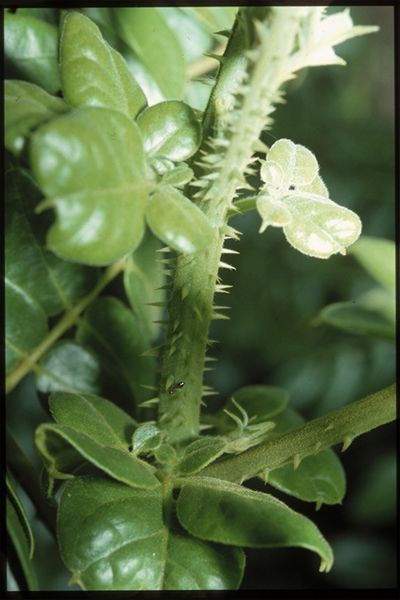
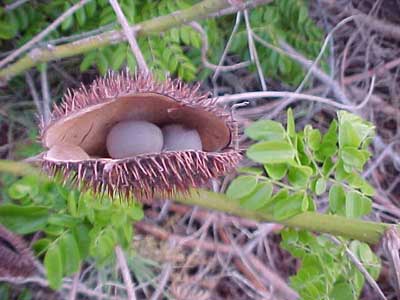
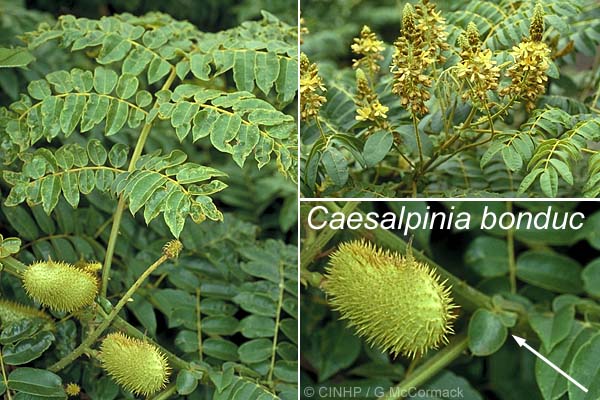
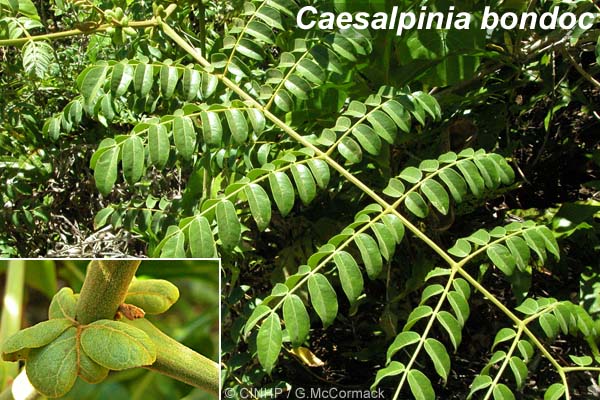
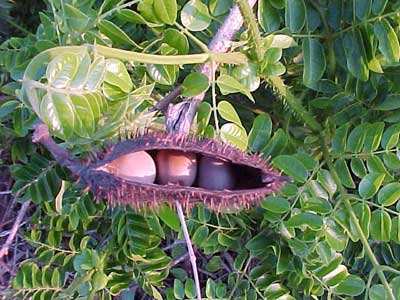
| Liana with stems up to 15 m long, usually armed with robust prickles. Leaves alternate, bipinnately compound, with 6–11 pairs of pinnae; stipules pinnate or 3–5-lobed, up to 20 mm long; petiole and rachis 15–80 cm long; leaflets opposite, 6–9(–12) pairs per pinna, oblong, 2–4 cm × 1–2 cm, base rounded, apex rounded to acute, shortly hairy at least on midrib and margins. Inflorescence a supra-axillary or terminal raceme or panicle 30–60 cm long, densely flowered. Flowers bisexual or functionally unisexual, zygomorphic, 5-merous; sepals free, unequal, c. 5 mm × 2.5 mm, the lowest one hood-shaped; petals free, unequal, 6–7 mm × 2–3 mm, clawed, yellow, the upper one different in shape and size; stamens 10, free, c. 5 mm long, filaments hairy towards base; ovary superior, style short. Fruit an oblong, inflated pod 5–8 cm × 3–4.5 cm, dehiscent, covered with stiff, long hairy prickles, 1–2 seeded. Seeds ovoid, 1.5–2 cm in diameter, smooth, hard, pale grey. Seedling with epigeal germination; cotyledons rounded, thick. | |||
| show more data (9) | comments (0) |
| Caesalpinia comprises about 200 species and is pantropical, most of the species occurring in tropical America. In tropical Africa about 25 species are indigenous, naturalized or cultivated. Caesalpinia crista L. mentioned in literature on Africa is a misapplied name and can refer to either the indigenous Caesalpinia bonduc or the introduced Caesalpinia decapetala (Roth) Alston. In tropical Africa Caesalpinia crista has only been recorded in the Seychelles and Mauritius and is otherwise found in the Americas, Asia, Australia and the Pacific Ocean islands. ‘Brazilwood’ or ‘Pernambuco wood’ is often associated with Caesalpinia bonduc, however the wood derives from an endemic of Brazil, Caesalpinia echinata Lam. which also yields a dye. The dyes brasilin and brasilein have only been isolated from the latter and not from Caesalpinia bonduc. | |||
| show more data (4) | comments (0) |
| Caesalpinia bonduc can be found flowering and fruiting throughout the year. Seeds of Caesalpinia bonduc float and retain their viability in water for extended periods. This explains its presence in coastal areas throughout the tropics. | |||
| show more data (3) | comments (0) |
| Caesalpinia bonduc occurs especially in disturbed sites. In tropical Africa it has become naturalized around inland villages probably as a result of seeds being transported for medicinal use and for use in popular board games. | |||
| show more data (7) | comments (0) |
| Caesalpinia bonduc is only propagated by seed. | |||
| show more data (3) | comments (0) |
| In Equatorial Guinea Caesalpinia bonduc has been cultivated for its seed oil. | |||
| show more data (0) | comments (0) |
| Mature pods of Caesalpinia bonduc can be collected from the plant or picked up after they have dropped. Other plant parts are harvested whenever the need arises. | |||
| show more data (1) | comments (0) |
| Seeds of Caesalpinia bonduc may be simply dried and stored for later use. Other plant parts are probably used fresh. | |||
| show more data (0) | comments (0) |
| Caesalpinia bonduc is very widespread, not in danger of extinction or genetic erosion and is rare in germplasm collections. | |||
| show more data (0) | comments (0) |
| Extracts of Caesalpinia bonduc show interesting pharmacological effects, e.g. modulation of cholinergic receptors and antihyperglycaemic activity, which merit further research. | |||
| show more data (1) | comments (0) |
| • Burkill, H.M., 1995. The useful plants of West Tropical Africa. 2nd Edition. Volume 3, Families J–L. Royal Botanic Gardens, Kew, Richmond, United Kingdom. 857 pp. • Datte, J.Y., Traore, A., Offoumou, A.M. & Ziegler, A., 1998. Effects of leaf extract of Caesalpinia bonduc (Caesalpiniaceae) on the contractile activity of uterine smooth muscle of pregnant rats. Journal of Ethnopharmacology 60(2): 149–155. • du Puy, D.J., Labat, J.N., Rabevohitra, R., Villiers, J.-F., Bosser, J. & Moat, J., 2002. The Leguminosae of Madagascar. Royal Botanic Gardens, Kew, Richmond, United Kingdom. 750 pp. • Francis, J.K., 2003. Caesalpinia bonduc (L.) Roxb.: gray nicker bean. [Internet] http://www.fs.fed.us/ global/iitf/. Accessed January 2006. • Ibnu Utomo, B., 2001. Caesalpinia L. In: van Valkenburg, J.L.C.H. & Bunyapraphatsara, N. (Editors). Plant Resources of South-East Asia No 12(2): Medicinal and poisonous plants 2. Backhuys Publishers, Leiden, Netherlands. pp. 123–129. • Oliver-Bever, B., 1986. Medicinal plants in tropical West Africa. Cambridge University Press, Cambridge, United Kingdom. 375 pp. • Pakia, M. & Cooke, J.A., 2003. The ethnobotany of the Midzichenda tribes of the coastal forest areas in Kenya: 2. Medicinal plant uses. South African Journal of Botany 69(3): 382–395. • Sharma, S.R., Dwivedi, S.K. & Swarup, D., 1997. Hypoglycaemic, antihyperglycaemic and hypolipidemic activities of Caesalpinia bonducella seeds in rats. Journal of Ethnopharmacology 58(1): 39–44. | |||
| show more data (36) | comments (0) |
| • Ali, S.I., 1973. Caesalpiniaceae. In: Nasir, E. & Ali, S.I. (Editors). Flora of West Pakistan No 54. Department of Botany, University of Karachi, Pakistan. 47 pp. • Kinoshita, T., 2000. Chemical studies on the Philippine crude drug calumbibit (seeds of Caesalpinia bonduc): the isolation of new cassane diterpenes fused with a,b-butenolide. Chemical & Pharmaceutical Bulletin 48(9): 1375–1377. • Lyder, D.L., Peter, S.R., Tinto, W.F., Bissada, S.M., McLean, S. & Reynolds, W.F., 1998. Minor cassane diterpenoids of Caesalpinia bonduc. Journal of Natural Products 61(2): 1462–1465. • Moshi, M.J. & Nagpa, V., 2000. Effect of Caesalpina bonducella seeds on blood glucose in rabbits. Pharmaceutical Biology 38(2): 81–86. • Peter, S.R., Tinto, W.F., McLean, S., Reynolds, W.F. & Yu, M., 1997. Bonducellpins A–D, new cassane furanoditerpenes from Caesalpinia bonduc. Journal of Natural Products 60(12): 1462–1465. • Peter, S.R., Tinto, W.F., McLean, S., Reynolds, W.F. & Yu, M., 1998. Cassane diterpenes from Caesalpinia bonducella. Phytochemistry 47(6): 1153–1155. • Simin, K., Khaliq-uz-Zaman, S.M. & Ahmad, V.U., 2001. Antimicrobial activity of seed extracts and bondenolide from Caesalpinia bonduc (L.) Roxb. Phytotherapy Research 15(5): 437–440. • Stiles, D., 1998. The Mikea hunter-gatherers of southwest Madagascar: ecology and socioeconomics. African Study Monographs 19(3): 127–148. | |||
| show more data (28) | comments (0) |
| show more data (2) | comments (0) |
| • Ibnu Utomo, B., 2001. Caesalpinia L. In: van Valkenburg, J.L.C.H. & Bunyapraphatsara, N. (Editors). Plant Resources of South-East Asia No 12(2): Medicinal and poisonous plants 2. Backhuys Publishers, Leiden, Netherlands. pp. 123–129. | |||
| show more data (2) | comments (0) |
| |||||
| |||||||
| |||||||||||
| |||||||
| |||||
| Oudhia, P., 2007. Caesalpinia bonduc (L.) Roxb. [Internet] Record from PROTA4U. Schmelzer, G.H. & Gurib-Fakim, A. (Editors). PROTA (Plant Resources of Tropical Africa / Ressources végétales de l’Afrique tropicale), Wageningen, Netherlands. <http://www.prota4u.org/search.asp>. Accessed . | |||
| There are 6 study abstracts related to Caesalpinia bonduc (L.) Roxb.. Click on "show more" to view them. | ||
| show more data | comments (0) |
| There are 200 book citations related to Caesalpinia bonduc (L.) Roxb.. Click on "show more" to view them. | ||
| show more data | comments (0) |
| There are 200 citation in web searches related to Caesalpinia bonduc (L.) Roxb.. Click on "show more" to view them. | ||
| show more data | comments (0) |
| There are 181 citation in scholarly articles related to Caesalpinia bonduc (L.) Roxb.. Click on "show more" to view them. | ||
| show more data | comments (0) |
| There are 9 news article citations related to Caesalpinia bonduc (L.) Roxb.. Click on "show more" to view them. | ||
| show more data | comments (0) |
| There are 21 citations in Afrirefs related to Caesalpinia bonduc (L.) Roxb.. Click on "show more" to view them. | ||
| show more data | comments (0) |
| There are 15 Wikipedia citations related to Caesalpinia bonduc (L.) Roxb.. Click on "show more" to view them. | ||
| show more data | comments (0) |
| General importance |  |
| Geographic coverage Africa |  |
| Geographic coverage World |  |
| Ornamental use |  |
| Auxiliary use |  |
| Medicinal use | |
| Vegetable oil use | |



 Comments (