Record display
 PROTA4U Homepage
| Select translation pop-up: |
|
|
PROTA4U Record display |
PROTA4U Homepage
|
| Kew Bull. 32: 798 (1978). | |||
| show more data (5) | comments (0) |
| Rutaceae | |||
| show more data (8) | comments (0) |
| Fagara usambarensis Engl. (1905), Fagara becquetii G.C.C.Gilbert (1958), Zanthoxylum becquetii (G.C.C.Gilbert) P.G.Waterman (1975). | |||
| show more data (8) | comments (0) |
| show more data (1) | comments (0) |
| Zanthoxylum usambarense occurs in Ethiopia, Kenya, Tanzania and Rwanda. | |||
| show more data (0) | comments (0) |
| In Ethiopia a dried stem infusion is taken to treat kidney infections; fresh stem bark is crushed and used to poultice swollen joints. In Kenya and Tanzania Zanthoxylum usambarense is considered an important medicinal plant. A stem bark and root bark decoction is commonly taken by the Maasai people for the treatment of malaria, backache, painful joints and rheumatism and also as an emetic and purgative. They are also taken as a cough mixture and to treat pneumonia. The fruits and the leaves are chewed to treat mouth infections, intestinal worms, diarrhoea, dysentery, cough, vomiting and stomach-ache. They are also helping digestion and defecation. An infusion of the fruit is mixed with milk to treat fever, sore throat, tonsillitis and chest pains. A hot decoction of the seeds is taken to treat malignant catarrhal fever and respiratory tract infections. In Kenya the plant is used for dying cloth; the root bark yields a yellow dye, and the stem bark yields a beige dye. The wood is used in house construction and to make furniture and bows; it is reported as hard and durable. It is considered good firewood as it burns easily. Zanthoxylum usambarense is also used as a life fence. The young twigs are used as chew sticks for dental hygiene. | |||
| show more data (0) | comments (0) |
| A wide variety of compounds, especially alkaloids, has been isolated from the stem bark and root bark. The main alkaloids isolated from both the stem bark and root bark are the aporphine alkaloids magnoflorine (0.08% and 0.33% respectively) and chelerythrine (0.01% and 0.02% respectively) and the berberine alkaloid N-methylcanadine (0.03% and 0.13% respectively). A minor alkaloid isolated from the stem bark and root bark is the canthinone alkaloid canthin-6-one. Minor alkaloids from the stem bark are the tetrahydroprotoberberine alkaloid usambarine, the benzophenanthridine alkaloids nitidine and oxychelerythrine, the quinoline alkaloid N-methylplatydesmine, the aporphine alkaloids tembetarine and norchelerythrine, the isoquinoline alkaloid usambanoline and the benzylisoquinoline alkaloid oblongine. Other compounds isolated from the stem bark and root bark are sesamine and piperitol-3,3-dimethylallyl ether as well as the aliphatic amide pellitorine. From the roots the coumarins toddaculin, phellopterin, pimpinellin, toddalolactone and O-methylcedrelopsin were isolated. Canthin-6-one possesses a broad spectrum of fungicidal, trypanocidal and leishmannicidal activities, besides its low toxicity. Pellitorine has significant insecticidal properties. Total methanol and water extracts prepared from the stem bark showed significant antiplasmodial activities, with IC50 values of <6 μg/ml and 6–15 μg/ml against chloroquine-sensitive and resistant Plasmodium falciparum strains respectively. A water extract of the stem bark showed significant antiplasmodial activity in vitro and in vivo against Plasmodium knowlesi and Plasmodium bergei. Extracts of Zanthoxylum usambarense have also been shown to have antimalarial effects in an animal model. Different extracts of the stem bark and the root bark were found to possess significant antibacterial activities against Bacillus subtilis, Micrococcus luteus and Staphylococcus aureus. The hexane, methanol and water extracts of the leaves, root bark and stem bark showed significant anti-inflammatory activity in the cyclooxygenase (COX-1) assay. | |||
| show more data (0) | comments (0) |
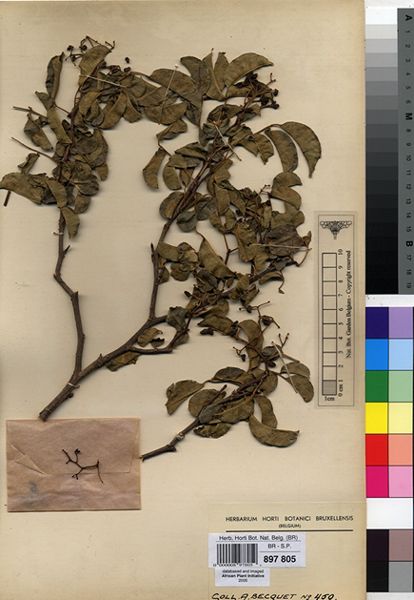
| Much-branched tree up to c. 15 m tall; bole unbranched up to 2–3 m, up to 35 cm in diameter, with conical woody protuberances 2–3 cm long ending in sharp straight thorns 5–9 mm long; bark rough with longitudinal ridges and furrows as deep as 5 cm, greyish brown, peeling yellow underneath; branches with sharp straight to slightly upcurved dark red prickles 6–12 mm long. Leaves alternate, imparipinnately compound with 2–8 pairs of leaflets, 10–24 cm long; stipules absent; rachis with or without small prickles; leaflets with petiolule (0–)0.5–2 mm long, up to 5 mm long on terminal leaflet; leaflets (almost) opposite, elliptical to elliptical-oblong, 2.2–8 cm × 1.5–3 cm, apex acuminate or apiculate to almost obtuse, base obtuse and slightly unequal to cuneate, margin slightly toothed, with distinct glandular dots along the margin, stiff, glabrous, pinnately veined with 8–16 pairs of lateral veins. Inflorescence a terminal, much-branched corymbose panicle 10–15 cm × 7–19 cm, glabrous. Flowers unisexual, 4-merous, regular; pedicel 0–3 mm long; sepals ovate to elliptical, 1–1.5 mm long; petals elliptical to elliptical-oblong, 2–4.5 mm long, apex obtuse, white to cream or greenish yellow; male flowers with 4 stamens variable in length, ovary rudimentary; female flowers without staminodes, ovary superior, carpels 2, partly united, 1–1.5 mm long, styles 2, c. 1 mm long, partly united. Fruit usually a pair of almost globose follicles 8–10 mm × 6–7.5 mm, mucronate, reddish green, glandular pitted, each follicle 1-seeded. Seed ovoid, 5–7 mm × 4.5–5.5 mm, dark blue-black and shiny. | |||
| show more data (0) | comments (0) |
| Zanthoxylum is pantropical and comprises about 200 species, with tropical America being richest in species. Mainland Africa harbours about 35 species, whereas about 5 species are endemic to Madagascar. Another Zanthoxylum species which is medicinally used in the region is Zanthoxylum holtzianum (Engl.) P.G.Waterman. It occurs in Kenya, Tanzania and Mozambique. In Tanzania dried powdered root bark is taken in porridge to treat convulsions. A root decoction is drunk or the vapours of a leaf decoction inhaled to treat hardened abscesses, whereas root scrapings are used as a dressing. Leaf sap is drunk and the body washed with it to treat malarial fever. In the IUCN Red List of Threatened Species it is classified as vulnerable. | |||
| show more data (0) | comments (0) |
| Zanthoxylum usambarense occurs in wooded savanna, montane dry forest and forest remnants, rocky slopes, evergreen bushland and marshy woodland, at 1200–2600 m altitude. | |||
| show more data (0) | comments (0) |
| Zanthoxylum usambarense is propagated using wildlings or seedlings. The seeds loose viability within a very short period and should therefore be sown immediately. | |||
| show more data (0) | comments (0) |
| Zanthoxylum usambarense grows in a wide variety of habitats, but it is not common. However, it does not seem to be threatened by genetic erosion. | |||
| show more data (0) | comments (0) |
| From Zanthoxylum usambarense a wide variety of alkaloids has been isolated. Aromatic and aliphatic amides have mostly not been isolated, and it would be interesting to evaluate their presence as they have interesting pharmacological activities. The water extracts of the stem bark shows significant antimalarial activity and this property certainly deserves more attention. | |||
| show more data (0) | comments (0) |
| • Baerts, M. & Lehmann, J., 2010. Zanthoxylum usambarense. [Internet] Prelude Medicinal Plants Database. Metafro-Infosys, Royal Museum for Central Africa, Tervuren, Belgium http://www.metafro.be/prelude. Accessed October 2010. • Kirira, P.G., Rukunga, G.M., Wanyonyi, A.W., Muregi, F.M., Gathirwa, J.W., Muthaura, C.N., Omar, S.A., Tolo, F., Mungai, G.M. & Ndiege, I.O., 2006. Anti-plasmodial activity and toxicity of extracts of plants used in traditional malaria therapy in Meru and Kilifi districts of Kenya. Journal of Ethnopharmacology 106: 403–407. • Matu, E.N. & van Staden, J., 2003. Antibacterial and anti-inflammatory activities of some plants used for medicinal purposes in Kenya. Journal of Ethnopharmacology 87: 35–41. • Neuwinger, H.D., 2000. African traditional medicine: a dictionary of plant use and applications. Medpharm Scientific, Stuttgart, Germany. 589 pp. • Were, P.S., Kinjanjui, P., Gicheru, M.M., Mwangi, E. & Ozwara, H.S., 2010. Prophylactic and curative activities of extracts from Warburgia ugandensis Sprague (Canellaceae) and Zanthoxylum usambarense (Engl.) Kokwaro (Rutaceae) against Plasmodium knowlesi and Plasmodium berghei. Journal of Ethnopharmacology 130(1): 158–162. | |||
| show more data (4) | comments (0) |
| • Beentje, H.J., 1994. Kenya trees, shrubs and lianas. National Museums of Kenya, Nairobi, Kenya. 722 pp. • He, W.-D., van Puyvelde, L., de Kimpe, N., Verbruggen, L., Anthonissen, K., van der Flaas, M., Bosselaers, J., Mathenge, S.G. & Mudida, F.P., 2002. Chemical constituents and biological activities of Zanthoxylum usambarense. Phytotherapy Research 16(1): 66–70. • Hindmarsh, L., 1982. A notebook for Kenyan dyers. National Museum of Kenya, Nairobi, Kenya. 65 pp. • Kokwaro, J.O., 1982. Rutaceae. In: Polhill, R.M. (Editor). Flora of Tropical East Africa. A.A. Balkema, Rotterdam, Netherlands. 52 pp. • Kato, A., Moriyasu, M., Ichimaru, M., Nishiyama, Y., Juma, F.D., Nganga, J.N., Mathenge, S.G. & Ogeto J.O., 1996. Isolation of alkaloidal constituents of Zanthoxylum usambarense and Zanthoxylum chalybeum using ion-pair HPLC. Journal of Natural Products 59(3): 316–318. • Kokwaro, J.O., Messana, I., Galeffi, C., Patamia, M. & Marini Bettolo, G.B., 1983. Research on African medicinal plants. V. Coumarins from Zanthoxylum usambarense. Planta Medica 47(4): 251–253. • Lulekal, E., Kelbessa, E., Bekele, T. & Yineger H., 2008. An ethnobotanical study of medicinal plants in Mana Angetu District, southeastern Ethiopia. Journal of Ethnobiology and Ethnomedicine 4: 10. • Maundu, P., Berger, D., Saitabau, C., Nasieku, J., Kipelian, M., Mathenge, S., Morimoto, Y. & Höft, R., 2001. Ethnobotany of the Loita Maasai. Towards community management of the forest of the Lost Child. Experiences from the Loita Ethnobotany Project. UNESCO People and Plants Working Paper 8, Paris, France. 34 pp. • Nanyingi, M.O., Mbaria, J.M., Lanyasunya, A.L., Wagate, C.G., Koros, K.B., Kaburia, H.F., Munenge, R.W. & Ogara, W.O., 2008. Ethnopharmacological survey of Samburu District, Kenya. Journal of Ethnobiology and Ethnomedicine 4: 14. | |||
| show more data (4) | comments (0) |
| |||||
| |||||||
| |||||
| Matu, E.N., 2011. Zanthoxylum usambarense (Engl.) Kokwaro. [Internet] Record from PROTA4U. Schmelzer, G.H. & Gurib-Fakim, A. (Editors). PROTA (Plant Resources of Tropical Africa / Ressources végétales de l’Afrique tropicale), Wageningen, Netherlands. <http://www.prota4u.org/search.asp>. Accessed . | |||
| There are 1 study abstracts related to Zanthoxylum usambarense (Engl.) Kokwaro. Click on "show more" to view them. | ||
| show more data | comments (0) |
| There are 15 book citations related to Zanthoxylum usambarense (Engl.) Kokwaro. Click on "show more" to view them. | ||
| show more data | comments (0) |
| There are 127 citation in web searches related to Zanthoxylum usambarense (Engl.) Kokwaro. Click on "show more" to view them. | ||
| show more data | comments (0) |
| There are 29 citation in scholarly articles related to Zanthoxylum usambarense (Engl.) Kokwaro. Click on "show more" to view them. | ||
| show more data | comments (0) |
| There are 3 citations in Afrirefs related to Zanthoxylum usambarense (Engl.) Kokwaro. Click on "show more" to view them. | ||
| show more data | comments (0) |
| General importance |  |
| Geographic coverage Africa |  |
| Geographic coverage World | |
| Dye and tannins use | |
| Timber use | |
| Auxiliary use | |
| Fuel use |  |
| Medicinal use | |
| Fibre use | |



 Comments (