Record display
 PROTA4U Homepage
| Select translation pop-up: |
|
|
PROTA4U Record display |
PROTA4U Homepage
|
| Enum. pl. afric. austral.: 356 (1837). | |||
| show more data (3) | comments (0) |
| Hamamelidaceae | |||
| show more data (8) | comments (0) |
| 2n = 24 | |||
| show more data (1) | comments (0) |
| show more data (5) | comments (0) |
| Wych hazel, witch-hazel, white witch-hazel, Natal hazel (En). | |||
| show more data (1) | comments (0) |
| Trichocladus ellipticus occurs from Sudan and Ethiopia, through eastern DR Congo and East Africa, south to southern Africa. | |||
| show more data (4) | comments (0) |
| The wood of Trichocladus ellipticus is used for construction, fencing, carpentry and carvings, and as firewood. Larger boles are used as posts in building and smaller stems for cross poles. Trichocladus ellipticus is the favourite species of the Maasai people for making frames for their shields. A bark decoction is added to soup or meat to improve digestion and to cure an upset stomach. | |||
| show more data (0) | comments (0) |
| The wood is white, tough and hard, but bends easily. It hardens when heated. The Wandorobo people of East Africa consider the wood termite resistant. | |||
| show more data (0) | comments (0) |
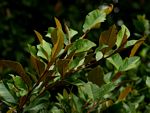
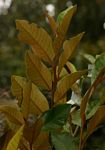
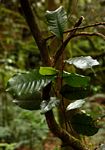
| Shrub or small tree up to 10(–18) m tall; bark smooth or slightly rough, greyish white or creamy brown; young branches with yellow or rusty-brown stellate hairs. Leaves alternate, simple and entire; stipules linear, early caducous; petiole 0.5–2 cm long; blade elliptical to obovate-elliptical or oblanceolate, (1.5–)5–28 cm × 1–12 cm, cuneate to rounded at base, acute to acuminate at apex, densely soft-hairy below, pinnately veined. Inflorescence axillary, head-like; peduncle 5–15 mm long. Flowers bisexual, regular, sessile; calyx with c. 1 mm long tube and 4–5 lobes c. 1 mm long, soft-hairy; petals free, 1–1.5 mm long, white, greenish yellow or yellow, soft-hairy outside; stamens 5, filaments c. 1 mm long, anthers c. 1 mm long; ovary ellipsoid, hairy, 2-celled, styles 2. Fruit a globose capsule 6–8 mm long, pubescent, 1–2-seeded. Seeds ovoid to ellipsoid, c. 5 mm × 3–4 mm, yellowish or greyish, mottled black. Trichocladus comprises about 4 species, 2 of them endemic to South Africa. It is the only genus of Hamamelidaceae on the African continent and it is not found elsewhere. Two subspecies are distinguished in Trichocladus ellipticus: subsp. malosanus (Baker) Verdc., widespread in tropical Africa, and subsp. ellipticus, restricted to South Africa. The latter is characterized by smaller, narrower and more acuminate leaves. | |||
| show more data (0) | comments (0) |
| show more data (3) | comments (0) |
| show more data (2) | comments (0) |
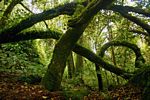
| Trichocladus ellipticus is found in the understorey of montane forest at 1250–2100(–3000) m altitude, often along streams. | |||
| show more data (4) | comments (0) |
| show more data (1) | comments (0) |
| In South Africa Trichocladus ellipticus is considered ‘near threatened’. Elsewhere, it is widespread, often dominant and even occurring in almost pure stands. As it is apparently not heavily exploited there seems to be no threat of genetic erosion. | |||
| show more data (0) | comments (0) |
| Trichocladus ellipticus will remain only locally important. | |||
| show more data (0) | comments (0) |
| • Dovie, D.B.K., Witkowski, E.T.F. & Shackleton, C.M., 2008. Knowledge of plant resource use based on location, gender and generation. Applied Geography 28(4): 311–322. • Kokwaro, J.O., 1993. Medicinal plants of East Africa. 2nd Edition. Kenya Literature Bureau, Nairobi, Kenya. 401 pp. • Mendes, E.J. & Vidigal, M.P., 1978. Hamamelidaceae. In: Launert, E. (Editor). Flora Zambesiaca. Volume 4. Flora Zambesiaca Managing Committee, London, United Kingdom. pp. 71–73. | |||
| show more data (5) | comments (0) |
| • Coates Palgrave, K., 1983. Trees of southern Africa. 2nd Edition. Struik Publishers, Cape Town, South Africa. 959 pp. • Dale, I.R. & Greenway, P.J., 1961. Kenya trees and shrubs. Buchanan’s Kenya Estates Limited, Nairobi, Kenya. 654 pp. • Ichikawa, M., 1987. A preliminary report on the ethnobotany of the Suiei Dorobo in northern Kenya. African Study Monographs, Supplement 7: 1–52. • Legilisho-Kiyiap, J., 1998. Forest cover type, habitat diversity, and anthropogenic influences on forest ecosystems adjoining the Maasai Mara National Reserve, Kenya. In: Proceedings of a Conference held in August 1998 in Boise, Idaho, USA: 296–304. • Medley, K.E. & Kalibo, H.W., 2007. Ethnobotanical survey of 'wild' woody plant resources at Mount Kasigau, Kenya. Journal of East African Natural History 96(2): 149–186. • Verdcourt, B., 1989. Hamamelidaceae. In: Hedberg, I. & Edwards, S. (Editors). Flora of Ethiopia. Volume 3. Pittosporaceae to Araliaceae. The National Herbarium, Addis Ababa University, Addis Ababa, Ethiopia and Department of Systematic Botany, Uppsala University, Uppsala, Sweden. pp. 252–253. • von Breitenbach, F., 1994. The indigenous trees of Ethiopia. 3rd edition. Ethiopian Forestry Association, Addis Ababa, Ethiopia. 272 pp. | |||
| show more data (2) | comments (0) |
| show more data (2) | comments (0) |
| |||||
| |||||||||
| |||||
| |||||
| Bosch, C.H., 2010. Trichocladus ellipticus Eckl. & Zeyh. [Internet] Record from PROTA4U. Lemmens, R.H.M.J., Louppe, D. & Oteng-Amoako, A.A. (Editors). PROTA (Plant Resources of Tropical Africa / Ressources végétales de l’Afrique tropicale), Wageningen, Netherlands. <http://www.prota4u.org/search.asp>. Accessed . | |||
| There are 85 book citations related to Trichocladus ellipticus Eckl. & Zeyh.. Click on "show more" to view them. | ||
| show more data | comments (0) |
| There are 100 citation in web searches related to Trichocladus ellipticus Eckl. & Zeyh.. Click on "show more" to view them. | ||
| show more data | comments (0) |
| There are 30 citation in scholarly articles related to Trichocladus ellipticus Eckl. & Zeyh.. Click on "show more" to view them. | ||
| show more data | comments (0) |
| There are 3 citations in Afrirefs related to Trichocladus ellipticus Eckl. & Zeyh.. Click on "show more" to view them. | ||
| show more data | comments (0) |
| There are 4 Wikipedia citations related to Trichocladus ellipticus Eckl. & Zeyh.. Click on "show more" to view them. | ||
| show more data | comments (0) |
| General importance |  |
| Geographic coverage Africa |  |
| Geographic coverage World |  |
| Timber use | |
| Fuel use | |
| Medicinal use | |



 Comments (