Record display
 PROTA4U Homepage
| Select translation pop-up: |
|
|
PROTA4U Record display |
PROTA4U Homepage
|
| Suppl. pl.: 148 (1781). | |||
| show more data (5) | comments (0) |
| Loganiaceae | |||
| show more data (11) | comments (0) |
| show more data (13) | comments (0) |
| Grape strychnos (En). | |||
| show more data (4) | comments (0) |
| Strychnos potatorum occurs from DR Congo and Tanzania south to northern South Africa. Strychnos potatorum was probably introduced in Asia by Arabic traders; it occurs in India, Sri Lanka and Myanmar. | |||
| show more data (21) | comments (0) |
| In Tanzania pounded leaves are used to treat watering and aching eyes and the vapour of a root decoction is inhaled to treat venereal diseases. In Malawi a leaf decoction is taken to treat epilepsy. In Zambia the vapour of a root decoction is inhaled to treat colds. In Tanzania and Zambia the roots are used as an aphrodisiac. In Zimbabwe a decoction of roots and leaves is taken to treat cough. In Indian traditional medicine Strychnos potatorum seeds are used for the treatment of complaints of the liver, kidneys and stomach and gonorrhoea, leucorrhoea, bronchitis, chronic diarrhoea, strangury, kidney and bladder stones, diabetes and eye diseases. In Zimbabwe, Mozambique and South Africa the pounded fruits are used as fish poison, and in Zimbabwe crushed bark is also used for this purpose. In Tanzania and Zambia the wood is used to make tool handles. In Asia the seeds are used to clear muddy water. | |||
| show more data (9) | comments (0) |
| Strychnos potatorum contains many monomeric and dimeric indole alkaloids, the root bark being especially rich. The monoterpene alkaloid cantleyine, isolated from the root bark, showed a relaxing effect on isolated tracheal smooth muscles of guinea-pig and may be the active ingredients responsible for the anticough and anti-asthmatic activity. Normacusine B, a monomeric alkaloid of the corynanthe class, also found in Rauvolfia, Tabernaemontana and Vinca spp., is sympatholytic and its hypotensive activity is stronger than that of reserpine, which is commonly used against high blood pressure. In-vitro tested ochrolifuanine A, a dimeric alkaloid of the β-carboline class, showed significant activity against chloroquine sensitive and chloroquine resistant Plasmodium falciparum strains. The total alkaloidal extracts of the seeds, bark and leaves showed strychnine-like activity in vivo, had marked hypotensive effect and exhibited a depressant action on isolated heart. In in-vivo tests the seed powder and an aqueous extract of the seeds prevented ulcer formation by decreasing acid secretory activity and increasing the mucin activity in rats. An aqueous extract of the seeds also showed significant hepatoprotective activity in rats. A methanol extract of the seeds had a diuretic effect and an antidiarrhoeal activity on castor oil-induced diarrhoea in rats. The seeds contain polyelectrolytes which can be used as coagulants to clarify turbid waters. In laboratory tests, direct filtration of turbid surface water with the seeds as a coagulant, produced a substantial improvement in its aesthetic and microbiological quality. The aerial parts also contain β-sitosterol, stigmasterol, oleanolic acid and its 3β-acetate, triterpenes and the polysaccharide mannogalactan. The wood is very hard and termite resistant, but splits easily and is therefore not suitable for carving. | |||
| show more data (0) | comments (0) |
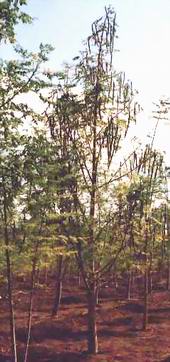
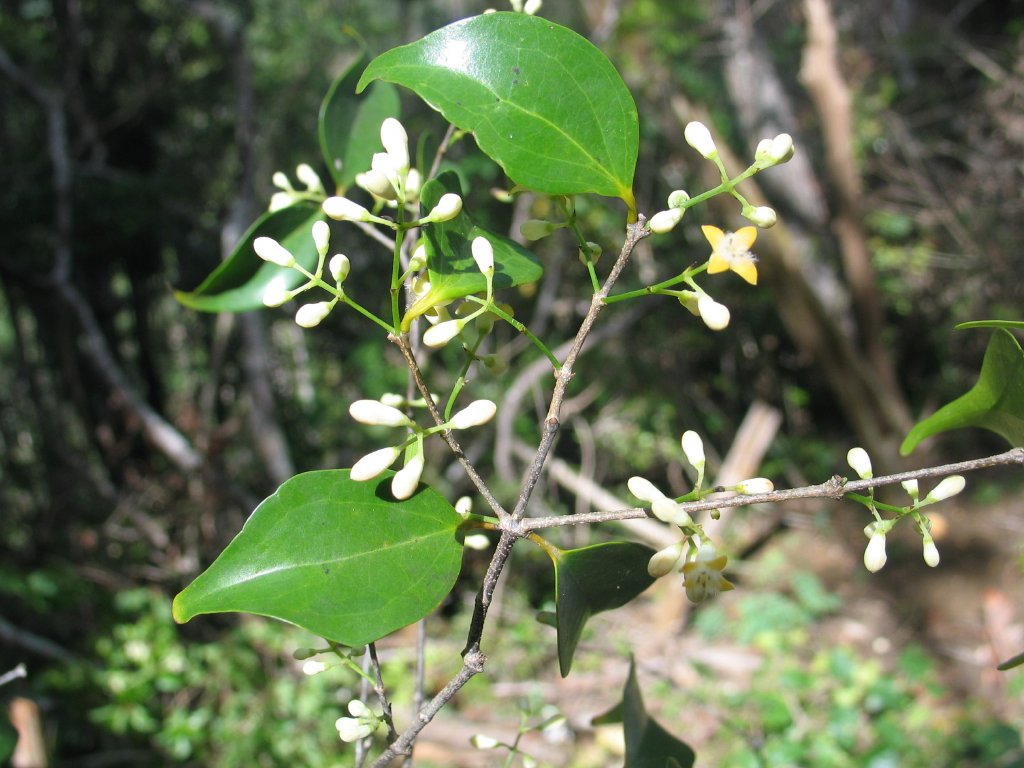
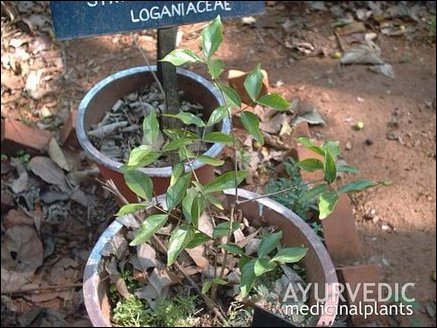
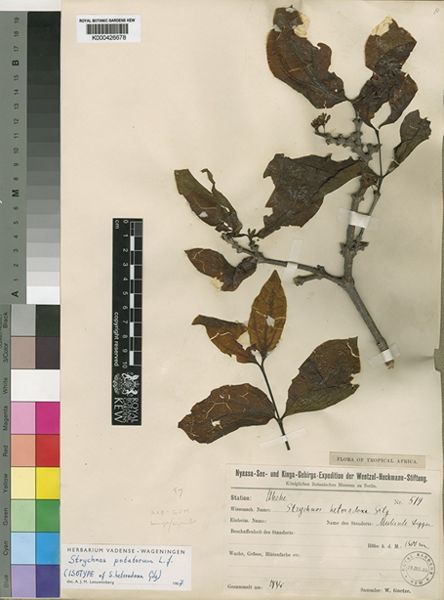
| Deciduous much-branched shrub or small or medium-sized tree up to 18 m tall; bole up to 100 cm in diameter; branchlets pale to dark brown, glabrous, apex modified into a spine-like tip 1–3 mm long. Leaves opposite, simple and entire; stipules absent; petiole 1–7 mm long, glabrous; blade elliptical to ovate, 6–15 cm × 3–9 cm, base cuneate to rounded, apex acute to acuminate, glabrous, 5-veined from the base. Inflorescence an axillary lax or congested thyrse 1.5–2.5 cm long. Flowers bisexual, regular, (4–)5-merous, appearing before or with the young leaves; sepals fused at base, ovate to oblong, up to 2.5 mm long; corolla tube up to 3.5 mm long, lobes oblong, c. 4.5 mm long, acute, spreading, glabrous outside, inside with hairs on the base of the lobes, white, creamy or yellow; stamens inserted at the mouth of the corolla tube, exserted; ovary superior, ovoid or conical, 1–2 mm long, glabrous, 2-celled, style up to 4.5 mm long, stigma small, head-shaped or sometimes obscurely 2-lobed. Fruit a globose berry (10–)15–25 mm in diameter, soft, blue-black, pulp purplish, smooth, shining, 1-seeded. Seed depressed-globose or ellipsoid, 10–13 mm × 9–13 mm × 6–9 mm, slightly glossy, with an obscure angular line all around, densely silky hairy, smooth. Strychnos comprises about 200 species: about 60 species in Asia, 65 in America and 75 in Africa. Strychnos potatorum belongs to the section Rouhamon. | |||
| show more data (0) | comments (0) |
| show more data (5) | comments (0) |
| Strychnos potatorum occurs in gallery forest, in Brachystegia -woodland and in semi-evergreen bushland, often on river banks or on termite hills, from sea-level up to 1600 m altitude. | |||
| show more data (4) | comments (0) |
| show more data (1) | comments (0) |
| Strychnos potatorum is widespread and not in danger of genetic erosion. | |||
| show more data (0) | comments (0) |
| Several alkaloids of Strychnos potatorum show promising medicinal activities, and more research into the pharmacological activities of the compounds seems warranted. | |||
| show more data (0) | comments (0) |
| • Bisset, N.G., 1970. The African species of Strychnos. Part I. The ethnobotany. Lloydia 33(2): 201–243. • Leeuwenberg, A.J.M., 1969. The Loganiaceae of Africa 8. Strychnos 3. Revision of the African species with notes on the extra-African. Mededelingen Landbouwhogeschool Wageningen 69–1. Wageningen, Netherlands. 316 pp. • Leeuwenberg, A.J.M. (Editor), 1980. Angiospermae: Ordnung Gentiales. Fam. Loganiaceae. Die natürlichen Pflanzenfamilien. Second Edition. Band 28 b-1. Duncker & Humblot, Berlin, Germany. 255 pp. • Massiot, G., Thepenier, P., Jacquier, M.-J., Le Men-Olivier, L. & Delaude, C., 1992. Alkaloids from roots of Strychnos potatorum. Phytochemistry 31(8): 2873–2876. • Neuwinger, H.D., 2000. African traditional medicine: a dictionary of plant use and applications. Medpharm Scientific, Stuttgart, Germany. 589 pp. | |||
| show more data (35) | comments (0) |
| • Babu, R. & Chaudhuri, M., 2005. Home water treatment by direct filtration with natural coagulant. Journal of Water and Health 3(1): 27–30. • Biswas, S., Murugesan, T., Maiti, K., Ghosh, L., Pal, M. & Saha, B.P., 2001. Study on the diuretic activity of Strychnos potatorum Linn. seed extract in albino rats. Phytomedicine 8(6): 469–471. • Cavendish, W., 1999. The complexity of the commons: environmental resource demands in rural Zimbabwe. The Centre for the Study of African Economies Working Paper Series. Working Paper 92. 52 pp. • Clarkson, C., Maharaj, V.J., Crouch, N.R., Grace, O.M., Pillay, P., Matsabisa, M.G., Bhagwandin, N., Smith, P.J. & Folb, P.I., 2004. In vitro antiplasmodial activity of medicinal plants native to or naturalised in South Africa. Journal of Ethnopharmacology 92: 177–191. • Coates Palgrave, K., 1983. Trees of southern Africa. 2nd Edition. Struik Publishers, Cape Town, South Africa. 959 pp. • Gelfand, M., Mavi, S., Drummond, R.B. & Ndemera, B., 1985. The traditional medical practitioner in Zimbabwe: his principles of practice and pharmacopoeia. Mambo Press, Gweru, Zimbabwe. 411 pp. • Sanmugapriya, E. & Venkataraman, S., 2006. Studies on hepatoprotective and antioxidant actions of Strychnos potatorum Linn. seeds on CCl4-induced acute hepatic injury in experimental rats. Journal of Ethnopharmacology 105(1): 154–160. • Sanmugapriya, E. & Venkataraman, S., 2007. Antiulcerogenic potential of Strychnos potatorum Linn seeds on Aspirin plus pyloric ligation-induced ulcers in experimental rats. Phytomedicine 14(5): 360–365. • Zhu, W.M., He, H.P., Fan, L.M., Shen, Y.M., Zhou, J. & Hao, X.J., 2005. Components of stem barks of Winchia calophylla A. DC. and their bronchodilator activities. Journal of Integrative Plant Biology 47(7): 892–896. | |||
| show more data (20) | comments (0) |
| show more data (2) | comments (0) |
| show more data (1) | comments (0) |
| |||||
| |||||||
| |||||||||||
| |||||||
| |||||
| de Ruijter, A., 2008. Strychnos potatorum L.f. [Internet] Record from PROTA4U. Schmelzer, G.H. & Gurib-Fakim, A. (Editors). PROTA (Plant Resources of Tropical Africa / Ressources végétales de l’Afrique tropicale), Wageningen, Netherlands. <http://www.prota4u.org/search.asp>. Accessed . | |||
| There are 4 study abstracts related to Strychnos potatorum L.f.. Click on "show more" to view them. | ||
| show more data | comments (0) |
| There are 100 book citations related to Strychnos potatorum L.f.. Click on "show more" to view them. | ||
| show more data | comments (0) |
| There are 100 citation in web searches related to Strychnos potatorum L.f.. Click on "show more" to view them. | ||
| show more data | comments (0) |
| There are 83 citation in scholarly articles related to Strychnos potatorum L.f.. Click on "show more" to view them. | ||
| show more data | comments (0) |
| There are 7 news article citations related to Strychnos potatorum L.f.. Click on "show more" to view them. | ||
| show more data | comments (0) |
| There are 5 citations in Afrirefs related to Strychnos potatorum L.f.. Click on "show more" to view them. | ||
| show more data | comments (0) |
| There are 5 Wikipedia citations related to Strychnos potatorum L.f.. Click on "show more" to view them. | ||
| show more data | comments (0) |
| General importance |  |
| Geographic coverage Africa | |
| Geographic coverage World |  |
| Timber use |  |
| Auxiliary use | |
| Medicinal use | |



 Comments (