Record display
 PROTA4U Homepage
| Select translation pop-up: |
|
|
PROTA4U Record display |
PROTA4U Homepage
|
| Journ. Linn. Soc., Bot. 40: 146 (1911). | |||
| show more data (3) | comments (0) |
| Loganiaceae | |||
| show more data (6) | comments (0) |
| show more data (6) | comments (0) |
| Pitted-leaf strychnos (En). Mtonga, mwangajini mdogo, mlyaminga (Sw). | |||
| show more data (1) | comments (0) |
| Strychnos mitis occurs from Sudan and Ethiopia southward to Angola, Zimbabwe, Mozambique, eastern South Africa and Swaziland, and in Comoros and Mayotte. | |||
| show more data (8) | comments (0) |
| The wood of Strychnos mitis, known as ‘hard pear’, is often used for building poles, railway sleepers and tool handles. It is suitable for flooring, joinery, interior trim, mine props, ship building, vehicle bodies, furniture, sporting goods, toys, novelties, agricultural implements and turnery. It is widely used as firewood and for making charcoal. In Ethiopia and Uganda Strychnos mitis is used as shade tree in coffee plantations, in Uganda also in cocoa plantations and as an avenue tree. In Ethiopia the fruits are eaten. In DR Congo an ordeal poison is prepared from the wood and roots, and the Mbuti people use the sap of the tree in the preparation of arrow poison. | |||
| show more data (1) | comments (0) |
| The wood of Strychnos mitis is only used and traded locally. | |||
| show more data (0) | comments (0) |
| The heartwood is pale grey to cream, yellow or pale brown with conspicuous white streaks, and indistinctly demarcated from the sapwood. The grain is straight or interlocked, texture coarse. The wood is heavy, with a density of (785–)860–990 kg/m³ at 10% moisture content. It air dries slowly with a considerable risk of distortion and surface checking. The rates of shrinkage are moderate, from green to oven dry about 3.8% radial and 6.9% tangential. At 12% moisture content the modulus of rupture is 120–125 N/mm², modulus of elasticity 16,500 N/mm², compression parallel to grain 58–65 N/mm², cleavage 19 N/mm and Chalais-Meudon side hardness 4.0. Considerable force is needed for sawing and working, and the wood has a marked blunting effect on saw teeth and tool edges. It has a nice finish when a filler is used. The wood is not durable, being susceptible to insect attacks. The heartwood is resistant to impregnation with preservatives. | |||
| show more data (0) | comments (0) |
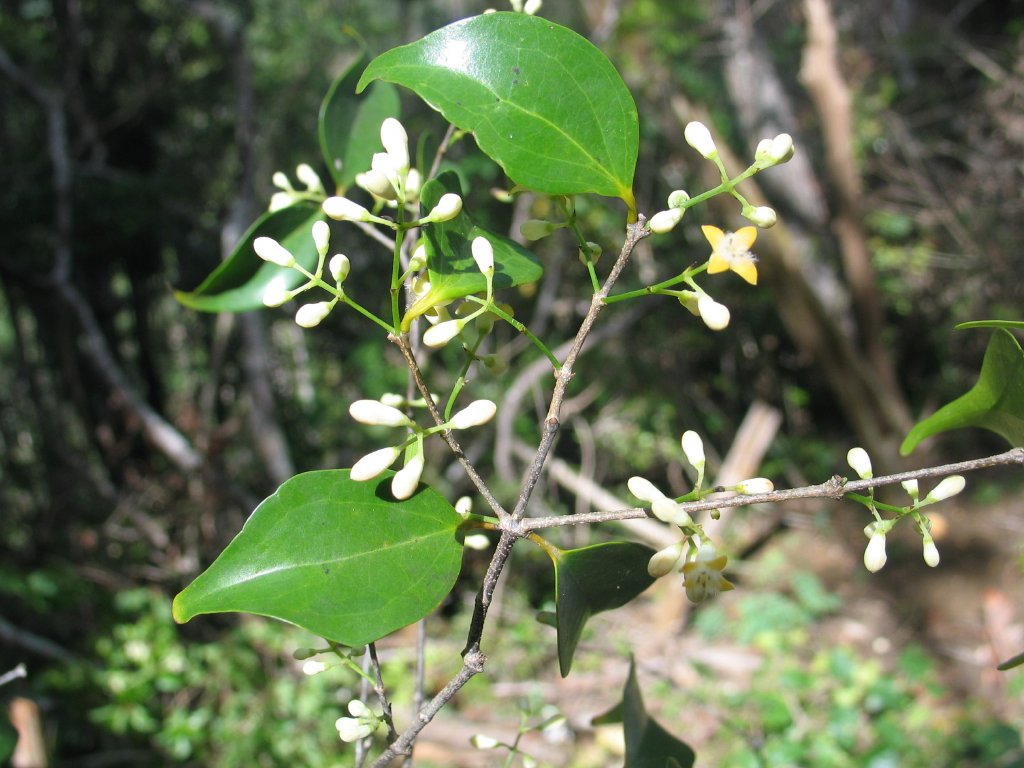
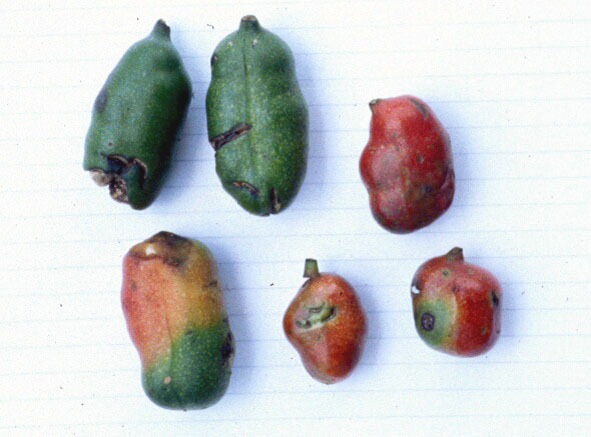
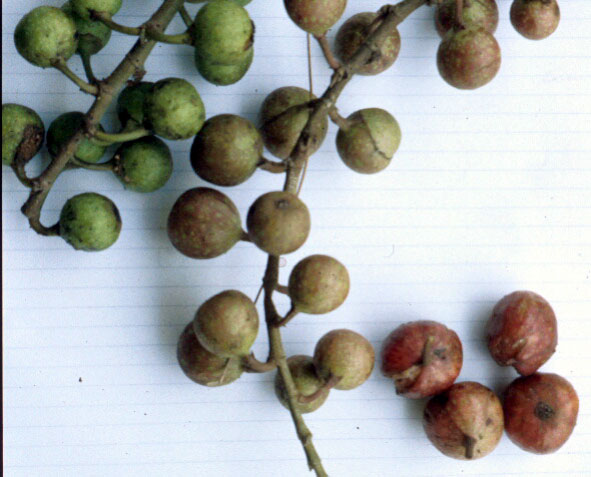
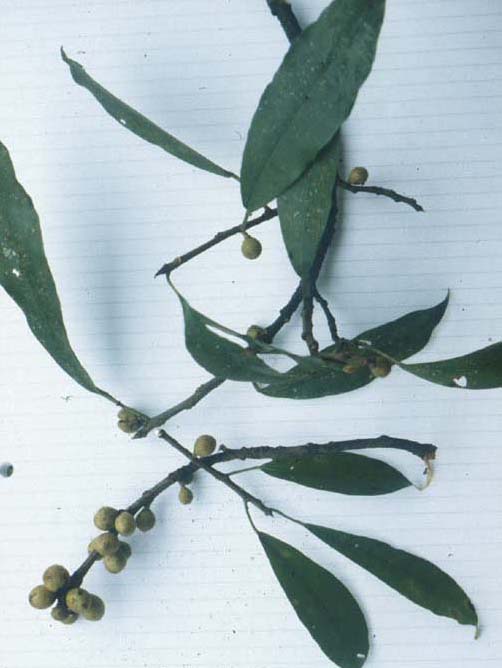
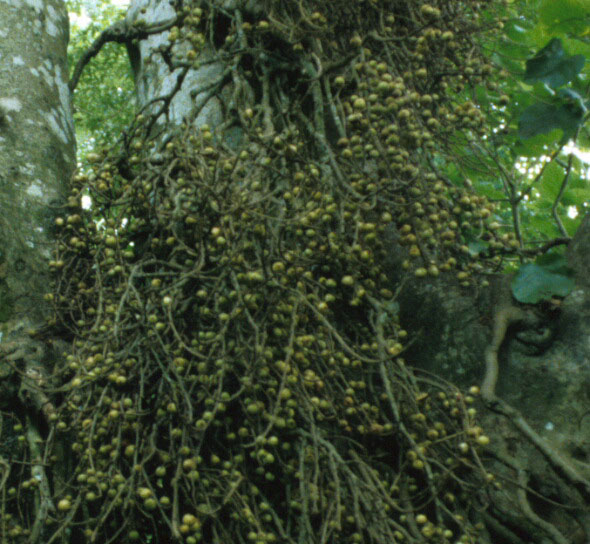
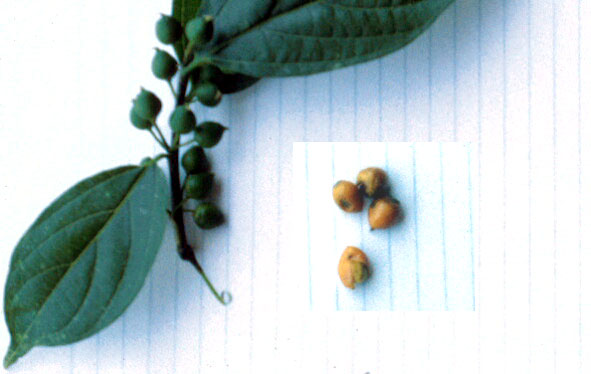
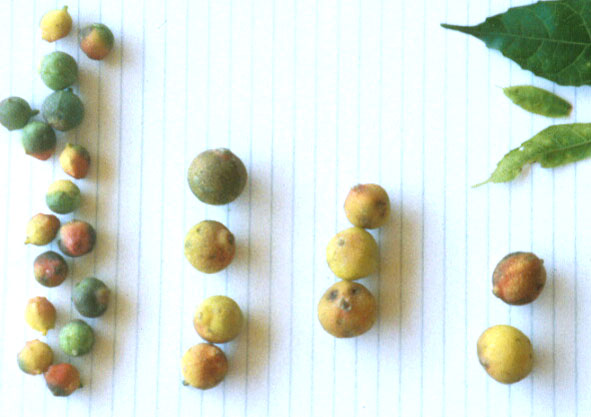
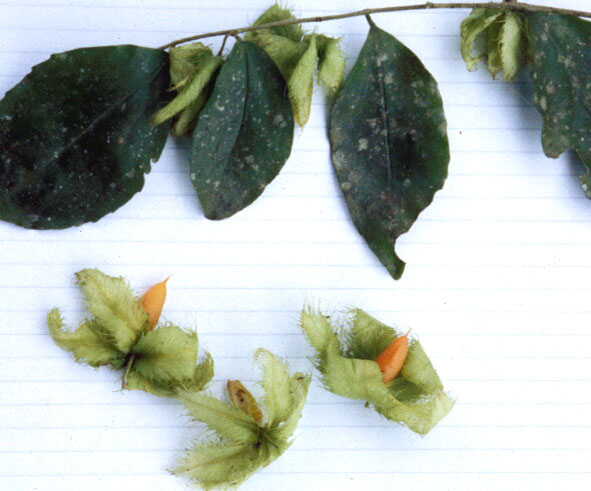
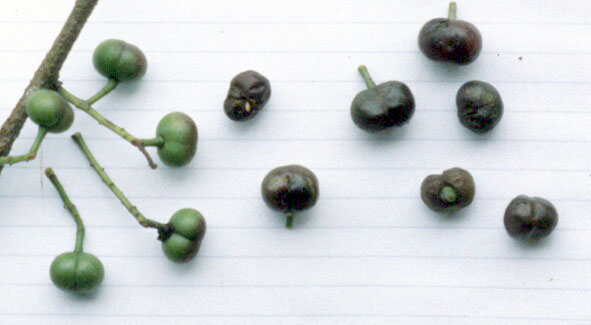
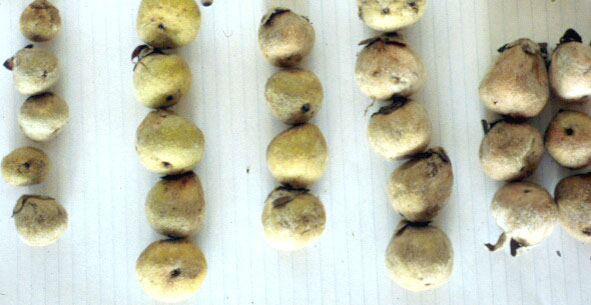
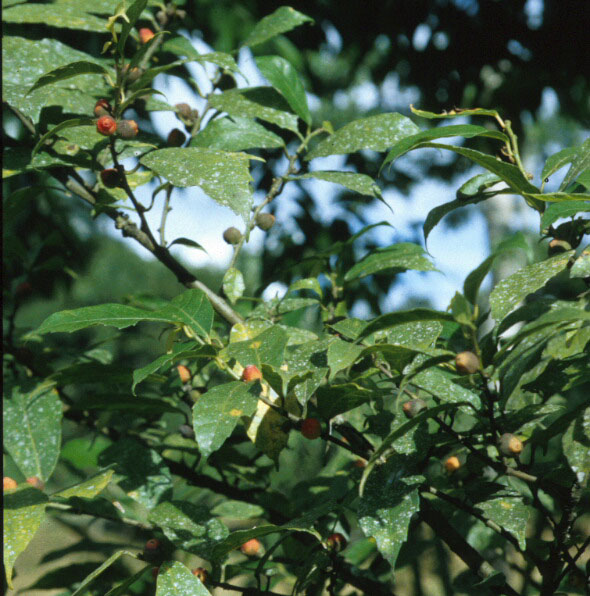
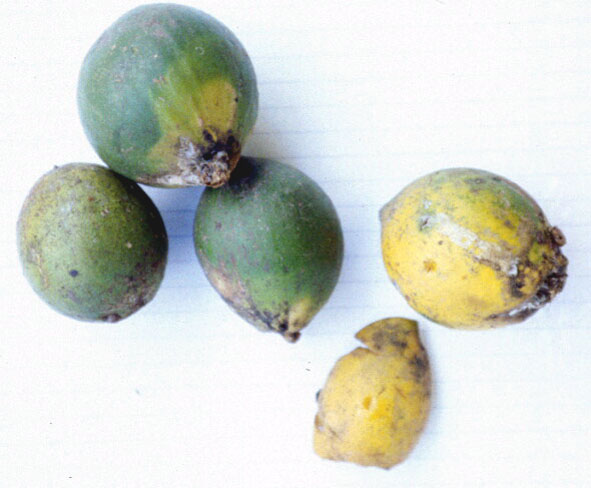
| Evergreen small to fairly large tree up to 35(–40) m tall; bole branchless for up to 20(–25) m, straight and cylindrical or crooked and twisted, up to 60(–100) cm in diameter; bark smooth or slightly fissured and scaly, grey to greyish brown or greenish, inner bark thin, fibrous, pale brown or cream with orange-brown flecks; crown rounded; twigs glabrous, with lenticels. Leaves opposite, simple and entire; stipules reduced to a rim connecting the petiole bases; petiole 2–5 mm long; blade elliptical to ovate, 4–11.5 cm × 1.5–5 cm, base usually cuneate, apex acuminate, thin-leathery, usually glabrous, with 1 pair of lateral veins c. 1 cm above leaf base and a fainter pair of veins from the base along the margins. Inflorescence a compound, axillary or terminal cyme 1–3(–4) cm long, fairly dense, short-hairy. Flowers bisexual, regular, 4–5-merous, sessile; sepals broadly ovate to nearly round, 1.5–2 mm long, glabrous to slightly hairy; corolla cream, yellow or greenish, tube campanulate, 1.5–2 mm long, lobes ovate-triangular, 1.5–2.5 mm long, hairy inside at base; stamens inserted just above the middle of the corolla tube, filaments short, anthers with long hairs at base; ovary superior, ovoid, 1–2 mm long, 2-celled, style 1–1.5 mm long. Fruit a globose berry 1–2 cm in diameter, yellow to orange, 1(–2)-seeded. Seeds ellipsoid, flattened on one side, c. 1 cm long, smooth and glabrous but with minute pits. | |||
| show more data (2) | comments (0) |
| Strychnos comprises about 200 species: about 60 species in Asia, 65 in America and 75 in Africa. Many Strychnos spp. are well known as medicinal plants and several for their edible fruits. However, the wood of some species is used for similar purposes as that of Strychnos mitis. Strychnos decussata (Pappe) Gilg (synonym: Strychnos atherstonei Harv.) is a shrub or small tree up to 12(–17) m tall with bole up to 30(–45) cm in diameter, occurring from Kenya southward to eastern South Africa, and in Madagascar. Its dark brown and heavy wood, with a density of 850–930 kg/m³ at 10% moisture content, is used for laths in house construction and musical instruments. Root decoctions and infusions are taken to treat stomach-ache and snakebites, and root powder is applied externally to snakebites. Fruits have been reported to be edible, but young fruits appear to be toxic. Strychnos mellodora S.Moore is a medium-sized to fairly large tree up to 35 m tall with bole up to 50 cm in diameter, occurring in montane rainforest in Tanzania, Zimbabwe and Mozambique. Its whitish, heavy and hard wood is used for poles in house building, for tool handles and as firewood. The flowers provide nectar for honey bees. Several alkaloids have been isolated from the bark, some of which showed weak in-vitro antiplasmodial activity. | |||
| show more data (1) | comments (0) |
| Wood-anatomical description (IAWA hardwood codes): Growth rings: 1: growth ring boundaries distinct; 2: growth ring boundaries indistinct or absent. Vessels: 5: wood diffuse-porous; 7: vessels in diagonal and/or radial pattern; 8: vessels in dendritic pattern; (10: vessels in radial multiples of 4 or more common); (12: solitary vessel outline angular); 13: simple perforation plates; 22: intervessel pits alternate; 25: intervessel pits small (4–7 μm); 29: vestured pits; 30: vessel-ray pits with distinct borders; similar to intervessel pits in size and shape throughout the ray cell; 41: mean tangential diameter of vessel lumina 50–100 μm; 49: 40–100 vessels per square millimetre. Tracheids and fibres: 61: fibres with simple to minutely bordered pits; 66: non-septate fibres present; 70: fibres very thick-walled. Axial parenchyma: 76: axial parenchyma diffuse; (77: axial parenchyma diffuse-in-aggregates); 78: axial parenchyma scanty paratracheal; 83: axial parenchyma confluent; 86: axial parenchyma in narrow bands or lines up to three cells wide; (89: axial parenchyma in marginal or in seemingly marginal bands); 93: eight (5–8) cells per parenchyma strand; 94: over eight cells per parenchyma strand. Rays: (97: ray width 1–3 cells); 98: larger rays commonly 4- to 10-seriate; 107: body ray cells procumbent with mostly 2–4 rows of upright and/or square marginal cells; 110: sheath cells present; 115: 4–12 rays per mm. Secretory elements and cambial variants: 134: included phloem, diffuse. Mineral inclusions: 136: prismatic crystals present; 137: prismatic crystals in upright and/or square ray cells; 138: prismatic crystals in procumbent ray cells; 141: prismatic crystals in non-chambered axial parenchyma cells; 142: prismatic crystals in chambered axial parenchyma cells. (R. Shanda, P. Baas & H. Beeckman) | |||
| show more data (0) | comments (0) |
| Strychnos mitis regenerates profusely under natural conditions. In southern Africa, trees usually flower in February–April and fruit about 3 months after flowering. In Uganda ripe fruits are produced year-round. They are eaten by turacos, which are probably the main seed dispersers, but also by chimpanzees. | |||
| show more data (0) | comments (0) |
| Strychnos mitis occurs in rainforest, riverine forest and montane forest from sea-level up to 2300 m altitude. In southern Africa it is also found in low evergreen coastal forest in moist localities. | |||
| show more data (3) | comments (0) |
| Strychnos mitis is propagated by seed. Fruits are collected, seed extracted and thoroughly dried. Seed keeps well in dry and cool conditions. Before sowing, it is recommended to soak seeds in water for one night. Wildlings are sometimes collected for planting. | |||
| show more data (0) | comments (0) |
| Trees respond well to pollarding and coppicing. | |||
| show more data (0) | comments (0) |
| Strychnos mitis is widespread and common in many regions within its distribution area, and regenerates well. There are no indications that it is in danger of genetic erosion. | |||
| show more data (0) | comments (0) |
| The wood of Strychnos mitis is likely to remain important in local construction, as firewood and as source of charcoal. In Uganda planting of Strychnos mitis in firewood plots has been recommended. More attention for its silvicultural management is needed because it may be interesting for more extensive planting in agroforestry systems. | |||
| show more data (0) | comments (0) |
| • Beentje, H.J., 1994. Kenya trees, shrubs and lianas. National Museums of Kenya, Nairobi, Kenya. 722 pp. • Bolza, E. & Keating, W.G., 1972. African timbers: the properties, uses and characteristics of 700 species. Division of Building Research, CSIRO, Melbourne, Australia. 710 pp. • Coates Palgrave, K., 2002. Trees of southern Africa. 3rd Edition. Struik Publishers, Cape Town, South Africa. 1212 pp. • Katende, A.B., Birnie, A. & Tengnäs, B., 1995. Useful trees and shrubs for Uganda: identification, propagation and management for agricultural and pastoral communities. Technical Handbook 10. Regional Soil Conservation Unit, Nairobi, Kenya. 710 pp. • Leeuwenberg, A.J.M., 1983. Loganiaceae. In: Launert, E. (Editor). Flora Zambesiaca. Volume 7, part 1. Flora Zambesiaca Managing Committee, London, United Kingdom. pp. 327–374. • Leeuwenberg, A.J.M., 1984. Loganiaceae. Flore de Madagascar et des Comores, famille 167. Muséum National d’Histoire Naturelle, Paris, France. 107 pp. • Maundu, P. & Tengnäs, B. (Editors), 2005. Useful trees and shrubs for Kenya. World Agroforestry Centre - East and Central Africa Regional Programme (ICRAF-ECA), Technical Handbook 35, Nairobi, Kenya. 484 pp. • Neuwinger, H.D., 2000. African traditional medicine: a dictionary of plant use and applications. Medpharm Scientific, Stuttgart, Germany. 589 pp. • Takahashi, A., 1978. Compilation of data on the mechanical properties of foreign woods (part 3) Africa. Shimane University, Matsue, Japan. 248 pp. • Teketay, D., Senbeta, F., Maclachlan, M., Bekele, M. & Barklund, P., 2010. Edible wild plants in Ethiopia. Addis Ababa University Press, Addis Ababa, Ethiopia. 575 pp. | |||
| show more data (8) | comments (0) |
| • Bruce, E.A. & Lewis, J., 1960. Loganiaceae. In: Hubbard, C.E. & Milne-Redhead, E. (Editors). Flora of Tropical East Africa. Crown Agents for Oversea Governments and Administrations, London, United Kingdom. 47 pp. • Caniato, R. & Puricelli, L., 2003. Review: natural antimalarial agents (1995–2001). Critical Reviews in Plant Sciences 22(1): 79–105. • Grace, O.M., Prendergast, H.D.V., Jäger, A.K. & van Staden, J., 2002. Bark medicines in traditional healthcare in KwaZulu-Natal, South Africa: an inventory. South African Journal of Botany 69(3): 301–363. • Leeuwenberg, A.J.M., 2003. Loganiaceae. In: Hedberg, I., Edwards, S. & Sileshi Nemomissa (Editors). Flora of Ethiopia and Eritrea. Volume 4, part 1. Apiaceae to Dipsacaceae. The National Herbarium, Addis Ababa University, Addis Ababa, Ethiopia and Department of Systematic Botany, Uppsala University, Uppsala, Sweden. pp. 70–78. • Leeuwenberg, A.J.M. & Bamps, P., 1979. Loganiaceae. In: Bamps, P. (Editor). Flore d’Afrique centrale. Spermatophytes. Jardin botanique national de Belgique, Brussels, Belgium. 149 pp. • Lovett, J.C., Ruffo, C.K., Gereau, R.E. & Taplin, J.R.D., 2007. Field Guide to the moist forest trees of Tanzania. Frontier Publishing, United Kingdom. 303 pp. • Pascal, O., Labat, J-N., Pignal, M. & Soumille, O., 2001. Diversité, affinités phytogéographiques et origines présumées de la flore de Mayotte (Archipel des Comores). Systematics and Geography of Plants 71(2): 1101–1123. • Philippe, G., Angenot, L., De Mol, P., Goffin, E., Hayette, M.-P., Tits, M. & Frédérich, M., 2005. In vitro screening of some Strychnos species for antiplasmodial activity. Journal of Ethnopharmacology 97(3): 535–539. • Rasoanaivo, P., Petitjean, A. & Conan, J.Y., 1993. Toxic and poisonous plants of Madagascar: an ethnopharmacological survey. Fitoterapia 64: 117–129. • van Vuuren, N.J.J., Banks, C.H. & Stohr, H.P., 1978. Shrinkage and density of timbers used in the Republic of South Africa. Bulletin No 57. South African Forestry Research Institute, Pretoria, South Africa. 55 pp. • van Wyk, B.E. & Gericke, N., 2000. People’s plants: a guide to useful plants of southern Africa. Briza Publications, Pretoria, South Africa. 351 pp. • Verdoorn, I.C., 1963. Loganiaceae. In: Dyer, R.A. & Codd, L.E. (Editors). Flora of southern Africa. Volume 26. Botanical Research Institute, Department of Agricultural Technical Services, Pretoria, South Africa. pp. 134–171. | |||
| show more data (1) | comments (0) |
| • Leeuwenberg, A.J.M., 1969. The Loganiaceae of Africa 8. Strychnos 3. Revision of the African species with notes on the extra-African. Mededelingen Landbouwhogeschool Wageningen 69–1. Wageningen, Netherlands. 316 pp. • Maundu, P. & Tengnäs, B. (Editors), 2005. Useful trees and shrubs for Kenya. World Agroforestry Centre - East and Central Africa Regional Programme (ICRAF-ECA), Technical Handbook 35, Nairobi, Kenya. 484 pp. | |||
| show more data (1) | comments (0) |
| |||||
| |||||||||
| |||||
| |||||
| Oyen, L.P.A., 2012. Strychnos mitis S.Moore. [Internet] Record from PROTA4U. Lemmens, R.H.M.J., Louppe, D. & Oteng-Amoako, A.A. (Editors). PROTA (Plant Resources of Tropical Africa / Ressources végétales de l’Afrique tropicale), Wageningen, Netherlands. <http://www.prota4u.org/search.asp>. Accessed . | |||
| There are 58 book citations related to Strychnos mitis S.Moore. Click on "show more" to view them. | ||
| show more data | comments (0) |
| There are 100 citation in web searches related to Strychnos mitis S.Moore. Click on "show more" to view them. | ||
| show more data | comments (0) |
| There are 77 citation in scholarly articles related to Strychnos mitis S.Moore. Click on "show more" to view them. | ||
| show more data | comments (0) |
| There are 6 citations in Afrirefs related to Strychnos mitis S.Moore. Click on "show more" to view them. | ||
| show more data | comments (0) |
| There are 1 Wikipedia citations related to Strychnos mitis S.Moore. Click on "show more" to view them. | ||
| show more data | comments (0) |
| General importance |  |
| Geographic coverage Africa |  |
| Geographic coverage World |  |
| Ornamental use | |
| Timber use | |
| Auxiliary use | |
| Fuel use | |
| Medicinal use | |



 Comments (