Record display
 PROTA4U Homepage
| Select translation pop-up: |
|
|
PROTA4U Record display |
PROTA4U Homepage
|
| Notizbl. Königl. Bot. Gart. Berlin 5: app. 21(1): 4 (1909). | |||
| show more data (3) | comments (0) |
| Olacaceae | |||
| show more data (6) | comments (0) |
| show more data (4) | comments (0) |
| Strombosia (En). Msangana (Sw). | |||
| show more data (1) | comments (0) |
| Strombosia scheffleri occurs from south-eastern Nigeria east to southern Sudan and Kenya, and southwards to Angola, Zimbabwe and Mozambique. | |||
| show more data (10) | comments (0) |
| The wood of Strombosia scheffleri is locally used, mainly for heavy construction, poles, carpentry, furniture and mortars. It is suitable for heavy-duty flooring, interior trim, vehicle bodies, railway sleepers, sporting goods, ladders, toys, novelties, utensils, tool handles and turnery. Ground wood chips were found to be suitable for the manufacture of cement particle boards. The wood is also used as firewood and for charcoal production. The chipped bark is boiled in water in a ceramic pot to strengthen it. The bark powder with water is applied to spear heads to fix them to shafts. In DR Congo pulverized bark in water is taken to treat abdominal problems. In Tanzania a decoction of bark and leaves is drunk to treat diarrhoea. Pulverized twig bark is used as snuff to treat fever. In Angola the seed is eaten in small quantities, but mainly during periods of food shortage, as it can cause vomiting. Strombosia scheffleri is often planted as a shade tree in crop plantations including coffee, banana and cocoa. The flowers are much visited by honey bees. In DR Congo fruits are used as bait in traps for small mammals. | |||
| show more data (1) | comments (0) |
| The wood of Strombosia scheffleri is mainly used locally and rarely traded on the international market. It is often sold in mixed consignments with other Strombosia spp. | |||
| show more data (0) | comments (0) |
| The heartwood is pale reddish brown, darkening upon exposure, and indistinctly demarcated by a pinkish intermediate zone from the whitish cream, 2.5–5 cm wide sapwood. The grain is fairly straight, sometimes wavy, texture medium to fine and even. The wood is fairly lustrous. The wood is heavy, with a density of (610–)800–1010 kg/m³ at 12% moisture content, and hard. It air dries slowly with moderate to high risk of distortion. End splitting is common and flat-sawn boards have a tendency to cup. Kiln drying should be done slowly to avoid serious distortion and end splitting. The rates of shrinkage are quite high, from green to oven dry about 5.3% radial and 9.3% tangential. Once dry, the wood is unstable in service. At 12% moisture content, the modulus of rupture is 116–123 N/mm², modulus of elasticity 14,130–15,190 N/mm², compression parallel to grain 65–68 N/mm², shear 15 N/mm² and Janka side hardness 7520 N. The outer wood saws easily, but spring is severe and boards are liable to split. The heartwood near the centre of the bole is much harder, causing rapid blunting of saw teeth, whereas gumming up of saw blades may occur. Dry wood works fairly easily with machine tools, but is difficult to work with hand tools; it is recommended to keep the speed in machine operations fairly low. In planing operations, a reduced cutting angle of 10° is recommended for flat-sawn stocks and 20° for quarter-sawn stock. The wood takes a smooth finish and polishes well. Boring and mortising properties are less favourable and ample support should be provided. The wood moulds and turns well, but is difficult to nail without pre-boring; the nail-holding capacity is high. Gluing characteristics are good especially with synthetic resin glues. It can be sliced into veneer. The wood has good durability in general, but is not durable in contact with the ground. It is considered fairly resistant to fungi, but susceptible to termite, Lyctus and marine borer attacks. The heartwood is resistant to impregnation by preservatives with ordinary pressure treatment methods, but the sapwood is fairly permeable. In Angola seed samples showed an oil yield of 15–18%. Dichloromethane extracts of leaves and bark of Strombosia scheffleri showed significant antibacterial activity against Vibrio cholerae, Staphylococcus aureus and Pseudomonas aeruginosa. The extracts showed low toxicity in the brine shrimp toxicity test. | |||
| show more data (0) | comments (0) |
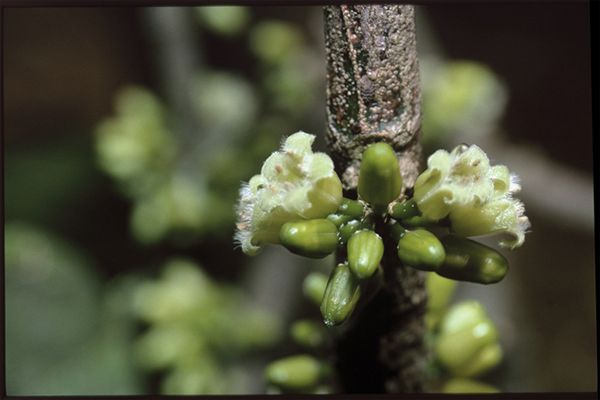
| Medium-sized to fairly large tree up 35 m tall; bole branchless for up to 25 m, slightly sinuous to straight and cylindrical, up to 70(–100) cm in diameter, slightly fluted at base or with buttresses up to 2.5 m high; bark surface smooth, pale brown to grey or yellowish green, often flaking in irregular patches, inner bark thin, reddish, with a milky exudate; crown small, dense; twigs often drooping, slightly fluted, glabrous. Leaves alternate, simple and entire; stipules absent; petiole 1–3 cm long, deeply grooved above; blade oblong to oblong-elliptical or ovate, (6–)9–16(–38) cm × 4–9(–12) cm, base cuneate to rounded, apex acute to rounded, leathery, glabrous, pinnately veined with (4–)5–7(–10) pairs of lateral veins. Inflorescence an axillary fascicle, few- to many-flowered. Flowers bisexual, regular, 5-merous; pedicel 2.5–5 mm long; calyx lobes broadly ovate, c. 0.5 mm long; petals free, linear-oblong, 2.5–5 mm long, upper inner half densely short-hairy, outside glabrous, white to yellowish green; stamens c. 3.5 mm long, filaments fused for c. 2.5 mm with petals; ovary inferior or semi-inferior, 1-celled but at base imperfectly 3(–5)-celled, upper part surrounded by disk, style 2–4 mm long, stigma 3-lobed. Fruit an ellipsoid, fleshy drupe 2–3 cm long, enclosed by fleshy calyx, black when ripe, with depression at apex, stone 1-seeded. Seeds obovoid, with much waxy endosperm. Seedling with epigeal germination. | |||
| show more data (2) | comments (0) |
| Strombosia comprises about 10 species, 7 of which occur in tropical Africa and 3 in tropical Asia. It has been classified in Olacaceae, but recent molecular studies showed that it is better placed in a separate family Strombosiaceae, together with 5 other genera including Strombosiopsis. | |||
| show more data (1) | comments (0) |
| Wood-anatomical description (IAWA hardwood codes): Growth rings: 2: growth ring boundaries indistinct or absent. Vessels: 5: wood diffuse-porous; (10: vessels in radial multiples of 4 or more common); 12: solitary vessel outline angular; 14: scalariform perforation plates; 16: scalariform perforation plates with 10–20 bars; 17: scalariform perforation plates with 20–40 bars; 20: intervessel pits scalariform; 21: intervessel pits opposite; 32: vessel-ray pits with much reduced borders to apparently simple: pits horizontal (scalariform, gash-like) to vertical (palisade); 41: mean tangential diameter of vessel lumina 50–100 μm; 49: 40–100 vessels per square millimetre; 56: tyloses common; (58: gums and other deposits in heartwood vessels). Tracheids and fibres: 61: fibres with simple to minutely bordered pits; 66: non-septate fibres present; 70: fibres very thick-walled. Axial parenchyma: 76: axial parenchyma diffuse; 77: axial parenchyma diffuse-in-aggregates; (78: axial parenchyma scanty paratracheal); 93: eight (5–8) cells per parenchyma strand; 94: over eight cells per parenchyma strand. Rays: 97: ray width 1–3 cells; (98: larger rays commonly 4- to 10-seriate); (106: body ray cells procumbent with one row of upright and/or square marginal cells); 107: body ray cells procumbent with mostly 2–4 rows of upright and/or square marginal cells; 108: body ray cells procumbent with over 4 rows of upright and/or square marginal cells; 115: 4–12 rays per mm; 116: ≥ 12 rays per mm. Mineral inclusions: 136: prismatic crystals present; 141: prismatic crystals in non-chambered axial parenchyma cells; 142: prismatic crystals in chambered axial parenchyma cells. (E. Uetimane, P. Baas & H. Beeckman) | |||
| show more data (0) | comments (0) |
| Strombosia scheffleri prefers shade and does not grow well when planted in open localities. The leaves vary considerably on the same tree; leaves on the lower half of the tree are usually much larger than leaves on the upper half, whereas the smaller leaves are often folded along the midrib. | |||
| show more data (0) | comments (0) |
| Strombosia scheffleri occurs in evergreen forest, often as understory tree, up to 2500 m altitude. It often occurs on acidic and granitic soils and prefers higher banks along water courses. | |||
| show more data (7) | comments (0) |
| Fruits are collected from the ground. There are about 100 fruits, 140 stones and 220 seeds per kg. Fruit stones can be stored for up to 5 months when they are depulped, cleaned and dried, and kept in a cool and dry place. Germination is enhanced by scarification and soaking in water for 24 hours. In Uganda germination of fresh seeds is said to be rapid with a high germination rate, but germination can take long; periods of several months have been recorded. Propagation by wildlings is also possible; they may be abundant near the mother tree. Tests in Uganda showed that propagation by stem cuttings is promising, but air layering failed, as well as propagation by root cuttings and suckers. | |||
| show more data (0) | comments (0) |
| Strombosia scheffleri trees can be managed by pruning, lopping and pollarding. In East Africa Strombosia scheffleri has been planted in pure stands for timber production, and as shade tree for crops. | |||
| show more data (0) | comments (0) |
| When felling the trees, care is needed because the bole of older trees often shows heart rot. | |||
| show more data (0) | comments (0) |
| During storage of logs, small star shakes may develop, but damage by borers and blue stain is minimal. | |||
| show more data (0) | comments (0) |
| Strombosia scheffleri is locally common, sometimes even dominant, within its wide geographical range. It is unlikely that it suffers from genetic erosion. | |||
| show more data (0) | comments (0) |
| Strombosia scheffleri is a locally useful timber tree, and also has potential as a shade tree in crop plantations. It could have good prospects for inclusion in agroforestry systems. The potential of the antimicrobial properties in leaves and bark are worth further investigation. | |||
| show more data (0) | comments (0) |
| • Bolza, E. & Keating, W.G., 1972. African timbers: the properties, uses and characteristics of 700 species. Division of Building Research, CSIRO, Melbourne, Australia. 710 pp. • Bryce, J.M., 1966. The strength properties of Tanzania timbers. Technical Note No 35. Tanzania Forest Division, Utilisation Section, Moshi, Tanzania. 17 pp. • Burkill, H.M., 1997. The useful plants of West Tropical Africa. 2nd Edition. Volume 4, Families M–R. Royal Botanic Gardens, Kew, Richmond, United Kingdom. 969 pp. • Chikamai, B.N., Githiomi, J.K., Gachathi, F.N. & Njenga, M.G., undated. Commercial timber resources of Kenya. Kenya Forestry Research Institute (KEFRI), Nairobi, Kenya. 164 pp. • Katende, A.B., Birnie, A. & Tengnäs, B., 1995. Useful trees and shrubs for Uganda: identification, propagation and management for agricultural and pastoral communities. Technical Handbook 10. Regional Soil Conservation Unit, Nairobi, Kenya. 710 pp. • Keay, R.W.J., 1989. Trees of Nigeria. A revised version of Nigerian trees (1960, 1964) by Keay, R.W.J., Onochie, C.F.A. & Stanfield, D.P. Clarendon Press, Oxford, United Kingdom. 476 pp. • Lucas, G.L.L., 1968. Olacaceae. In: Milne-Redhead, E. & Polhill, R.M. (Editors). Flora of Tropical East Africa. Crown Agents for Oversea Governments and Administrations, London, United Kingdom. 16 pp. • Maundu, P. & Tengnäs, B. (Editors), 2005. Useful trees and shrubs for Kenya. World Agroforestry Centre - East and Central Africa Regional Programme (ICRAF-ECA), Technical Handbook 35, Nairobi, Kenya. 484 pp. • Meunier, Q., Lemmens, R. & Morin, A., 2010. Growth and cultivation of 85 indigenous trees. GraphiConsult, Kampala, Uganda. 224 pp. • Takahashi, A., 1978. Compilation of data on the mechanical properties of foreign woods (part 3) Africa. Shimane University, Matsue, Japan. 248 pp. | |||
| show more data (2) | comments (0) |
| • Beentje, H.J., 1994. Kenya trees, shrubs and lianas. National Museums of Kenya, Nairobi, Kenya. 722 pp. • Friis, I. & Vollesen, K., 1998. Flora of the Sudan-Uganda border area east of the Nile. I. Catalogue of vascular plants, 1st part. Biologiske Skrifter No 51:1. The Royal Danish Academy of Sciences and Letters, Copenhagen, Denmark. 388 pp. • Iddi, S., Hamza, K.F.S., Ringo, W.N. & lshengoma, R.C., 1992. The suitability of some Tanzanian hardwoods for the manufacture of cement particleboards. Holz als Roh- und Werkstoff 50: 280–281. • Moshi, M.J., Innocent, E., Masimba, P.J., Otieno, D.F., Weisheit, A., Mbabazi, P., Lynes, M., Meachem, K., Hamilton, A. & Urassa, I., 2009. Antimicrobial and brine shrimp toxicity of some plants used in traditional medicine in Bukoba District, north-western Tanzania. Tanzania Journal of Health Research 11(1): 23-28. • Muhanguzi, H.D.R., Obua, J., Oreym-Origa, H. & Vetaas, O.R., 2005. Forest site disturbances and seedling emergence in Kalinzu forest, Uganda. Tropical Ecology 46(1): 91–98. • Terashima, H. & Ichikawa, M., 2003. A comparative ethnobotany of the Mbuti and Efe hunter-gatherers in the Ituri forest, Democratic Republic of Congo. African Study Monographs 24(1–2): 1–168. • Villiers, J.-F., 1973. Olacaceae. Flore du Cameroun. Volume 15. Muséum National d’Histoire Naturelle, Paris, France. pp. 101–162. | |||
| show more data (3) | comments (0) |
| show more data (7) | comments (0) |
| • Lucas, G.L.L., 1968. Olacaceae. In: Milne-Redhead, E. & Polhill, R.M. (Editors). Flora of Tropical East Africa. Crown Agents for Oversea Governments and Administrations, London, United Kingdom. 16 pp. | |||
| show more data (0) | comments (0) |
| |||||
| |||||||||
| |||||
| |||||
| Obeng, E.A., 2012. Strombosia scheffleri Engl. [Internet] Record from PROTA4U. Lemmens, R.H.M.J., Louppe, D. & Oteng-Amoako, A.A. (Editors). PROTA (Plant Resources of Tropical Africa / Ressources végétales de l’Afrique tropicale), Wageningen, Netherlands. <http://www.prota4u.org/search.asp>. Accessed . | |||
| There are 1 study abstracts related to Strombosia scheffleri Engl.. Click on "show more" to view them. | ||
| show more data | comments (0) |
| There are 100 book citations related to Strombosia scheffleri Engl.. Click on "show more" to view them. | ||
| show more data | comments (0) |
| There are 100 citation in web searches related to Strombosia scheffleri Engl.. Click on "show more" to view them. | ||
| show more data | comments (0) |
| There are 91 citation in scholarly articles related to Strombosia scheffleri Engl.. Click on "show more" to view them. | ||
| show more data | comments (0) |
| There are 1 news article citations related to Strombosia scheffleri Engl.. Click on "show more" to view them. | ||
| show more data | comments (0) |
| There are 15 citations in Afrirefs related to Strombosia scheffleri Engl.. Click on "show more" to view them. | ||
| show more data | comments (0) |
| There are 1 Wikipedia citations related to Strombosia scheffleri Engl.. Click on "show more" to view them. | ||
| show more data | comments (0) |
| General importance |  |
| Geographic coverage Africa | |
| Geographic coverage World |  |
| Fruit use | |
| Timber use | |
| Auxiliary use | |
| Fuel use | |
| Medicinal use | |
| Food security | |



 Comments (