Record display
 PROTA4U Homepage
| Select translation pop-up: |
|
|
PROTA4U Record display |
PROTA4U Homepage
|
| Notizbl. Bot. Gart. Berlin 8: 152 (1922). | |||
| show more data (0) | comments (0) |
| Papilionaceae (Leguminosae - Papilionoideae, Fabaceae) | |||
| show more data (5) | comments (0) |
| show more data (11) | comments (0) |
| Padouk blanc (Fr). Mkula (Sw). | |||
| show more data (1) | comments (0) |
| Pterocarpus mildbraedii is found in Sierra Leone, Liberia, Côte d’Ivoire, Ghana, Benin, Nigeria, Cameroon, Equatorial Guinea, Gabon and the Usambara and Udzungwe Mountains (Tanzania). Records for DR Congo are based on misidentification. | |||
| show more data (3) | comments (0) |
| The leaves of Pterocarpus mildbraedii are used as a cooked vegetable in Nigeria. In Ghana the trees have been planted or retained in cocoa plantations to provide shade. Pterocarpus mildbraedii is rarely exploited for its timber, e.g. in Tanzania, and the wood is used to make mortars. | |||
| show more data (2) | comments (0) |
| The leaves of Pterocarpus mildbraedii contain per 100 g edible portion: water 85 g, energy 237 kJ (57 kcal), protein 3.8 g, fat 0.8 g, carbohydrate 8.2 g, crude fibre 1.13 g, Ca 72 mg, Mg 28 mg, Fe 4.7 mg and Zn 3.1 mg (Akpanyung, E.O., Udoh, A.P. & Akpan, E.J., 1995). Hydrogen cyanide and oxalate levels are high but not such that they pose a health danger for consumers. An ethanolic extract proved toxic to rats only after intraperitoneal administration. The wood is whitish and soft, and of little commercial value. | |||
| show more data (0) | comments (0) |
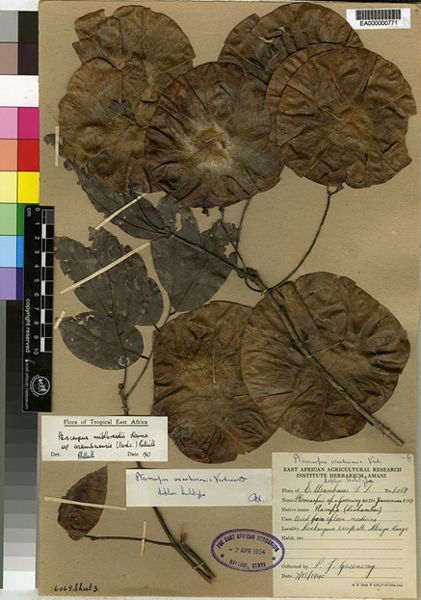
| Medium-sized to large tree up to 35 m tall, with smooth, grey or pale brown bark, exuding red gum when cut, and small, rounded crown. Leaves alternate, imparipinnate, up to 35 cm long; stipules lanceolate, up to 1 cm long, caducous; leaflets (5–)7–15, alternate, elliptical-oblong to ovate, 6–14 cm × 3–7 cm, base rounded to cuneate, apex abruptly acuminate. Inflorescence a raceme or little-branched panicle 5–15 cm long. Flowers bisexual, papilionaceous, 5-merous; calyx 5–8 mm long, densely covered with short hairs on the lobes inside and near lobe margins outside; corolla golden-yellow, 1–1.5 cm long. Fruit an obovate-orbicular pod 10–12 cm long, with very broad membranous wing, style base lateral, 1(–2)-seeded. Pterocarpus comprises about 60 species, 20 of them in Africa. Several Asian and African species are commercial timbers. Pterocarpus santanalioides DC., Pterocarpus soyauxii Taub. and Pterocarpus osun Craib, all primarily used for timber, have leaves that are used as vegetable as well. The two disjunct populations of Pterocarpus mildbraedii in West-Central Africa and East Africa are sometimes considered as subspecies: subsp. mildbraedii and subsp. usambarensis (Verdc.) Polhill, respectively. They differ in the size of bracts and flowers. Pterocarpus mildbraedii grows fast and coppices well. Its root system is superficial: most roots are in the top 30 cm of the soil. It has an intermittent pattern of leaf flushes. Flushes appear in the dry season when other leafy vegetables are scarce. | |||
| show more data (0) | comments (0) |
| show more data (6) | comments (0) |
| show more data (1) | comments (0) |
| Pterocarpus mildbraedii occurs in lowland rainforest, dry evergreen forest and riverine forest, up to 1250 m altitude. In Tanzania it is restricted to altitudes of 300–600 m. It is tolerant of acid soil. | |||
| show more data (1) | comments (0) |
| Pterocarpus mildbraedii leaves are collected from the wild, but frequently marketed. Attempts to domesticate it are being made. Propagation can be done by seed, budding or cuttings. | |||
| show more data (0) | comments (0) |
| In West and Central Africa Pterocarpus mildbraedii is widespread, although in some countries recorded as rare (e.g. in Ghana), and does not seem to be liable to genetic erosion. However, the populations in Tanzania are of limited extent and vulnerable. | |||
| show more data (0) | comments (0) |
| Pterocarpus mildbraedii is a nutritious vegetable but despite this is only exploited as such in southern Nigeria. A better understanding of the variation in the species might help in the process of domestication. It is being tested in agroforestry systems. | |||
| show more data (0) | comments (0) |
| • Gillett, J.B., Polhill, R.M., Verdcourt, B., Schubert, B.G., Milne-Redhead, E., & Brummitt, R.K., 1971. Leguminosae (Parts 3–4), subfamily Papilionoideae (1–2). In: Milne-Redhead, E. & Polhill, R.M. (Editors). Flora of Tropical East Africa. Crown Agents for Oversea Governments and Administrations, London, United Kingdom. 1108 pp. • Okafor, J.C., 1991. Improving edible species of forest products. Unasylva 165(42): 17–23. • Okigbo, B.N., 1977. Neglected plants of horticultural importance in traditional farming systems of tropical Africa. Acta Horticulturae 53: 131–150. • Rojo, J.P., 1972. Pterocarpus (Leguminosae-Papilionaceae) revised for the world. Phanerogamarum Monographiae. Volume 5. J. Cramer, Lehre, Germany. 119 pp. | |||
| show more data (6) | comments (0) |
| • Ajibesin, K.K., Bala, D.N., Ekpo, B.A.J. & Adesanya, S.A., 2002. Toxicity of some plants implicated as poisons in Nigerian ethnomedicine to rats. Nigerian Journal of Natural Products and Medecines 6: 8–10. • Akinnifesi, F.K., Kang, B.T. & Ladipo, D.O., 1998. Structural root form and fine root distribution of some woody species evaluated for agroforestry systems. Agroforestry Systems 42: 121–138. • Akpanyung, E.O., Udoh, A.P. & Akpan, E.J., 1995. Chemical composition of the edible leaves of Pterocarpus mildbraedii. Plant Foods and Human Nutrition 48(3): 209–215. • Burkill, H.M., 1995. The useful plants of West Tropical Africa. 2nd Edition. Volume 3, Families J–L. Royal Botanic Gardens, Kew, Richmond, United Kingdom. 857 pp. • Normand, D. & Paquis, J., 1976. Manuel d’identification des bois commerciaux. Tome 2. Afrique guinéo-congolaise. Centre Technique Forestier Tropical, Nogent-sur-Marne, France. 335 pp. • Roe, D., Mulliken, T, Milledge, S., Mremi, J., Mosha, S. & Grieg-Gran, M., 2002. Making a killing or making a living?: wildlife trade, trade controls and rural livelihoods. Biodiversity and Livelihoods Issues 6. TRAFFIC, Cambridge & IIED, London, United Kingdom. 114 pp. • Rojo, J.P. & Alonzo, D.S., 1993. Pterocarpus Jacq. In: Soerianegara, I. & Lemmens, R.H.M.J. (Editors). Plant Resources of South-East Asia No 5(1). Timber trees: Major commercial timbers. Pudoc Scientific Publishers, Wageningen, Netherlands. pp. 374–379. | |||
| show more data (2) | comments (0) |
| |||||
| |||||||
| |||||||
| |||||||
| Bosch, C.H., 2004. Pterocarpus mildbraedii Harms. [Internet] Record from PROTA4U. Grubben, G.J.H. & Denton, O.A. (Editors). PROTA (Plant Resources of Tropical Africa / Ressources végétales de l’Afrique tropicale), Wageningen, Netherlands. <http://www.prota4u.org/search.asp>. Accessed . | |||
| There are 39 book citations related to Pterocarpus mildbraedii Harms. Click on "show more" to view them. | ||
| show more data | comments (0) |
| There are 100 citation in web searches related to Pterocarpus mildbraedii Harms. Click on "show more" to view them. | ||
| show more data | comments (0) |
| There are 51 citation in scholarly articles related to Pterocarpus mildbraedii Harms. Click on "show more" to view them. | ||
| show more data | comments (0) |
| There are 8 citations in Afrirefs related to Pterocarpus mildbraedii Harms. Click on "show more" to view them. | ||
| show more data | comments (0) |
| There are 1 Wikipedia citations related to Pterocarpus mildbraedii Harms. Click on "show more" to view them. | ||
| show more data | comments (0) |
| General importance |  |
| Geographic coverage Africa | |
| Geographic coverage World |  |
| Vegetables | |
| Forage/feed use | |
| Timber use | |
| Auxiliary use | |
| Fuel use | |
| Food security | |



 Comments (