Record display
 PROTA4U Homepage
| Select translation pop-up: |
|
|
PROTA4U Record display |
PROTA4U Homepage
|
| Bot. Jahrb. Syst. 28: 20 (1899). | |||
| show more data (4) | comments (0) |
| Euphorbiaceae (APG: Phyllanthaceae) | |||
| show more data (9) | comments (0) |
| show more data (18) | comments (0) |
| Kudu berry, duiker berry (En). | |||
| show more data (11) | comments (0) |
| Pseudolachnostylis maprouneifolia occurs from DR Congo and Tanzania south throughout southern Africa including northern South Africa. | |||
| show more data (35) | comments (0) |
| In East Africa a root decoction is taken as a purgative to treat stomach-ache and abdominal problems. In Tanzania the roots and bark mixed with poisonous insects are burned and the ashes applied to incisions as a cure for tumours. The leaves pounded together with leaves, bark and roots of pigeon pea (Cajanus cajan (L.) Millsp.) in water are used as ear drops to treat earache. In southern Africa the smoke of burning roots is inhaled to treat pneumonia. The pulverized bark mixed in porridge is taken to treat pneumonia, tuberculosis and aenemia. A bark extract is drunk or dried powdered root mixed in porridge is taken to treat diarrhoea, dysentery and as an aphrodisiac. In Zambia the pulp of peeled roots is applied to leprous sores. In Zimbabwe the leaves are boiled and the strained liquid is rubbed into incisions on the side to treat pain in the side. A leaf decoction is taken to treat cough and fever. A root infusion is taken to treat abdominal pain, gonorrhoea and female sterility. A bark infusion is taken to treat dizziness and vomiting. Dried, pulverized root is sniffed to treat nosebleed and headache. It is sprinkled on fresh wounds to heal them. An infusion of leaves and roots is given to cattle to threat haematuria. The wood is used to make toys, joinery, turnery and handicrafts, and is also used as firewood and to make charcoal. The fruits are edible. The leaves and fruit are used as fodder. In Zambia Pseudolachnostylis maprouneifolia is a popular host plant of edible caterpillars. In Malawi the tree enters into religious ceremonies. | |||
| show more data (18) | comments (0) |
| No information is available concerning the phytochemistry and pharmacology. The wood is moderately heavy, with an even texture. The fresh fruit pulp contains per 100 g: water 60 g, energy 35 kJ (147 kcal), protein 3.3 g, fat 1.8 g, carbohydrate 33.5 g, cellulose 8 g, Ca 0.03 g, Mg 0.05 g, P 0.04 g, Fe 2.7 mg, Zn 2.6 mg, riboflavin 0.06 mg, niacin 1.09 mg. | |||
| show more data (3) | comments (0) |
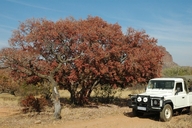
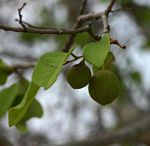
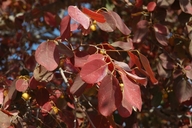
| Dioecious, deciduous small tree up to 10(–18)m tall; bole straight, branchless for c. 3.5 m; bark smooth, becoming transversely fissured and flaking, dark grey to blackish; crown compact and rounded, or lax with drooping branches; twigs glabrous to densely hairy. Leaves alternate, simple and entire; stipules lanceolate, 3–5 mm long, soon falling; petiole 2–10 mm long; blade broadly ovate to elliptical-ovate, 1.5–10(–12.5) cm × 1–6 cm, base cuneate to shallowly cordate, apex obtuse to rounded, glabrous or short-hairy, pinnately veined with 6–12 pairs of lateral veins, orange-red before falling. Inflorescence an axillary cyme; bracts up to 3 mm long; male inflorescence up to 2 cm long; female inflorescence up to 4 cm long. Flowers unisexual, regular; sepals 5(–6), ovate to elliptical, 3–5 mm × 1–3 mm, obtuse, glabrous to sparingly short-hairy, yellowish green; petals absent; disk c. 2 mm in diameter, pinkish; male flowers sessile, stamens 5–7, staminal column 1–2 mm long; female flowers with 1.5–2 mm long pedicel, ovary superior, ovoid, c. 1.5 mm × 1 mm, 3-celled, smooth, densely short-hairy to glabrous, styles 3, 1.5–2 cm long, fused at base, stigmas 2-fid. Fruit an ovoid to rounded drupe-like capsule 1.5–2 cm long, scarcely 2–4-lobed, tardily septicidally dehiscent, glabrous, yellowish green, yellow or pinkish green, 3-seeded by abortion. Seeds ellipsoid-ovoid, c. 7 mm × 5 mm long, slightly shiny, pale brown streaked with dark brown. Pseudolachnostylis comprises a single species, but up to 6 species have been recognized in the past, which are distinguished as varieties in recent treatments. Pseudolachnostylis maprouneifolia flowers from July to December, fruits remain long on the tree. | |||
| show more data (0) | comments (0) |
| show more data (10) | comments (0) |
| show more data (4) | comments (0) |
| show more data (2) | comments (0) |
| Pseudolachnostylis maprouneifolia occurs in mixed deciduous woodland, wooded grassland and riverine vegetation, usually on sandy soils, but also on rocky outcrops and disturbed soils near cultivation, at 200–1600 m altitude. Mature trees are moderately fire resistant. | |||
| show more data (14) | comments (0) |
| show more data (6) | comments (0) |
| Seeds can be stored for later use; the germination rate is increased when seeds are soaked in hot water and allowed to cool for 24 hours before sowing. The plants can be pruned and coppiced. | |||
| show more data (1) | comments (0) |
| show more data (1) | comments (0) |
| Pseudolachnostylis maprouneifolia is common in its area of distribution and not threatened by genetic erosion. | |||
| show more data (0) | comments (0) |
| Pseudolachnostylis maprouneifolia has many interesting medicinal uses, e.g. against different infectious ailments. However, no phytochemical or pharmacological research has been done so far, and it would be worthwhile evaluating the different plant parts for their activities. | |||
| show more data (2) | comments (0) |
| • Chilufya, H. & Tengnäs, B., 1996. Agroforestry extension manual for northern Zambia. Regional Soil Conservation Unit, Nairobi, Kenya. 120 + 124 pp. • Neuwinger, H.D., 2000. African traditional medicine: a dictionary of plant use and applications. Medpharm Scientific, Stuttgart, Germany. 589 pp. • Radcliffe-Smith, A., 1996. Euphorbiaceae, subfamilies Phyllantoideae, Oldfieldioideae, Acalyphoideae, Crotonoideae and Euphorbioideae, tribe Hippomaneae. In: Pope, G.V. (Editor). Flora Zambesiaca. Volume 9, part 4. Royal Botanic Gardens, Kew, Richmond, United Kingdom. pp. 1–337. • Williamson, J., 1955. Useful plants of Nyasaland. The Government Printer, Zomba, Nyasaland. 168 pp. | |||
| show more data (18) | comments (0) |
| • Chinemana, F., Drummond, R.B., Mavi, S. & de Zoysa, I., 1985. Indigenous plant remedies in Zimbabwe. Journal of Ethnopharmacology 14: 159–172. • Coates Palgrave, K., 1983. Trees of southern Africa. 2nd Edition. Struik Publishers, Cape Town, South Africa. 959 pp. • Oliveira, J.S., 1974. Valor alimentar de alguns frutos silvestres de Moçambique. Portugaliae Acta Biologica, Serie A: Morfologia, Fisiologia, Genetica e Biologia General 13(1–4): 47–62. • Kokwaro, J.O., 1993. Medicinal plants of East Africa. 2nd Edition. Kenya Literature Bureau, Nairobi, Kenya. 401 pp. | |||
| show more data (1) | comments (0) |
| show more data (1) | comments (0) |
| |||||
| |||||||
| |||||||||||
| |||||||
| |||||
| Schmelzer, G.H., 2007. Pseudolachnostylis maprouneifolia Pax. [Internet] Record from PROTA4U. Schmelzer, G.H. & Gurib-Fakim, A. (Editors). PROTA (Plant Resources of Tropical Africa / Ressources végétales de l’Afrique tropicale), Wageningen, Netherlands. <http://www.prota4u.org/search.asp>. Accessed . | |||
| There are 92 book citations related to Pseudolachnostylis maprouneifolia Pax. Click on "show more" to view them. | ||
| show more data | comments (0) |
| There are 100 citation in web searches related to Pseudolachnostylis maprouneifolia Pax. Click on "show more" to view them. | ||
| show more data | comments (0) |
| There are 84 citation in scholarly articles related to Pseudolachnostylis maprouneifolia Pax. Click on "show more" to view them. | ||
| show more data | comments (0) |
| There are 18 citations in Afrirefs related to Pseudolachnostylis maprouneifolia Pax. Click on "show more" to view them. | ||
| show more data | comments (0) |
| There are 5 Wikipedia citations related to Pseudolachnostylis maprouneifolia Pax. Click on "show more" to view them. | ||
| show more data | comments (0) |
| General importance |  |
| Geographic coverage Africa |  |
| Geographic coverage World |  |
| Dye and tannins use |  |
| Ornamental use | |
| Forage/feed use | |
| Fruit use | |
| Timber use | |
| Fuel use | |
| Medicinal use | |
| Food security | |



 Comments (