Record display
 PROTA4U Homepage
| Select translation pop-up: |
|
|
PROTA4U Record display |
PROTA4U Homepage
|
| Notizbl. Bot. Gart. Berlin-Dahlem 8: 700 (1924). | |||
| show more data (1) | comments (0) |
| Verbenaceae (APG: Lamiaceae) | |||
| show more data (4) | comments (0) |
| show more data (1) | comments (0) |
| show more data (1) | comments (0) |
| Premna maxima is endemic to Kenya, where it is confined to a few small localities near Meru and Marsabit. | |||
| show more data (3) | comments (0) |
| The wood of Premna maxima is suitable for construction, poles and piles, light flooring, mine props, ship and boat building, furniture and cabinet work, joinery, toys and novelties, agricultural implements, boxes and crates, vats, turnery, draining boards, food containers, veneer and plywood. In Kenya the wood is used in carpentry and construction. It has also been used for flour mills, stave piping and cooling-tower slats. | |||
| show more data (1) | comments (0) |
| The heartwood of Premna maxima is grey-brown or grey tinged with green, and not clearly demarcated from the sapwood. The grain is straight, texture medium and even. The density of the wood is 560–740 kg/m³ at 12% moisture content. The wood seasons well, but sharp moisture gradients may occur. The wood is hard and stable, but its strength is below average for its density. It works well with all tools, and paints, polishes and varnishes satisfactorily. The wood is durable due to the presence of oil. The sapwood is not susceptible to Lyctus borer attack. | |||
| show more data (0) | comments (0) |
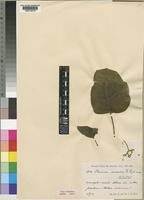
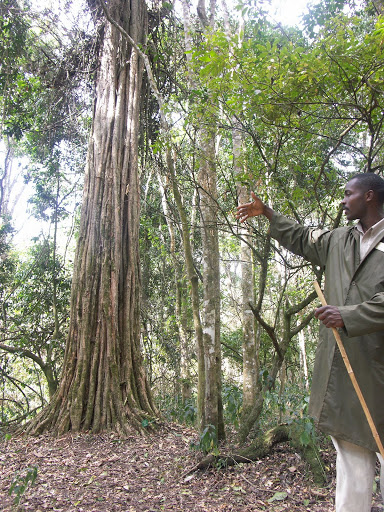
| Medium-sized tree up to 30(–40) m tall; bole up to 90 cm in diameter, generally fluted and bent or crooked; outer bark dark, rough, flaking vertically in small scales; branchlets first rusty brown hairy, but soon glabrous. Leaves opposite or in whorls of 3, simple and entire; petiole 3–8 cm long, rusty brown hairy; blade broadly ovate to elliptical or rounded, (6–)7–12(–19) cm × (4–)5–10.5(–16) cm, base usually rounded, apex rounded to acuminate, slightly yellowish hairy above, grey woolly hairy beneath, sometimes glabrous on both surfaces. Inflorescence a terminal umbel-like panicle, 12–16(–20) cm × 11–14 cm, yellow hairy, branches up to 6 cm long; bracts triangular, 5–9 mm × 1–4 mm. Flowers bisexual, zygomorphic; pedicel c. 1 mm long; calyx campanulate, c. 3.5 mm long, yellow hairy, 2-lipped, one lip 2-toothed, the other entire, persistent; corolla creamy white, narrowly funnel-shaped, tube c. 3 mm long, with 4 lobes, 2-lipped, lobes rounded and c. 2.5 mm × 2 mm; stamens 4, inserted in corolla tube, 2 longer and 2 shorter; ovary superior, 2-celled or falsely 4-celled, style subulate, c. 1.5 mm long, shortly 2-lobed at apex. Fruit a globose drupe c. 8 mm in diameter when dry, purplish; endocarp bony, few-seeded. Seeds oblong. Premna comprises about 225 species, distributed mainly in the Old World tropics and subtropics. In Kenya Premna maxima has been found flowering from January to June. | |||
| show more data (0) | comments (0) |
| show more data (1) | comments (0) |
| Premna maxima occurs at 1150–1800 m altitude in moist evergreen forest. | |||
| show more data (2) | comments (0) |
| The distribution of Premna maxima is limited to a single country, and it is classified as vulnerable on the IUCN Red list of threatened species. The population in the Marsabit National Reserve in Kenya is protected, and Premna maxima is being propagated in the Plant Conservation Programme in Kenya. | |||
| show more data (0) | comments (0) |
| Premna maxima has a restricted distribution and is considered vulnerable; hence harvesting the timber from wild stands should be discouraged. | |||
| show more data (0) | comments (0) |
| • Bolza, E. & Keating, W.G., 1972. African timbers: the properties, uses and characteristics of 700 species. Division of Building Research, CSIRO, Melbourne, Australia. 710 pp. • Verdcourt, B., 1992. Verbenaceae. In: Polhill, R.M. (Editor). Flora of Tropical East Africa. A.A. Balkema, Rotterdam, Netherlands. 155 pp. | |||
| show more data (1) | comments (0) |
| • Battiscombe, E., 1936. Trees and shrubs of Kenya colony. Government Printer, Nairobi, Kenya. 201 pp. • Beentje, H.J., 1994. Kenya trees, shrubs and lianas. National Museums of Kenya, Nairobi, Kenya. 722 pp. • Dale, I.R. & Greenway, P.J., 1961. Kenya trees and shrubs. Buchanan’s Kenya Estates Limited, Nairobi, Kenya. 654 pp. • Wimbush, S.H., 1957. Catalogue of Kenya timbers. 2nd reprint. Government Printer, Nairobi, Kenya. 74 pp. • World Conservation Monitoring Centre, 1998. Premna maxima. In: IUCN. 2006 Red list of threatened species. [Internet] http://www.iucnredlist.org. Accessed February 2007. | |||
| show more data (0) | comments (0) |
| |||||
| |||||||||
| |||||||||
| Brink, M., 2007. Premna maxima T.C.E.Fr. [Internet] Record from PROTA4U. Louppe, D., Oteng-Amoako, A.A. & Brink, M. (Editors). PROTA (Plant Resources of Tropical Africa / Ressources végétales de l’Afrique tropicale), Wageningen, Netherlands. <http://www.prota4u.org/search.asp>. Accessed . | |||
| There are 21 book citations related to Premna maxima T.C.E.Fr.. Click on "show more" to view them. | ||
| show more data | comments (0) |
| There are 74 citation in web searches related to Premna maxima T.C.E.Fr.. Click on "show more" to view them. | ||
| show more data | comments (0) |
| There are 15 citation in scholarly articles related to Premna maxima T.C.E.Fr.. Click on "show more" to view them. | ||
| show more data | comments (0) |
| There are 1 citations in Afrirefs related to Premna maxima T.C.E.Fr.. Click on "show more" to view them. | ||
| show more data | comments (0) |
| There are 7 Wikipedia citations related to Premna maxima T.C.E.Fr.. Click on "show more" to view them. | ||
| show more data | comments (0) |
| General importance |  |
| Geographic coverage Africa | |
| Geographic coverage World | |
| Timber use | |
| Conservation status |  |



 Comments (