Record display
 PROTA4U Homepage
| Select translation pop-up: |
|
|
PROTA4U Record display |
PROTA4U Homepage
|
| Bot. Jahrb. Syst. 18: 165 (1893). | |||
| show more data (2) | comments (0) |
| Verbenaceae (APG: Lamiaceae) | |||
| show more data (9) | comments (0) |
| Premna zenkeri Gürke (1903). | |||
| show more data (7) | comments (0) |
| Musalengue (Po). | |||
| show more data (4) | comments (0) |
| Premna angolensis is widely distributed in tropical Africa, from Senegal to Ethiopia, Kenya, Tanzania and Angola. | |||
| show more data (7) | comments (0) |
| The wood of Premna angolensis (trade name: muhorro) is suitable for construction, flooring, mine props, ship and boat building, furniture and cabinet work, interior trim, toys and novelties, agricultural implements, boxes and crates, carvings, turnery, draining boards, food containers, veneer and plywood. In Kenya it is used for carving and beehives, and it has been used in construction work in mines. In Tanzania it is used for animal traps, tool handles, and as firewood. In Côte d’Ivoire the bark of Premna angolensis is used in enemas and baths to treat fever in children. In São Tomé et Principe the bark is a remedy for malaria and fevers. In Gabon the bark is used in enemas and in fumigations against madness. In DR Congo juice squeezed from the crushed bark is instilled in the nostrils to treat epilepsy. In Tanzania a preparation of the bark is taken to treat stomach pain, and sap exuded from the bark is taken against dysentery. In Gabon Premna angolensis is taboo for some people, and its use in the kitchen is not allowed. The bad smell of leaves and twigs thrown on a fire is believed to keep away bad spirits. | |||
| show more data (2) | comments (0) |
| The heartwood of Premna angolensis is pale yellow-brown, the sapwood is only slightly paler. The grain is usually straight, but sometimes interlocked, texture medium and even. The smell has been described by some as sweet, by others as unpleasant. The density of the wood is 730–800 kg/m³ at 12% moisture content. Logs are usually hollow or have rotten cores. The wood seasons well, with little distortion, but some checking may occur. The wood works and planes well. It is recorded to be suitable for peeling and slicing, holds nails well, glues satisfactorily, and paints, polishes and varnishes well. The steam-bending properties are moderate to poor. The wood is durable, due to the presence of oil. The sapwood is not susceptible to Lyctus borer attack. | |||
| show more data (0) | comments (0) |
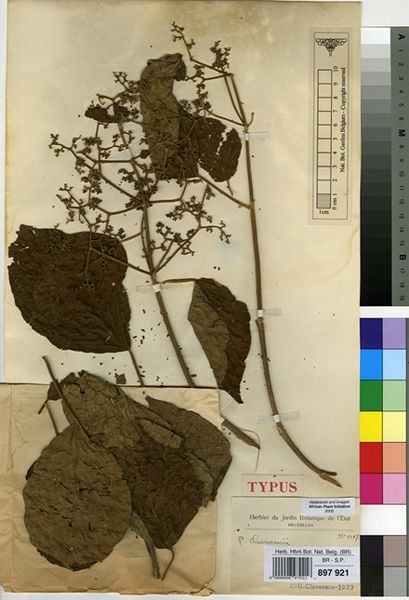
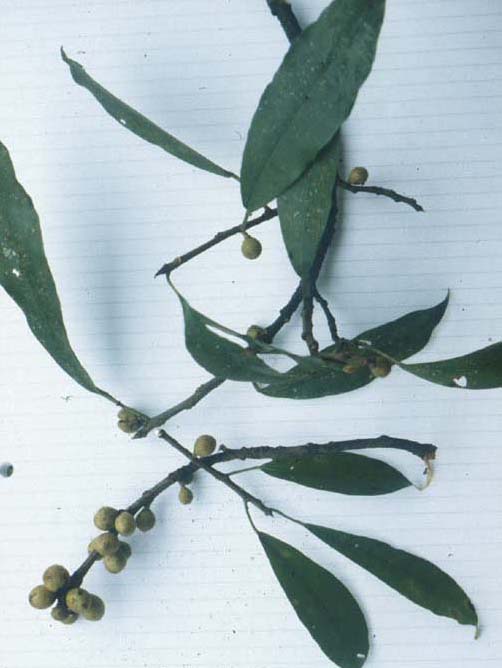
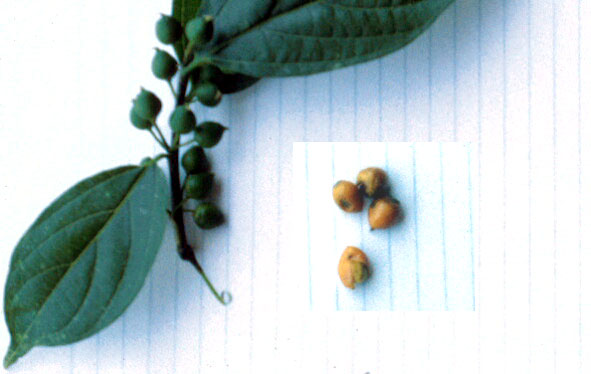
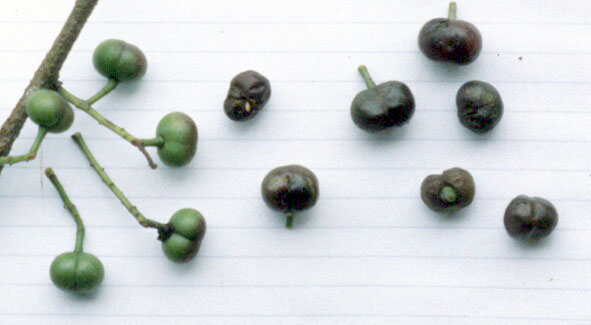
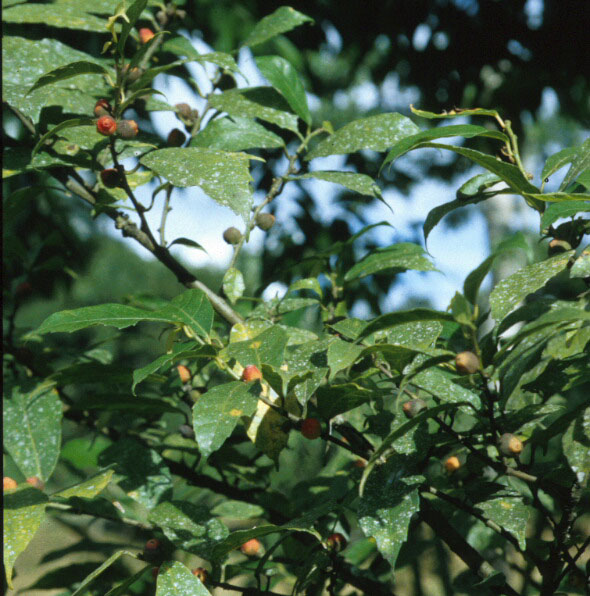
| Small to medium-sized tree up to 21(–33) m tall, less often shrubby; bole up to 120 cm in diameter, often crooked, sometimes fluted, usually hollow; outer bark pale grey or reddish grey, finely furrowed; crown spreading, with more or less horizontal branches; branchlets sparsely pubescent and glandular, becoming glabrous. Leaves mostly in whorls of 4, less often opposite, simple and entire; petiole 3–10 cm long; blade ovate, oblong or elliptical, 4–21 cm × 3–13(–17) cm, base cuneate or rounded to slightly cordate, apex acuminate, glabrous above, pubescent beneath on main veins, glandular punctate. Inflorescence a large thyrsoid panicle, terminal or axillary, 5–30 cm long, the main branches in whorls of 2–5 and 3–9 cm long; bracts linear to lanceolate, up to 1 cm long. Flowers bisexual, zygomorphic; pedicel up to 1 mm long; calyx 1.5–2 mm long, truncate or obscurely 2-lipped, pubescent or glabrous, persistent; corolla 4-lobed, white, glabrous outside, tube 2–2.5(–3) mm long, lobes c. 1 mm long; stamens 4, inserted in corolla tube, 2 longer and 2 shorter; ovary superior, 2-celled or falsely 4-celled, style subulate, shortly 2-lobed at apex. Fruit a globose drupe 4–6 mm in diameter, apex acute, green turning purple; endocarp bony, few-seeded. Seeds oblong. Premna comprises about 225 species, distributed mainly in the Old World tropics and subtropics. Various other Premna spp. are local sources of timber in tropical Africa. The wood of Premna hildebrandtii Gürke, distributed in Kenya and Tanzania, is hard and used for building poles, tool handles and as firewood. The foliage is browsed by goats, and a decoction of the root is used as a medicine for stomachache. The wood of Premna mooiensis (Pearson) Pieper, distributed in Mozambique and South Africa, is durable in the ground and has been used for fencing poles. The wood of Premna schliebenii Werderm., distributed in Tanzania and Mozambique, is tough and hard, and is used for building poles, tool handles and as firewood; it is unclear, however, whether this should be considered a separate species or be included in Premna chrysoclada (Boj.) Gürke. Premna schliebenii is classified as vulnerable on the IUCN Red list of threatened species. In Kenya Premna angolensis flowers in April–May. | |||
| show more data (0) | comments (0) |
| show more data (2) | comments (0) |
| show more data (1) | comments (0) |
| Premna angolensis occurs up to 2100 m altitude, in forest, bushland and grassland. In forest it occurs mainly in margins and clearings. | |||
| show more data (4) | comments (0) |
| In view of its wide distribution Premna angolensis is not threatened with genetic erosion. | |||
| show more data (0) | comments (0) |
| Premna angolensis is a useful local source of wood for various purposes, including construction. Commercially the wood has little potential, because logs are often hollow; so its importance is unlikely to increase. | |||
| show more data (0) | comments (0) |
| • Bolza, E. & Keating, W.G., 1972. African timbers: the properties, uses and characteristics of 700 species. Division of Building Research, CSIRO, Melbourne, Australia. 710 pp. • Burkill, H.M., 2000. The useful plants of West Tropical Africa. 2nd Edition. Volume 5, Families S–Z, Addenda. Royal Botanic Gardens, Kew, Richmond, United Kingdom. 686 pp. • Fernandes, R., 2005. Lamiaceae. In: Pope, G.V. & Martins, E.S. (Editors). Flora Zambesiaca. Volume 8, part 7. Royal Botanic Gardens, Kew, Richmond, United Kingdom. pp. 61–153. • Lovett, J.C., Ruffo, C.K., Gereau, R.E. & Taplin, J.R.D., 2006. Field guide to the moist forest trees of Tanzania. [Internet] Centre for Ecology Law and Policy, Environment Department, University of York, York, United Kingdom. http://www.york.ac.uk/ res/celp/webpages/projects/ecology/ tree%20guide/guide.htm. Accessed April 2006. • Verdcourt, B., 1992. Verbenaceae. In: Polhill, R.M. (Editor). Flora of Tropical East Africa. A.A. Balkema, Rotterdam, Netherlands. 155 pp. | |||
| show more data (1) | comments (0) |
| • Beentje, H.J., 1994. Kenya trees, shrubs and lianas. National Museums of Kenya, Nairobi, Kenya. 722 pp. • Chifundera, K., 2001. Contribution to the inventory of medicinal plants from the Bushi area, South Kivu Province, Democratic Republic of Congo. Fitoterapia 72: 351–368. • Coates Palgrave, K., 1983. Trees of southern Africa. 2nd Edition. Struik Publishers, Cape Town, South Africa. 959 pp. • Do Céu de Madureira, M., Martins, A.P., Gomes, M., Paiva, J., Proença da Cunha, A. & do Rosario, V., 2002. Antimalarial activity of medicinal plants used in traditional medicine in S. Tomé and Principe islands. Journal of Ethnopharmacology 81: 23–29. • Eggeling, W.J. & Dale, I.R., 1951. The indigenous trees of the Uganda Protectorate. Government Printer, Entebbe, Uganda. 491 pp. • Huber, H., Hepper, F.N. & Meikle, R.D., 1963. Verbenaceae. In: Hepper, F.N. (Editor). Flora of West Tropical Africa. Volume 2. 2nd Edition. Crown Agents for Oversea Governments and Administrations, London, United Kingdom. pp. 432–448. • Lovett, J. & Clarke, G.P., 1998. Premna schliebenii. In: IUCN. 2006 Red list of threatened species. [Internet] http://www.iucnredlist.org. Accessed February 2007. • Osolo, N.K., Kinuthia, J.N., Gachuiri, C.K., Okeyo, A.M., Wanyoike, M.M. & Okomo, M., 1996. Species abundance, food preference and nutritive value of goat diets in the semi-arid lands of east-central Kenya. In: Lebbie, S.H.B. & Kagwini, E. (Editors). Small ruminant research and development in Africa. Proceedings of the third biennial conference of the African Small Ruminant Research Network, UICC, Kampala, Uganda, 5–9 December 1994. ILRI (International Livestock Research Institute), Nairobi, Kenya. • Raponda-Walker, A. & Sillans, R., 1961. Les plantes utiles du Gabon. Paul Lechevalier, Paris, France. 614 pp. • Wimbush, S.H., 1957. Catalogue of Kenya timbers. 2nd reprint. Government Printer, Nairobi, Kenya. 74 pp. | |||
| show more data (0) | comments (0) |
| show more data (1) | comments (0) |
| |||||
| |||||||||
| |||||||||
| |||||
| Brink, M., 2007. Premna angolensis Gürke. [Internet] Record from PROTA4U. Louppe, D., Oteng-Amoako, A.A. & Brink, M. (Editors). PROTA (Plant Resources of Tropical Africa / Ressources végétales de l’Afrique tropicale), Wageningen, Netherlands. <http://www.prota4u.org/search.asp>. Accessed . | |||
| There are 54 book citations related to Premna angolensis Gürke. Click on "show more" to view them. | ||
| show more data | comments (0) |
| There are 125 citation in web searches related to Premna angolensis Gürke. Click on "show more" to view them. | ||
| show more data | comments (0) |
| There are 55 citation in scholarly articles related to Premna angolensis Gürke. Click on "show more" to view them. | ||
| show more data | comments (0) |
| There are 1 citations in Afrirefs related to Premna angolensis Gürke. Click on "show more" to view them. | ||
| show more data | comments (0) |
| General importance |  |
| Geographic coverage Africa |  |
| Geographic coverage World |  |
| Ornamental use | |
| Timber use | |
| Fuel use | |
| Medicinal use | |



 Comments (