Record display
 PROTA4U Homepage
| Select translation pop-up: |
|
|
PROTA4U Record display |
PROTA4U Homepage
|
| Agric. Colon. 5: 59 (1911). | |||
| show more data (4) | comments (0) |
| Moringaceae | |||
| show more data (10) | comments (0) |
| Moringa aptera Gaertn. (1791). | |||
| show more data (10) | comments (0) |
| Ben tree, wispy-needled yasar tree, wild drum-stick tree (En). Ben blanc, moringa aptère, arbre à noix de ben (Fr). | |||
| show more data (3) | comments (0) |
| Moringa peregrina occurs naturally in arid or semi-arid countries bordering the Red Sea, from Somalia and Yemen to Israel and on to Syria. In tropical Africa it is reported from Sudan, Ethiopia, Eritrea, Djibouti and Somalia. It is reported from Iran and Pakistan, but its occurrence there needs confirmation. | |||
| show more data (16) | comments (0) |
| The main product derived from Moringa peregrina is seed oil, called ‘ben oil’. The use of the oil goes back to antiquity and is already referred to in old Egyptian texts and the Bible. The oil is used for cooking, in cosmetics and in medicine. In Yemen the oil is used as a lubricant for small machinery. The seeds are also used as coagulant to purify water, e.g. in Sudan. In southern Sudan and Yemen Moringa peregrina is a bee plant and its leaves are used as fodder. The seeds are used in medicine in the Middle East and Sudan. The oil is used to treat abdominal pain. The tuber of the young plant is eaten in Yemen and Oman. The plant is grown as ornamental in Saudi Arabia and the Middle East. The wood is collected for fuel in the southern Sinai, but it has now become scarce. | |||
| show more data (18) | comments (0) |
| The amounts of ben oil produced from Moringa peregrina are not known, but seem to be declining. The oil is mainly produced for home consumption or local markets. | |||
| show more data (0) | comments (0) |
| The seed of Moringa peregrina contains about 50% oil. It is similar to the oil extracted from the seed of Moringa oleifera Lam. The approximate fatty acid composition of the oil is: palmitic acid 9%, stearic acid 4%, arachidic acid 2%, behenic acid 2%, oleic acid 71%, linoleic acid 1%, and gadoleic acid 2%. The oil contains the sterols campesterol, stigmasterol and β-sitosterol and the tocopherols α-, γ-, and δ-tocopherol. The water purifying properties of the seed are caused by a protein which coagulates dispersed particles. | |||
| show more data (0) | comments (0) |
| The oils of Moringa peregrina, Moringa stenopetala (Baker f.) Cufod. and Moringa oleifera are all referred to as ‘ben oil’ and can be used as substitutes. The oil of Moringa oleifera is used most widely. | |||
| show more data (0) | comments (0) |
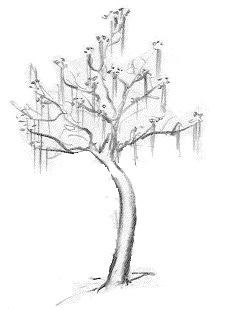
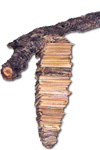
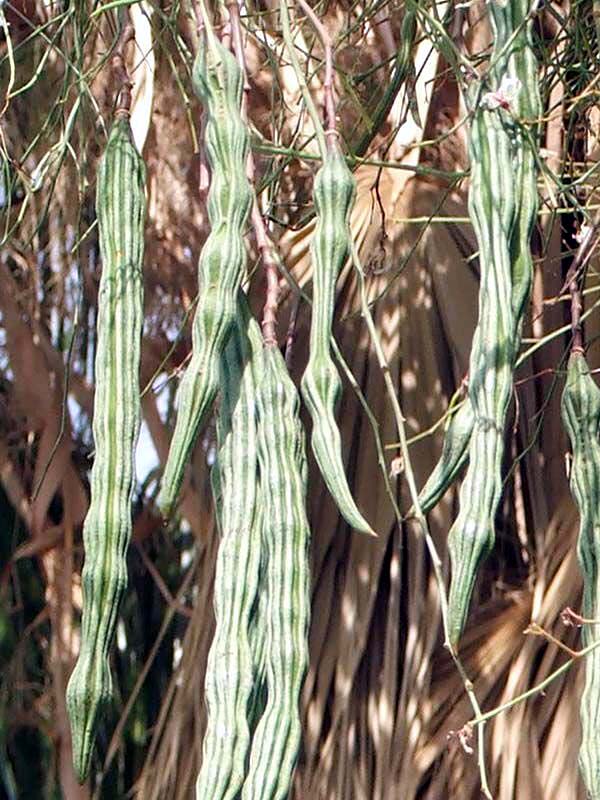
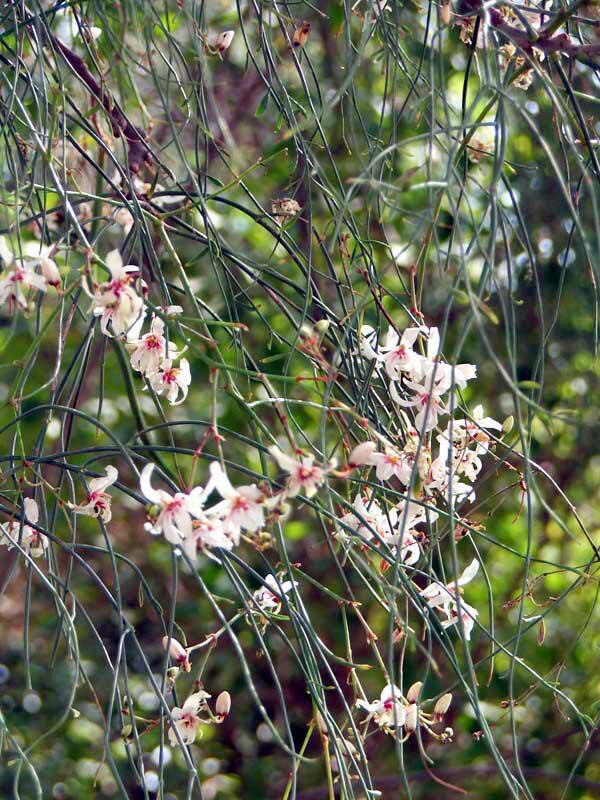
| Shrub or small tree up to 10 m tall, with tuberous rootstock; bole up to 40 cm in diameter; bark grey, purple-grey or bright brown; crown ovoid; branches terete, slender, young stems grey-white or waxy blue-green; twigs brittle. Leaves alternate, in bunches at the ends of branches, 15–40 cm long, 2–pinnate, with 2–5 pairs of pinnae; leaflets opposite or alternate, obovate, oblanceolate or spatulate, 3–20(–35) mm × 2–10(–13) mm, base cuneate to rounded, apex rounded or notched, grey or waxy green. Inflorescence an axillary, lax, much-branched panicle 18–30 cm long. Flowers bisexual, slightly zygomorphic, 5-merous, white with purple heart or pink-flushed, sometimes scented; pedicel 2–9 mm long, jointed; sepals free, oblong to lanceolate, 7–9 mm × 1.5–3 mm, acuminate, hairy on both surfaces; petals free, narrowly oblong, obovate or spatulate, 8–15 mm × 2–5 mm, hairy inside; stamens 5, free, 4.5–7 mm long, alternating with 5 staminodes, 4–5 mm long; ovary superior, shortly stalked, cylindrical, hairy, 1-celled, style slender. Fruit an elongate capsule (10–)32–39 cm × (1–)1.5–1.7 cm, somewhat trigonous, slightly narrowed between the seeds, with a beak, glabrous, dehiscent with 3 valves. Seeds globose to ovoid or trigonous, 10–12 mm × 10–12 mm, brown. | |||
| show more data (2) | comments (0) |
| Moringa is the only genus of the Moringaceae, a family related to Brassicaceae. It comprises 13 species, of which 8 are endemic to the Horn of Africa and 2 to Madagascar. | |||
| show more data (0) | comments (0) |
| Young seedlings have broad leaflets and form a large tuber. Through many dry seasons, the shoot dies back to the tuber to below ground-level. As the plant gets older the stem becomes permanent and the leaves get progressively longer, while the leaflets get smaller and more widely spaced. Adult trees produce leaves with a full complement of tiny leaflets, only to drop them as the leaf matures. However, the naked leaf axes remain, giving the tree a wispy look similar to Tamarix spp. | |||
| show more data (1) | comments (0) |
| Moringa peregrina grows on rocky slopes of wadis and gullies, up to 850 m altitude in Acacia - Commiphora woodland, sometimes on nearly bare rock with a strongly reduced root system. | |||
| show more data (1) | comments (0) |
| Planting trials of Moringa peregrina have been done in Sudan. Both seeds and cuttings can be used for multiplying it in a nursery. Exposure to full sunlight and high temperatures reduced seedling growth. Transplanting 5-month-old seedlings gave good survival rates. Branches of 1–1.5 m in length have been used as cuttings and these have performed well. Moringa peregrina grows fast from both seeds and cuttings; 3–4 m annual growth in height is not unusual when adequate moisture is available. First fruits are produced about 3 years after planting. | |||
| show more data (2) | comments (0) |
| Pollarding or pruning following harvesting is recommended to promote branching. This increases pod production and facilitates harvesting as the tree is kept at a manageable height. | |||
| show more data (0) | comments (0) |
| Seeds are collected from the wild. | |||
| show more data (0) | comments (0) |
| A single tree may produce up to 1000 pods per year. | |||
| show more data (0) | comments (0) |
| Traditional methods to extract the oil used by Bedouin are very simple, but yield little oil. Seeds are crushed, water is added and the seeds are boiled. The mixture is left overnight to allow the oil to float to the surface, from where it is skimmed off. In a more advanced method the seeds are crushed, some water is added and the mixture is gently heated for 10–15 minutes. The oil is then extracted using a screw press or hydraulic press. For water purification, seeds are ground to a paste. The paste is put in a bottle and water is added. The mixture is shaken for 5 minutes to activate the protein. The mixture is then sieved and the solution is added to turbid water. After slowly stirring for 20 minutes, fine particles including bacteria coagulate, sink and settle on the bottom. After one hour clear water can be drawn off. | |||
| show more data (0) | comments (0) |
| Although there is concern about the decline of Moringa peregrina stands especially where it is collected for firewood, it is not listed in the IUCN Red List 2006. It is endangered in the Sinai in Egypt. Efforts to restore the local vegetation by restoring the stand of the dominant species, including Acacia tortilis (Forssk.) Hayne, have resulted in an increase in the numbers of trees of Moringa peregrina as well. Moringa peregrina is included in a field genebank of fodder plants in Oman. | |||
| show more data (0) | comments (0) |
| Protection of Moringa peregrina and its vulnerable habitat is needed. Continued use of the seed for oil production and water clarification requires its domestication and cultivation. Initial results of experiments to achieve this are promising. | |||
| show more data (0) | comments (0) |
| • Jahn, S.A.A., 1986. Cultivation of Moringa trees. Schriftenreihe der Deutsche Gesellschaft für Technische Zusammenarbeit 191: 233–298. • Jahn, S.A.A., 1986. Water treatment with traditional plant coagulants and clarifying clays. Schriftenreihe der Deutsche Gesellschaft für Technische Zusammenarbeit 191: 67–157. • Jahn, S.A.A., Musnad, H.A. & Burgstaller, H., 1986. The tree that purifies water: cultivating multipurpose Moringaceae in the Sudan. Unasylva 152: 23–28. • Keraudren, M., 1965. Le genre Moringa en Afrique et à Madagascar (affinités systématiques, intérêt biogéographique). Webbia 19: 815–824. • Moustafa, A.E.A., El-Wahab, R.H.A., Helmy, M.A. & Batanouny, K.H., 1998. Phenology, germination and propagation of some wild trees and shrubs in south Sinai, Egypt. Egyptian Journal of Botany 36: 91–107. • Olson, M.E., 2002. Combining data from DNA sequences and morphology for a phylogeny of Moringaceae (Brassicales). Systematic Botany 27(1): 55–73. • Somali, M.A., Bajneid, M.A. & Al-Fhaimani, S.S., 1984. Chemical composition and characteristics of Moringa peregrina seeds and seeds oil. Journal of the American Oil Chemists’ Society 61: 85–86. • Thulin, M., 1993. Moringaceae. In: Thulin, M. (Editor). Flora of Somalia. Volume 1. Pteridophyta; Gymnospermae; Angiospermae (Annonaceae-Fabaceae). Royal Botanic Gardens, Kew, Richmond, United Kingdom. pp. 60–62. • Tsakis, J., 1998. Characterization of Moringa peregrina Saudi Arabia seed oil. Grasas y Aceites (Seville) 49(2): 170–176. • Verdcourt, B., 2000. Moringaceae. In: Edwards, S., Mesfin Tadesse, Demissew Sebsebe & Hedberg, I. (Editors). Flora of Ethiopia and Eritrea. Volume 2, part 1. Magnoliaceae to Flacourtiaceae. The National Herbarium, Addis Ababa University, Addis Ababa, Ethiopia and Department of Systematic Botany, Uppsala University, Uppsala, Sweden. pp. 155–162. | |||
| show more data (10) | comments (0) |
| • Batanouny, K.H., 1999. Wild medicinal plants in Egypt: an inventory to support conservation and sustainable use. [Internet] Palm Press, Cairo, Egypt. 207 pp. http://www.iucn.org/ places/medoffice/nabp/web/documents/book/ chapter3.pdf. Accessed October 2006. • Fahn, A., Werker, E. & Baas, P., 1986. Wood anatomy and identification of trees and shrubs from Israel and adjacent regions. The Israel Academy of Sciences and Humanities, Jerusalem, Israel. • Ibrahim, S.S., Ismail, M., Samuel, G., Kamel, E. & El Azhari, T., 1974. Benseeds: a potential oil source. Egyptian Journal of Agricultural Research 52(9): 47–50. • Olson, M.E., 1999. The home page of the plant family Moringaceae. [Internet] http://www.mobot.org/ gradstudents/olson/ moringahome.html. Accessed September 2006. • Olson, M.E., 2003. Ontogenetic origins of floral bilateral symmetry in Moringaceae (Brassicales). American Journal of Botany 890(1): 49–71. • Olson, M.E. & Carlquist, S., 2001. Stem and root anatomical correlations with life form diversity, ecology and systematics in Moringa (Moringaceae). Botanical Journal of the Linnean Society 135: 315–348. • Verdcourt, B., 1965. A synopsis of the Moringaceae. Kew Bulletin 40: 1–23. | |||
| show more data (8) | comments (0) |
| • Zohary, M., 1966. Flora Palaestina. Part 1: Equisetaceae to Moringaceae. Plates. The Israel Academy of Sciences and Humanities, Jerusalem, Israel. 495 plates. | |||
| show more data (0) | comments (0) |
| |||||||
| |||||||
| |||||||
| |||||
| Munyanziza, E. & Yongabi, K.A., 2007. Moringa peregrina (Forssk.) Fiori. [Internet] Record from PROTA4U. van der Vossen, H.A.M. & Mkamilo, G.S. (Editors). PROTA (Plant Resources of Tropical Africa / Ressources végétales de l’Afrique tropicale), Wageningen, Netherlands. <http://www.prota4u.org/search.asp>. Accessed . | |||
| There are 4 study abstracts related to Moringa peregrina (Forssk.) Fiori. Click on "show more" to view them. | ||
| show more data | comments (0) |
| There are 200 book citations related to Moringa peregrina (Forssk.) Fiori. Click on "show more" to view them. | ||
| show more data | comments (0) |
| There are 200 citation in web searches related to Moringa peregrina (Forssk.) Fiori. Click on "show more" to view them. | ||
| show more data | comments (0) |
| There are 136 citation in scholarly articles related to Moringa peregrina (Forssk.) Fiori. Click on "show more" to view them. | ||
| show more data | comments (0) |
| There are 2 news article citations related to Moringa peregrina (Forssk.) Fiori. Click on "show more" to view them. | ||
| show more data | comments (0) |
| There are 3 citations in Afrirefs related to Moringa peregrina (Forssk.) Fiori. Click on "show more" to view them. | ||
| show more data | comments (0) |
| General importance |  |
| Geographic coverage Africa |  |
| Geographic coverage World | |
| Ornamental use | |
| Forage/feed use | |
| Carbohydrate/starch use | |
| Fuel use | |
| Medicinal use | |
| Essential oil and exudate use | |
| Vegetable oil use | |
| Climate change | |
| Food security | |
| Conservation status | |



 Comments (