Record display
 PROTA4U Homepage
| Select translation pop-up: |
|
|
PROTA4U Record display |
PROTA4U Homepage
|
| Linnaea 23: 74 (1850). | |||
| show more data (3) | comments (0) |
| Sapotaceae | |||
| show more data (9) | comments (0) |
| show more data (8) | comments (0) |
| Transvaal red milkwood, common red milkwood, moepel (En). Mgamba kapu (Sw). | |||
| show more data (4) | comments (0) |
| Mimusops zeyheri occurs from Tanzania and Angola to Botswana, Zimbabwe, Mozambique, north-eastern South Africa and Swaziland. | |||
| show more data (15) | comments (0) |
| The wood is useful as general-purpose timber. It is used for furniture, and is also suitable for general carpentry. The fruit is edible; the yellow fruit flesh is pleasantly sweet and floury. It is eaten fresh and can be stored after sun drying. It can be used in jams and jellies, and the juice is fermented to produce an alcoholic drink. Branches are used as fire-sticks in traditional fire-making by friction. In Swaziland a root infusion is taken to treat candidiasis, and a bark decoction to treat wounds and ulcers. In Zimbabwe the tree is maintained in fields because it is considered to improve soil fertility. Mimusops zeyheri is planted as an ornamental, and plants are sometimes sold as pot plants, e.g. in the United States. | |||
| show more data (7) | comments (0) |
| The heartwood is creamy brown to reddish brown, fairly heavy and hard, and fine-grained. It is moderately durable. It works well, but fresh sawdust may cause sneezing. The content of ascorbic acid (vitamin C) in the fruit is reportedly fairly high, about 90 mg per 100 g. The fruit has a comparatively low energy value and low content of protein, fat and carbohydrate, but contains per 100 g Ca 27 mg, P 13 mg and Fe 24 mg. | |||
| show more data (2) | comments (0) |
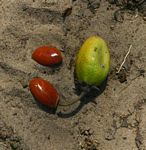
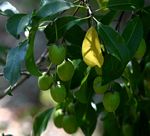
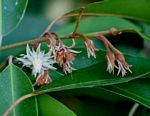
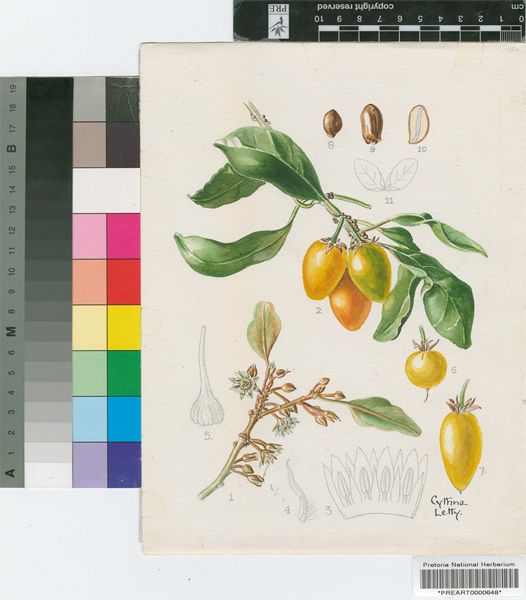
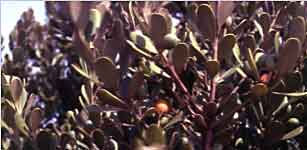
| Shrub or small to medium-sized tree up to 25 m tall, containing latex; bark almost smooth to roughly reticulately fissured, grey to dark brown or black; crown dense, rounded; young branches densely red-brown pubescent. Leaves arranged spirally, more or less in tufts at the ends of branches, simple and entire; stipules absent; petiole 0.5–3.5 cm long; blade oblong-elliptical to obovate-elliptical or lanceolate, 3.5–11.5 cm × 1.5–5.5 cm, cuneate at base, usually shortly acuminate at apex but sometimes rounded or slightly notched, leathery, initially reddish brown pubescent below but glabrescent, with many lateral veins. Flowers in fascicles of up to 7 in the leaf axils, bisexual, regular; pedicel 1–3 cm long, curved; sepals in 2 whorls of 4; corolla creamy-white, with a short tube and 8 lobes each with 2 appendages, up to 10 mm long; stamens 8, alternating with 8 hairy staminodes; ovary superior, 8-celled. Fruit an ellipsoid to ovoid or almost globose berry up to 4.5 cm long, yellow-orange when ripe, 1–2-seeded. Seeds ellipsoid, 1–2 cm long, shiny pale brown, with small circular basal scar. Mimusops zeyheri closely resembles Mimusops obtusifolia Lam. (synonym: Mimusops fruticosa A.DC.), which occurs in eastern Kenya, Tanzania, Malawi, Zimbabwe and Mozambique. In Kenya and Tanzania the wood of the latter species is used for poles, tool handles, carving, boats and dugout canoes, which have a service life of up to 8 years, whereas the sweet fruits are commonly eaten throughout the distribution area of the species. In Tanzania the roots are used to treat constipation, hernia and venereal diseases. Mimusops obtusifolia differs from Mimusops zeyheri in its leaves rounded at apex and glabrous or sparsely pubescent below, and slightly smaller fruits. Mimusops zeyheri trees grow slowly and are long-lived. In Zambia they have ripe fruits between March and June, and flower buds develop at the end of the rainy season. | |||
| show more data (0) | comments (0) |
| show more data (5) | comments (0) |
| show more data (4) | comments (0) |
| show more data (2) | comments (0) |
| Mimusops zeyheri is characteristic for riparian woodland, where it is even found on sandy, infertile alluvial soils, and termite mounds, but is occasionally also found in swamp forest, thickets and rocky hill slopes. | |||
| show more data (5) | comments (0) |
| show more data (3) | comments (0) |
| The seeds are orthodox; they maintain 60% viability after one month when the moisture content is reduced to 15% and when they are stored at –20°C. They should be scarified and subsequently immersed in water during 24 hours before sowing. | |||
| show more data (0) | comments (0) |
| Mimusops zeyheri as well as Mimusops obtusifolia are widespread in various habitats and not in danger of genetic erosion. | |||
| show more data (0) | comments (0) |
| Mimusops zeyheri and some other Mimusops species have some importance for the production of general-purpose timber and as a supplier of supplementary food in the often monotonous diet of people in southern Africa. These multipurpose trees deserve more attention in research. However, the potential for domestication is limited because of the slow growth. Mimusops zeyheri is considered by FAO as potentially important as multipurpose tree, for which breeding programmes should be developed. | |||
| show more data (0) | comments (0) |
| • Coates Palgrave, K., 1983. Trees of southern Africa. 2nd Edition. Struik Publishers, Cape Town, South Africa. 959 pp. • du Preez, R.J. & Welgemoed, C.P., 1993. Transvaal red-milkwood / moepel. Inligtingsbulletin Instituut vir Tropiese en Subtropiese Gewasse 255: 9–10. • Kupicha, F.K., 1983. Sapotaceae. In: Launert, E. (Editor). Flora Zambesiaca. Volume 7, part 1. Flora Zambesiaca Managing Committee, London, United Kingdom. pp. 210–247. • van Wyk, B.E. & Gericke, N., 2000. People’s plants: a guide to useful plants of southern Africa. Briza Publications, Pretoria, South Africa. 351 pp. | |||
| show more data (8) | comments (0) |
| • Amusan, O.O.G., Dlamini, P.S., Msonthi, J.D. & Makhubu, L.P., 2002. Some herbal remedies from Manzini region of Swaziland. Journal of Ethnopharmacology 79: 109–112. • Beentje, H.J., 1994. Kenya trees, shrubs and lianas. National Museums of Kenya, Nairobi, Kenya. 722 pp. • Hemsley, J.H., 1968. Sapotaceae. In: Milne-Redhead, E. & Polhill, R.M. (Editors). Flora of Tropical East Africa. Crown Agents for Oversea Governments and Administrations, London, United Kingdom. 79 pp. • Kamuhabwa, A., Nshimo, C. & de Witte, P., 2000. Cytotoxicity of some medicinal plant extracts used in Tanzanian traditional medicine. Journal of Ethnopharmacology 70: 143–149. • Meeuse, A.D.J., 1963. Sapotaceae. In: Dyer, R.A. & Codd, L.E. (Editors). Flora of southern Africa. Volume 26. Botanical Research Institute, Department of Agricultural Technical Services, Pretoria, South Africa. pp. 31–53. • Ruffo, C.K., Birnie, A. & Tengnäs, B., 2002. Edible wild plants of Tanzania. Technical Handbook No 27. Regional Land Management Unit/ SIDA, Nairobi, Kenya. 766 pp. | |||
| show more data (1) | comments (0) |
| show more data (1) | comments (0) |
| |||||
| |||||||||
| |||||||||
| |||||
| Lemmens, R.H.M.J., 2005. Mimusops zeyheri Sond. [Internet] Record from PROTA4U. Louppe, D., Oteng-Amoako, A.A. & Brink, M. (Editors). PROTA (Plant Resources of Tropical Africa / Ressources végétales de l’Afrique tropicale), Wageningen, Netherlands. <http://www.prota4u.org/search.asp>. Accessed . | |||
| There are 94 book citations related to Mimusops zeyheri Sond.. Click on "show more" to view them. | ||
| show more data | comments (0) |
| There are 100 citation in web searches related to Mimusops zeyheri Sond.. Click on "show more" to view them. | ||
| show more data | comments (0) |
| There are 41 citation in scholarly articles related to Mimusops zeyheri Sond.. Click on "show more" to view them. | ||
| show more data | comments (0) |
| There are 11 citations in Afrirefs related to Mimusops zeyheri Sond.. Click on "show more" to view them. | ||
| show more data | comments (0) |
| There are 8 Wikipedia citations related to Mimusops zeyheri Sond.. Click on "show more" to view them. | ||
| show more data | comments (0) |
| General importance |  |
| Geographic coverage Africa | |
| Geographic coverage World |  |
| Ornamental use | |
| Fruit use | |
| Timber use | |
| Medicinal use | |
| Food security | |



 Comments (




_ripe_fruit_in_Kolkata_W_IMG_2833.jpg/111px-Maulsari_(Mimusops_elengi)_ripe_fruit_in_Kolkata_W_IMG_2833.jpg)
_trees_in_Kolkata_W_IMG_2848.jpg/102px-Maulsari_(Mimusops_elengi)_trees_in_Kolkata_W_IMG_2848.jpg)
_green_fruit_in_Kolkata_W_IMG_2831.jpg/96px-Maulsari_(Mimusops_elengi)_green_fruit_in_Kolkata_W_IMG_2831.jpg)