Record display
 PROTA4U Homepage
| Select translation pop-up: |
|
|
PROTA4U Record display |
PROTA4U Homepage
|
| Forest fl. Cape: 314, t. 139 (1907). | |||
| show more data (5) | comments (0) |
| Euphorbiaceae | |||
| show more data (14) | comments (0) |
| Macaranga kilimandscharica Pax (1895), Macaranga neomildbraediana Lebrun (1934). | |||
| show more data (15) | comments (0) |
| River macaranga, spiny macaranga, swamp poplar, wild poplar (En). Mkalanga, mlanga-makelele, mbawa (Sw). | |||
| show more data (3) | comments (0) |
| Macaranga capensis is distributed from Sudan and Ethiopia south to Zimbabwe, Mozambique and South Africa. | |||
| show more data (24) | comments (0) |
| The wood is used for light construction, planks, low-grade furniture, knife sheaths, boxes, crates, beehives, xylophones, water pots and stools, and as firewood. Macaranga capensis is planted for shade in coffee plantations and for soil conservation. In Burundi the leaves are consumed as vegetable. A decoction of the leaves is used as medicine for stomach-ache. A decoction of boiled roots is used for treating coughs and colds, and a root extract to cure bilharzia. Leaves are used to treat allergies. In north-western Ethiopia a ground piece of fresh root is put in local beer, and a cup is drunk to cure male infertility. In Zimbabwe powdered roots are used as an aphrodisiac. The flowers are scented and attract honey-bees. | |||
| show more data (6) | comments (0) |
| The timber of Macaranga capensis is traded under the names ‘muhaa’, ‘mukuhakula’, ‘muhoti’ and ‘omuburashasha’. No trade statistics are available. | |||
| show more data (0) | comments (0) |
| The heartwood is pink to greyish, with dark brown stripes, and distinctly demarcated from the white, narrow sapwood. The grain is usually straight, texture medium. The wood is lightweight, with a density of 360–500 kg/m³ at 12% moisture content. It is liable to splitting during air drying. The rates of shrinkage are quite low, from green to oven dry about 2.3% radial and 6.0% tangential. At 12% moisture content, the modulus of rupture is 67 N/mm², compression parallel to grain 41 N/mm², Janka side hardness 3115 N and Janka end hardness 3780 N. The wood is fairly easy to saw and work. It holds nails and screws well. It is easy to glue, but unsuitable for peeling except for core-stock. The wood is not durable, less than 1 year in contact with the soil. It is liable to attacks by blue stain fungi and susceptible to termite, dry-wood borer and marine borer attacks. It is easy to impregnate with preservatives. An acetone extract of the leaves showed pronounced antibacterial activity with a MIC value of 0.03 mg/ml. | |||
| show more data (0) | comments (0) |
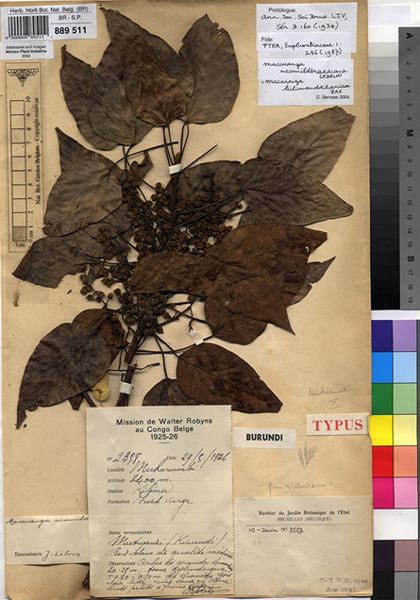
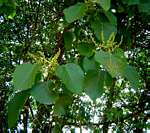
| Dioecious small to medium-sized tree up to 30 m tall; bole branchless for up to 12 m, usually straight, up to 60(–100) cm in diameter, often fluted near base, sometimes with buttresses; bark surface smooth, pale grey to pale brown, often with horizontal markings; crown spreading, somewhat flattened; young twigs densely rusty-brown hairy, later becoming glabrous. Leaves alternate, simple and usually entire; stipules lanceolate, 1–2 cm long; petiole (2–)10–20(–30) cm long, whitish hairy; blade peltate or not, broadly ovate to triangular ovate, (6–)10–30(–40) cm × (4–)10–20(–30) cm, rounded to shallowly cordate at base, short-acuminate at apex, papery to thinly leathery, with 2 basal glands, glabrous or hairy below, pinnately veined with 7–11 pairs of lateral veins. Inflorescence an axillary panicle, short-hairy; male inflorescence 8–10(–14) cm long, with axes zigzag toward the apex, 20–30-flowered; female inflorescence (2.5–)5–12 cm long, with straight axes, 3–5-flowered. Flowers unisexual, regular, 2–3(–4)-merous, without petals; male flowers subsessile, calyx lobes ovate, c. 0.5 mm long, greenish cream, stamens free, c. 1 mm long; female flowers with short pedicel, calyx splitting in c. 0.5 mm long lobes, greenish, ovary superior, nearly globose, 1–1.5 mm long, usually 1-celled, style short. Fruit a nearly globose capsule 3–6 mm in diameter, glandular but becoming smooth, yellowish green, dehiscent with 2 valves, usually 1-seeded. Seed nearly globose, 2.5–3 mm in diameter, with fleshy dark reddish or purplish seed coat. | |||
| show more data (7) | comments (0) |
| Macaranga comprises about 280 species, with approximately 40 species in tropical Africa. Macaranga conglomerata Brenan is a medium-sized tree up to 30 m tall and is closely related to Macaranga capensis, but can be distinguished by the long-stalked inflorescence. It is restricted to the higher altitudes of the Taita Hills in Kenya and Lushoto District in north-eastern Tanzania. The wood, with a density of 415–480 kg/m³ at 12% moisture content, has similar uses as that of Macaranga capensis, also as firewood and shade tree. Macaranga vermoesenii De Wild. is a medium-sized tree with a bole up to 50 cm in diameter, known from Congo and DR Congo. In eastern DR Congo its wood is used for house posts and as firewood. In Madagascar about 10 species of Macaranga are recognized. A number of them share the vernacular name ‘mokorana’ referring to the whitish and lightweight wood that is in demand for making dug-out canoes and paddles. Macaranga alnifolia Baker, Macaranga ferruginea Baker, Macaranga oblongifolia Baill. and Macaranga obovata Boivin ex Baill. are all commonly used for canoes. Impregnation with preservatives is recommended when the wood is used for construction because it perishable. Without distinction the crushed leaves of all these Madagascan species are used medicinally. They are administered to cure colds and cough in children. From the fruits of Macaranga alnifolia pharmacologically interesting stilbenes and flavonoids with cell division inhibiting properties have been isolated. | |||
| show more data (5) | comments (0) |
| Wood-anatomical description (IAWA hardwood codes): Growth rings: 2: growth ring boundaries indistinct or absent. Vessels: 5: wood diffuse-porous; 13: simple perforation plates; 22: intervessel pits alternate; (23: shape of alternate pits polygonal); 27: intervessel pits large (≥ 10 μm); (30: vessel-ray pits with distinct borders; similar to intervessel pits in size and shape throughout the ray cell); 31: vessel-ray pits with much reduced borders to apparently simple: pits rounded or angular; (32: vessel-ray pits with much reduced borders to apparently simple: pits horizontal (scalariform, gash-like) to vertical (palisade)); 42: mean tangential diameter of vessel lumina 100–200 μm; 46: ≤ 5 vessels per square millimetre; 47: 5–20 vessels per square millimetre. Tracheids and fibres: 61: fibres with simple to minutely bordered pits; 66: non-septate fibres present; 68: fibres very thin-walled; (69: fibres thin- to thick-walled). Axial parenchyma: 76: axial parenchyma diffuse; 78: axial parenchyma scanty paratracheal; (79: axial parenchyma vasicentric); 93: eight (5–8) cells per parenchyma strand; 94: over eight cells per parenchyma strand. Rays: 97: ray width 1–3 cells; (102: ray height > 1 mm); 107: body ray cells procumbent with mostly 2–4 rows of upright and/or square marginal cells; 108: body ray cells procumbent with over 4 rows of upright and/or square marginal cells; (109: rays with procumbent, square and upright cells mixed throughout the ray); 113: disjunctive ray parenchyma cell walls present; 116: ≥ 12 rays per mm. Mineral inclusions: 144: druses present; 145: druses in ray parenchyma cells; 148: druses in chambered cells. (P. Mugabi, P.E. Gasson & E.A. Wheeler) | |||
| show more data (0) | comments (0) |
| Macaranga capensis is fast-growing, light demanding and fire-resistant. It behaves as a pioneer and becomes established after disturbance. On well-drained and rich soils in localities with more than 1500 mm annual rainfall, it produces fair amounts of firewood after 3–4 years. In Rwanda the seeds of Macaranga capensis can contribute 30–35% to the total food intake for 2 monkey species (Cercopithecus spp.) in certain periods of the year. The dry fruits remain on the plant and are avoided as long as sufficient fresh, succulent fruits of more preferred species are available. Macaranga plants produce threadlike wax crystals on the stems, which make the stems slippery and impassable for insects except species of ants known as ‘wax runners’. | |||
| show more data (1) | comments (0) |
| Macaranga capensis is common in sub-montane and montane mixed evergreen forest, forest patches in grassland, regenerating forest and forest margins, up to 3000 m altitude, and at lower altitudes in riverine forest. In Kenya it is locally dominant in mountain forest, associated with Ocotea usambarensis Engl., Juniperus and Podocarpus spp., but it can also be found in the rainforest in the coastal belt above 300 m altitude. | |||
| show more data (16) | comments (0) |
| In Uganda it has been recorded that Macaranga capensis regenerates profusely in secondary forest, forest gaps and edges. The seeds are usually collected from the ground and sown without any pre-treatment in the nursery or directly into the field. | |||
| show more data (2) | comments (0) |
| show more data (1) | comments (0) |
| It is recommended to treat logs with preservatives soon after felling to avoid losses by blue stain attack. | |||
| show more data (0) | comments (0) |
| Macaranga capensis is quite widespread and occurs in disturbed habitats. It is consequently not in danger of genetic erosion. Systematic germplasm collection or preservation programmes do not seem to exist. | |||
| show more data (0) | comments (0) |
| No breeding work has been undertaken yet. The most important selection criteria would be long and straight boles for timber production. | |||
| show more data (0) | comments (0) |
| The multiple uses and the fast growth of Macaranga capensis and other Macaranga species make them interesting for more intensive local utilization, especially in higher-altitude agroforestry systems, e.g. as shade trees in coffee plantations. Suitable management systems should be developed to optimize production. | |||
| show more data (0) | comments (0) |
| • Bolza, E. & Keating, W.G., 1972. African timbers: the properties, uses and characteristics of 700 species. Division of Building Research, CSIRO, Melbourne, Australia. 710 pp. • Bryce, J.M., 1966. The strength properties of Tanzania timbers. Technical Note No 35. Tanzania Forest Division, Utilisation Section, Moshi, Tanzania. 17 pp. • Chikamai, B.N., Githiomi, J.K., Gachathi, F.N. & Njenga, M.G., undated. Commercial timber resources of Kenya. Kenya Forestry Research Institute (KEFRI), Nairobi, Kenya. 164 pp. • Coates Palgrave, K., 1983. Trees of southern Africa. 2nd Edition. Struik Publishers, Cape Town, South Africa. 959 pp. • Dale, I.R. & Greenway, P.J., 1961. Kenya trees and shrubs. Buchanan’s Kenya Estates Limited, Nairobi, Kenya. 654 pp. • Gilbert, M.G., 1995. Euphorbiaceae. In: Edwards, S., Mesfin Tadesse & Hedberg, I. (Editors). Flora of Ethiopia and Eritrea. Volume 2, part 2. Canellaceae to Euphorbiaceae. The National Herbarium, Addis Ababa University, Addis Ababa, Ethiopia and Department of Systematic Botany, Uppsala University, Uppsala, Sweden. pp. 265–380. • Lovett, J.C., Ruffo, C.K., Gereau, R.E. & Taplin, J.R.D., 2007. Field Guide to the moist forest trees of Tanzania. Frontier Publishing, United Kingdom. 303 pp. • Palmer, E. & Pitman, N., 1972–1974. Trees of southern Africa, covering all known indigenous species in the Republic of South Africa, South-West Africa, Botswana, Lesotho and Swaziland. 3 volumes. Balkema, Cape Town, South Africa. 2235 pp. • Schatz, G.E., 2001. Generic tree flora of Madagascar. Royal Botanic Gardens, Kew, Richmond, United Kingdom. 477 pp. • Takahashi, A., 1978. Compilation of data on the mechanical properties of foreign woods (part 3) Africa. Shimane University, Matsue, Japan, 248 pp. | |||
| show more data (9) | comments (0) |
| • Beaujard, P., 1988. Plantes et médecine traditionnelle dans le Sud-Est de Madagascar. Journal of Ethnopharmacology 23(2–3): 165–265. • Boiteau, P., Boiteau, M. & Allorge-Boiteau, L., 1999. Dictionnaire des noms malgaches de végétaux. 4 Volumes + Index des noms scientifiques avec leurs équivalents malgaches. Editions Alzieu, Grenoble, France. • Chagnon, M., 1984. Inventaire pharmacologique général des plantes médicinales Rwandaises. Journal of Ethnopharmacology 12: 239–251. • Chigora, P., Masocha, R. & Mutenheri, F., 2007. The role of indigenous medicinal knowledge (IMK) in the treatment of ailments in rural Zimbabwe: the case of Mutirikwi Communal Lands. Journal of Sustainable Development in Africa 9(2): 26–43. • Cos, P., Hermans, N., de Bruyne, T., Apers, S., Sindambiwe, J.B., Vanden Berghe, D.A., Pieters, L. & Vlietinck, A.J., 2002. Further evaluation of Rwandan medicinal plant extracts for their antimicrobial and antiviral activities. Journal of Ethnopharmacology 79: 155–163. • Grace, O.M., Prendergast, H.D.V., Jäger, A.K. & van Staden, J., 2002. Bark medicines in traditional healthcare in KwaZulu-Natal, South Africa: an inventory. South African Journal of Botany 69(3): 301–363. • Hamill, F.A., Apio, S., Mubiru, N.K., Mosango, M., Bukenya-Ziraba, R., Maganyi, O.W. & Soejarto, D.D., 2000. Traditional herbal drugs of southern Uganda, 1. Journal of Ethnopharmacology 70: 281–300. • Kaikabo, A.A., Suleiman, M.M., Samuel, B.B. & Eloff, J.N., 2008. Antibacterial activity of eleven south African plants used in treatment of diarrhoea in folkloric medicine. [Internet] African Journal of Traditional, Complementary and Alternative medicines: Abstracts of the world congress on medicinal and aromatic plants, Cape Town, South Africa. http://journals.sfu.ca/ africanem/index.php/ajtcam/ article/view/631/0. Accessed October 2011. • Kaplin, B.A., 2001. Ranging behavior of two species of guenons (Cercopithecus lhoesti and C. mitis doggetti) in the Nyungwe Forest Reserve, Rwanda. International Journal of Primatology 22(4): 521–548. • Kaplin, B.A. & Moermond, T.C., 1998. Variation in seed handling by two species of forest monkeys in Rwanda. American Journal of Primatology 45: 83–101. • McPherson, G., 1996. A new species of Macaranga (Euphorbiaceae) from Madagascar. Bulletin du Muséum National d’Histoire Naturelle, Paris, séries 4, 10, section. B, Adansonia 18(3–4): 275–278. • Neuwinger, H.D., 2000. African traditional medicine: a dictionary of plant use and applications. Medpharm Scientific, Stuttgart, Germany. 589 pp. • Newmark, W.D., 2001. Conserving biodiversity in East African forests: a study of the eastern arc mountains. Ecological Studies 155. Springer, Berlin, Germany. 197 pp. • Nzigidahera, B., 2000. Analyse de la diversité biologique végétale nationale et identification des priorités pour sa conservation. Institut National pour l’Environnement et la Conservation de la Nature (INECN), Bujumbura, Burundi. 52 pp. • Ragunatha, M. & Mequente, S., 2009. The study of spiritual remedies in orthodox rural churches and traditional medicinal practice in Gondar Zuria district, Northwestern Ethiopia. Pharmacognosy Journal 1(3): 178–183. • Troupin, G., 1983. Euphorbiaceae. In: Troupin, G. (Editor). Flore du Rwanda. Spermatophytes. Volume 2. Agence de Cooperation Culturelle et Technique. Tervuren, Belgium. pp. 189–242. • Vlietinck, A.J., van Hoof, L., Totté, J., Lasure, A., Vanden Berghe, D.A., Rwangabo, P.C. & Mvukiyumwami, J., 1995. Screening of hundred Rwandese medicinal plants for antimicrobial and antiviral properties. Journal of Ethnopharmacology 46: 31–47. • Wilfred, P., Madoffe, S.S. & Luoga, E.J., 2006. Indigenous plant uses and use values in Uluguru Mountains, Morogoro, Tanzania. Journal of East African Natural History 95(2): 235–240. • Yamada, T., 1999. A report of the ethnobotany of the Nyindu in the eastern part of the former Zaire. African Study Monographs 20(1): 1–72. • Yoder, B.J., Cao, S., Norris, A., Miller, J.S., Ratovoson, F., Razafitsalama, J., Andriantsiferana, R., Rasamison, V.E. & Kingston, D.G.I., 2007. Antiproliferative prenylated stilbenes and flavonoids from Macaranga alnifolia from the Madagascar rainforest. Journal of Natural Products 70(3): 342–346. | |||
| show more data (3) | comments (0) |
| show more data (2) | comments (0) |
| • Dale, I.R. & Greenway, P.J., 1961. Kenya trees and shrubs. Buchanan’s Kenya Estates Limited, Nairobi, Kenya. 654 pp. • Palmer, E. & Pitman, N., 1972–1974. Trees of southern Africa, covering all known indigenous species in the Republic of South Africa, South-West Africa, Botswana, Lesotho and Swaziland. 3 volumes. Balkema, Cape Town, South Africa. 2235 pp. | |||
| show more data (0) | comments (0) |
| |||||
| |||||||||
| |||||
| |||||
| Jimu, L., 2012. Macaranga capensis (Baill.) Benth. ex Sim. [Internet] Record from PROTA4U. Lemmens, R.H.M.J., Louppe, D. & Oteng-Amoako, A.A. (Editors). PROTA (Plant Resources of Tropical Africa / Ressources végétales de l’Afrique tropicale), Wageningen, Netherlands. <http://www.prota4u.org/search.asp>. Accessed . | |||
| There are 1 study abstracts related to Macaranga capensis (Baill.) Sim. Click on "show more" to view them. | ||
| show more data | comments (0) |
| There are 167 book citations related to Macaranga capensis (Baill.) Sim. Click on "show more" to view them. | ||
| show more data | comments (0) |
| There are 200 citation in web searches related to Macaranga capensis (Baill.) Sim. Click on "show more" to view them. | ||
| show more data | comments (0) |
| There are 161 citation in scholarly articles related to Macaranga capensis (Baill.) Sim. Click on "show more" to view them. | ||
| show more data | comments (0) |
| There are 1 news article citations related to Macaranga capensis (Baill.) Sim. Click on "show more" to view them. | ||
| show more data | comments (0) |
| There are 14 citations in Afrirefs related to Macaranga capensis (Baill.) Sim. Click on "show more" to view them. | ||
| show more data | comments (0) |
| There are 3 Wikipedia citations related to Macaranga capensis (Baill.) Sim. Click on "show more" to view them. | ||
| show more data | comments (0) |
| General importance |  |
| Geographic coverage Africa | |
| Geographic coverage World |  |
| Timber use | |
| Auxiliary use | |
| Fuel use | |
| Medicinal use | |
| Climate change | |



 Comments (