Record display
 PROTA4U Homepage
| Select translation pop-up: |
|
|
PROTA4U Record display |
PROTA4U Homepage
|
| Fl. Zamb. 2(1): 305 (1963). | |||
| show more data (5) | comments (0) |
| Meliaceae | |||
| show more data (5) | comments (0) |
| Trichilia volkensii Gürke (1894). | |||
| show more data (7) | comments (0) |
| show more data (1) | comments (0) |
| Lepidotrichilia volkensii occurs in mountainous areas in eastern DR Congo, Rwanda, Burundi, Sudan, Ethiopia, Kenya, Uganda, Tanzania, Malawi and Zambia. | |||
| show more data (6) | comments (0) |
| In Ethiopia the wood is used for local construction and as fuelwood. In Tanzania it has the same uses, and is additionally used for spoons and tool handles, and for charcoal production. The fruit is edible and eaten raw in Ethiopia, where the bark is used in fermentation processes. | |||
| show more data (1) | comments (0) |
| The heartwood is whitish and hard, with a fine texture. The sesquiterpenoid voleneol has been isolated from Lepidotrichilia volkensii. | |||
| show more data (0) | comments (0) |
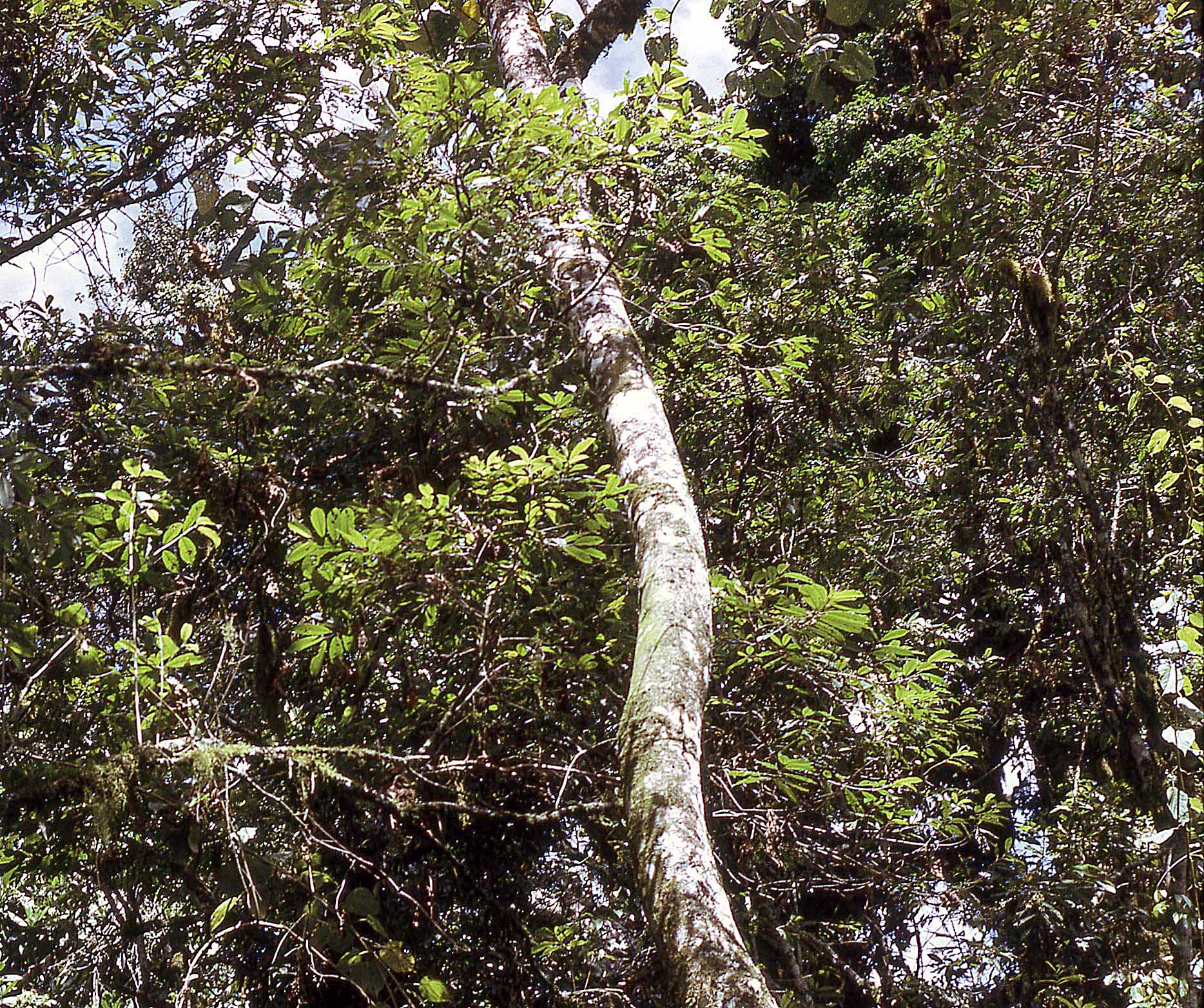
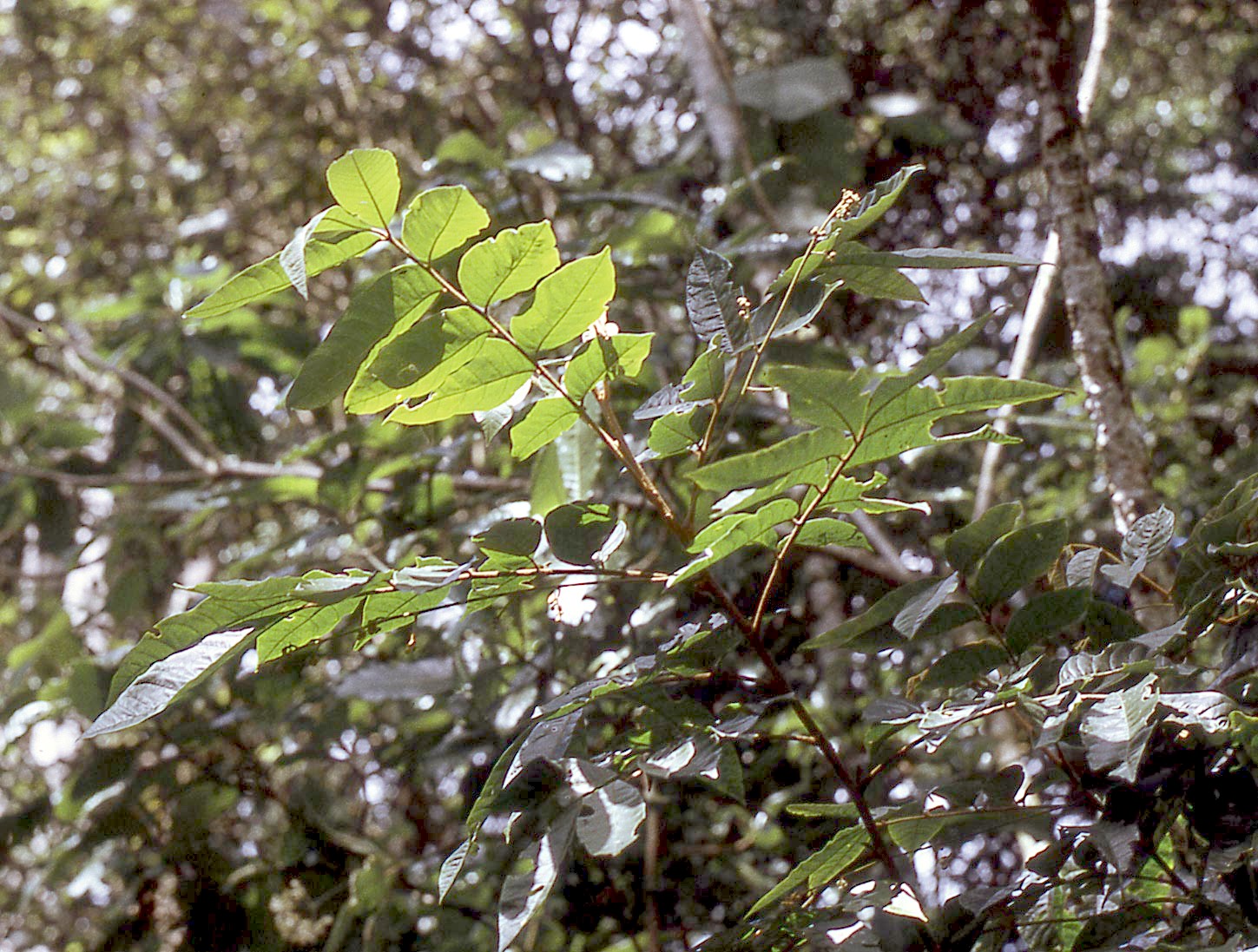
| Evergreen shrub or small to medium-sized tree up to 20(–25) m tall; bole often fluted; bark surface smooth, greyish; inner bark pink to red, sometimes with white lines, scented; crown spreading, strongly branched; young branches densely short-hairy. Leaves alternate, imparipinnately compound with (5–)7–11 leaflets; stipules absent; petiole 2.5–8 cm long, rachis 5–20 cm long; petiolules 2–10 mm long; leaflets opposite or alternate, elliptical to ovate, oblong or lanceolate, 5–20 cm × 2–7.5 cm, cuneate to obtuse and often asymmetrical at base, acute to acuminate at apex, short-hairy below with stellate hairs and minute glandular dots, pinnately veined. Inflorescence an axillary contracted panicle up to 25 cm long, short-hairy with yellowish brown, stellate hairs. Flowers bisexual, regular, 5-merous, creamy white, fragrant; pedicel 1–2.5 mm long; calyx cup-shaped, c. 2 mm long, with minute teeth; petals free, oblong-lanceolate, 4–5 mm long; stamens 3–4 mm long, fused in lower half into a tube, slightly hairy inside; ovary superior, nearly globose, glabrous, 2–4-celled, style 1–2 mm long, stigma head-shaped, surmounted by 2–4 erect stigmatic lobes. Fruit a depressed-globose berry 7–15 mm in diameter, shallowly grooved, densely covered with stellate hairs, (1–)2–3-seeded. Seeds 2–3 mm long, glossy dark brown or black. Lepidotrichilia comprises 4 species, 3 of which are endemic to Madagascar. | |||
| show more data (0) | comments (0) |
| show more data (2) | comments (0) |
| show more data (2) | comments (0) |
| Lepidotrichilia volkensii is restricted to montane forest at (1050–)1500–2400 (–3300) m altitude, where it often occurs in the understorey of moist forest types in association with Podocarpus, Hagenia and Schefflera, but sometimes also in secondary evergreen bushland. The mean annual rainfall range is 1500–2000 mm. | |||
| show more data (2) | comments (0) |
| Lepidotrichilia volkensii can be propagated by seed or by planting out wildlings. Treatment of the seed is not needed, but seeds can only be stored for short periods before they lose their viability. | |||
| show more data (0) | comments (0) |
| Although Lepidotrichilia volkensii is an Afromontane endemic, there are no indications that it suffers from genetic erosion; it is fairly widespread and locally common. | |||
| show more data (0) | comments (0) |
| Because Lepidotrichilia volkensii usually has a small bole size and only occurs in mountainous areas, it is very unlikely that the future importance of its wood will exceed its actual limited usage. | |||
| show more data (0) | comments (0) |
| • Bekele-Tesemma, A., 2007. Useful trees and shrubs for Ethiopia: identification, propagation and management for 17 agroclimatic zones. Technical Manual No 6. RELMA in ICRAF Project, Nairobi, Kenya. 552 pp. • Friis, I., 1992. Forests and forest trees of northeast tropical Africa: their natural habitats and distribution patterns in Ethiopia, Djibouti and Somalia. Kew Bulletin, Additional Series 15, H.M.S.O., London, United Kingdom. 396 pp. • Lovett, J.C., Ruffo, C.K., Gereau, R.E. & Taplin, J.R.D., 2006. Field guide to the moist forest trees of Tanzania. [Internet] Centre for Ecology Law and Policy, Environment Department, University of York, York, United Kingdom. http://www.york.ac.uk/ res/celp/webpages/projects/ecology/ tree%20guide/guide.htm. Accessed November 2007. • Styles, B.T. & White, F., 1991. Meliaceae. In: Polhill, R.M. (Editor). Flora of Tropical East Africa. A.A. Balkema, Rotterdam, Netherlands. 68 pp. | |||
| show more data (0) | comments (0) |
| • Beentje, H.J., 1994. Kenya trees, shrubs and lianas. National Museums of Kenya, Nairobi, Kenya. 722 pp. • Eggeling, W.J. & Dale, I.R., 1951. The indigenous trees of the Uganda Protectorate. Government Printer, Entebbe, Uganda. 491 pp. • Mulholland, D.A., Parel, B. & Coombes, P.H., 2000. The chemistry of the Meliaceae and Ptaeroxylaceae of Southern and Eastern Africa and Madagascar. Current Organic Chemistry 4(10): 1011–1054. • Staner, P. & Gilbert, G., 1958. Meliaceae. In: Robyns, W., Staner, P., Demaret, F., Germain, R., Gilbert, G., Hauman, L., Homès, M., Jurion, F., Lebrun, J., Vanden Abeele, M. & Boutique, R. (Editors). Flore du Congo belge et du Ruanda-Urundi. Spermatophytes. Volume 7. Institut National pour l’Étude Agronomique du Congo belge, Brussels, Belgium. pp. 147–213. • Styles, B.T. & White, F., 1989. Meliaceae. In: Hedberg, I. & Edwards, S. (Editors). Flora of Ethiopia. Volume 3. Pittosporaceae to Araliaceae. The National Herbarium, Addis Ababa University, Addis Ababa, Ethiopia and Department of Systematic Botany, Uppsala University, Uppsala, Sweden. pp. 479–489. • Troupin, G., 1982. Flore des plantes ligneuses du Rwanda. Publication No 21. Institut National de Recherche Scientifique, Butare, Rwanda. 747 pp. • von Breitenbach, F., 1963. The indigenous trees of Ethiopia. 2nd Edition. Ethiopian Forestry Association, Addis Ababa, Ethiopia. 305 pp. • White, F. & Styles, B.T., 1963. Meliaceae. In: Exell, A.W., Fernandes, A. & Wild, H. (Editors). Flora Zambesiaca. Volume 2, part 1. Crown Agents for Oversea Governments and Administrations, London, United Kingdom. pp. 285–319. | |||
| show more data (0) | comments (0) |
| |||||
| |||||||||
| |||||||||
| Lemmens, R.H.M.J., 2008. Lepidotrichilia volkensii (Gürke) J.-F.Leroy. [Internet] Record from PROTA4U. Louppe, D., Oteng-Amoako, A.A. & Brink, M. (Editors). PROTA (Plant Resources of Tropical Africa / Ressources végétales de l’Afrique tropicale), Wageningen, Netherlands. <http://www.prota4u.org/search.asp>. Accessed . | |||
| There are 65 book citations related to Lepidotrichilia volkensii (Gürke) J.-F.Leroy. Click on "show more" to view them. | ||
| show more data | comments (0) |
| There are 92 citation in web searches related to Lepidotrichilia volkensii (Gürke) J.-F.Leroy. Click on "show more" to view them. | ||
| show more data | comments (0) |
| There are 32 citation in scholarly articles related to Lepidotrichilia volkensii (Gürke) J.-F.Leroy. Click on "show more" to view them. | ||
| show more data | comments (0) |
| There are 3 citations in Afrirefs related to Lepidotrichilia volkensii (Gürke) J.-F.Leroy. Click on "show more" to view them. | ||
| show more data | comments (0) |
| General importance |  |
| Geographic coverage Africa | |
| Geographic coverage World |  |
| Fruit use | |
| Timber use | |
| Fuel use | |
| Medicinal use | |
| Spices and condiment use | |
| Food security | |



 Comments (