Record display
 PROTA4U Homepage
| Select translation pop-up: |
|
|
PROTA4U Record display |
PROTA4U Homepage
|
| Bull. Misc. Inform. Kew 1931: 356 (1931). | |||
| show more data (4) | comments (0) |
| Sapindaceae | |||
| show more data (5) | comments (0) |
| Haplocoelum gallaense (Engl.) Radlk. (1916), Haplocoelum mombasense Bullock (1931). | |||
| show more data (13) | comments (0) |
| Galla plum, northern galla plum (En). | |||
| show more data (1) | comments (0) |
| Haplocoelum foliolosum is distributed from Cameroun east to southern Ethiopia and Somalia, and south to Zambia, Angola, Zimbabwe, Mozambique and South Africa. | |||
| show more data (3) | comments (0) |
| The wood of Haplocoelum foliolosum is used in East Africa for construction, furniture and tool handles. The fruit is eaten. The flowers are an important source of nectar for honey bees. In Kenya leaf decoctions are used as eye lotion. The twigs are used as toothbrushes. | |||
| show more data (0) | comments (0) |
| The wood is reddish and very hard. | |||
| show more data (0) | comments (0) |
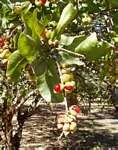
| Deciduous, dioecious shrub or small tree up to 15(–25) m tall; bark smooth, grey; branchlets grey-brown to black, short-hairy. Leaves alternate, paripinnately compound with 2–16 pairs of leaflets; stipules absent; petiole 0.5–1.5 cm long, rachis 2–10 cm long, narrowly winged; petiolules up to 0.5 mm long; leaflets opposite, oblong to elliptical, 1.5–6 cm × 0.5–1 cm, cuneate to obtuse and asymmetrical at base, usually notched at apex, glabrous or sparsely hairy on midrib, pinnately veined with numerous closely spaced lateral veins. Inflorescence an axillary fascicle or cyme. Flowers unisexual, regular, white to yellowish; pedicel 1–3 mm long in male flowers, 5–10 mm in female flowers; sepals 5, oblong, c. 2 mm long, short hairy; petals absent; stamens 4–5, free, filaments 2–5 mm long; ovary superior, ovoid to rounded, 3-celled, style up to 1 mm long, 3-fid; male flowers without ovary, female flowers with rudimentary stamens. Fruit an ovoid to nearly globose capsule 1.5–2 cm × 1–1.5 cm, yellow to red-purple when ripe, indehiscent or irregularly rupturing, 1–2-seeded. Seeds ellipsoid, flattened, 1–1.5 cm × c. 0.5 cm, brown, covered by a thin, fleshy aril. Trees usually flower before new leaves develop. Haplocoelum foliolosum shows a lot of variation. Three subspecies have been distinguished, mainly based on the number of leaflets per leaf, but a large part of the variation seems to be caused by growing conditions. At 1850 m altitude on Mount Mulanje in Malawi, it can be a tree up to 25 m tall, but at lower altitudes it is often a straggling shrub or small tree of only 3–4 m in height. Haplocoelum comprises 4 species on the mainland of tropical Africa. A fifth species endemic to Madagascar was included in the genus as Haplocoelum perrieri Capuron, but it differs from the other species to such an extent that it was transferred to a distinct genus; its name is now Gereaua perrieri (Capuron) Buerki & Callmander. It is a small tree up to 15(–20) m tall suitable for timber; its branches are used for fencing and the seed aril is edible. Haplocoelum inoploeum Radlk. (synonym: Haplocoelum trigonocarpum Radlk.), called ‘mchumbi’ and ‘mfunga tanzu’ in Swahili, is a shrub or small tree up to 15 m tall occurring in coastal East Africa from Somalia to Tanzania. Its hard wood is used to manufacture walking sticks and clubs, and the seed aril is edible. | |||
| show more data (0) | comments (0) |
| show more data (2) | comments (0) |
| Haplocoelum foliolosum is found in grassland, thickets and woodland, including Brachystegia- Isoberlinia woodland, from sea-level up to 1500 m altitude, in Malawi up to 1850 m. | |||
| show more data (2) | comments (0) |
| As Haplocoelum foliolosum is widely distributed and not heavily exploited, no threats are envisaged. | |||
| show more data (0) | comments (0) |
| Haplocoelum foliolosum does not seem to have prospects as a timber tree of commercial importance because it rarely reaches large dimensions. In view of the large variation, it is an interesting subject for combined taxonomic and ecological research. | |||
| show more data (0) | comments (0) |
| • Burkill, H.M., 2000. The useful plants of West Tropical Africa. 2nd Edition. Volume 5, Families S–Z, Addenda. Royal Botanic Gardens, Kew, Richmond, United Kingdom. 686 pp. • Coates Palgrave, K., 1983. Trees of southern Africa. 2nd Edition. Struik Publishers, Cape Town, South Africa. 959 pp. • Davies, F.G. & Verdcourt, B., 1998. Sapindaceae. In: Beentje, H.J. (Editor). Flora of Tropical East Africa. A.A. Balkema, Rotterdam, Netherlands. 108 pp. • Kokwaro, J.O., 1993. Medicinal plants of East Africa. 2nd Edition. Kenya Literature Bureau, Nairobi, Kenya. 401 pp. | |||
| show more data (1) | comments (0) |
| • Beentje, H.J., 1994. Kenya trees, shrubs and lianas. National Museums of Kenya, Nairobi, Kenya. 722 pp. • Buerki, S., Lowry II, P.P., Phillipson, P.B. & Callmander, M.W., 2010. Molecular phylogenetic and morphological evidence supports recognition of Gereaua, a new endemic genus of Sapindaceae from Madagascar. Systematic Botany 35(1): 172–180. • Fouilloy, R. & Hallé, N., 1973. Sapindacées. Flore du Cameroun. Volume 16. Muséum National d’Histoire Naturelle, Paris, France. 202 pp. • Friis, I., Verdcourt, B. & Vollesen, K., 1996. New combinations in African Sapindaceae. Kew Bulletin 51(4): 802. • Friis, I. & Vollesen, K., 1999. Sapindaceae. In: Thulin, M. (Editor). Flora of Somalia. Volume 2. Angiospermae (Tiliaceae-Apiaceae). Royal Botanic Gardens, Kew, Richmond, United Kingdom. p. 239–253. • Hauman, L., 1960. Sapindaceae. In: Robyns, W., Staner, P., Demaret, F., Germain, R., Gilbert, G., Hauman, L., Homès, M., Jurion, F., Lebrun, J., Vanden Abeele, M. & Boutique, R. (Editors). Flore du Congo belge et du Ruanda-Urundi. Spermatophytes. Volume 9. Institut National pour l’Étude Agronomique du Congo belge, Brussels, Belgium. pp. 279–384. • Ichikawa, M., 1987. A preliminary report on the ethnobotany of the Suiei Dorobo in northern Kenya. African Study Monographs, Supplement 7: 1–52. • McGinley, M. (Topic Editor), 2008. South Malawi montane forest-grassland mosaic. [Internet] In: Cleveland, C.J. (Editor). Encyclopedia of Earth. http://www.eoearth.org/ article/South_Malawi_montane_forest-grassland_mosaic. Accessed February 2010. | |||
| show more data (0) | comments (0) |
| |||||
| |||||||||
| |||||
| Bosch, C.H., 2011. Haplocoelum foliolosum (Hiern) Bullock. [Internet] Record from PROTA4U. Lemmens, R.H.M.J., Louppe, D. & Oteng-Amoako, A.A. (Editors). PROTA (Plant Resources of Tropical Africa / Ressources végétales de l’Afrique tropicale), Wageningen, Netherlands. <http://www.prota4u.org/search.asp>. Accessed . | |||
| There are 46 book citations related to Haplocoelum foliolosum (Hiern) Bullock. Click on "show more" to view them. | ||
| show more data | comments (0) |
| There are 105 citation in web searches related to Haplocoelum foliolosum (Hiern) Bullock. Click on "show more" to view them. | ||
| show more data | comments (0) |
| There are 45 citation in scholarly articles related to Haplocoelum foliolosum (Hiern) Bullock. Click on "show more" to view them. | ||
| show more data | comments (0) |
| There are 3 citations in Afrirefs related to Haplocoelum foliolosum (Hiern) Bullock. Click on "show more" to view them. | ||
| show more data | comments (0) |
| General importance |  |
| Geographic coverage Africa |  |
| Geographic coverage World |  |
| Fruit use | |
| Timber use | |
| Carbohydrate/starch use | |
| Medicinal use | |
| Fibre use | |
| Food security | |



 Comments (