Record display
 PROTA4U Homepage
| Select translation pop-up: |
|
|
PROTA4U Record display |
PROTA4U Homepage
|
| Flora 28: 88 (1845). | |||
| show more data (10) | comments (0) |
| Moraceae | |||
| show more data (14) | comments (0) |
| 2n = 26 | |||
| show more data (1) | comments (0) |
| Ficus leprieurii Miq. (1867). | |||
| show more data (21) | comments (0) |
| Bark-cloth fig, Natal fig, common wild fig, strangler fig (En). Figuier de Natal (Fr). Mlumba, mlandege (Sw). | |||
| show more data (8) | comments (0) |
| Ficus natalensis occurs from Senegal eastward to Sudan and southward to DR Congo and Angola, and from Kenya southward to South Africa. | |||
| show more data (33) | comments (0) |
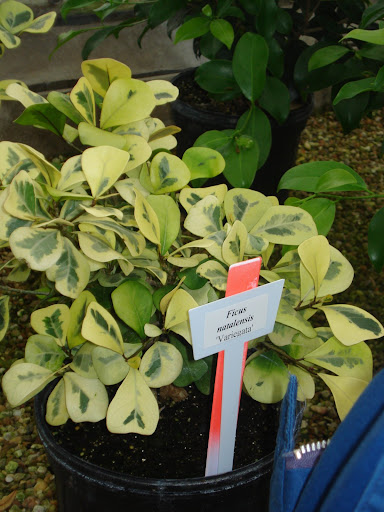
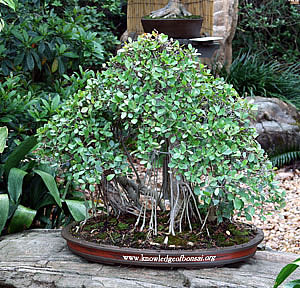
| The bark of Ficus natalensis used to be an important source of bark cloth. In Uganda this cloth adorns cultural sites and shrines, and is used in burying the dead. It is used in ceremonies, but also as bedding material and in handcrafts, and it is sold in curio-shops and local markets. The bark is also made into cordage. The fruit is edible, but of marginal importance; in West Africa it is eaten by children. In Uganda dried and pounded fruits are mixed with cassava flour to make bread. Leaves are given to domestic animals as fodder. The tree is planted in live fences or hedges around homesteads, as an avenue tree, or as a shade tree in coffee, cocoa, and banana plantations. It is also used as landmark. The wood is used to carve household utensils, as house-posts and as firewood. In South Africa the soft wood is used to make ‘fire sticks’. The latex is used as glue and bird-lime. Ficus natalensis is grown as a bonsai plant. In African traditional medicine, all parts of the tree are applied against a variety of ailments. The root has analgesic properties and is used in Senegal for the treatment of lumbago, arthritis and headache. In Uganda the root is applied to the eye for the treatment of cataract. In Tanzania the root enters into antivenom against snake-bites, in Uganda an infusion of the leaves is drunk for this purpose. In eastern Tanzania a root decoction is drunk against malaria, and in southern Africa against colic. A maceration of the bark is drunk regularly during pregnancy to ease childbirth. In Tanzania, the bark is used as a galactagogue and against influenza and whooping cough. Bark or root pulp is rubbed in against headache. The latex is credited with analgesic properties and is used in Senegal against toothache. It also enters into preparations against guinea-worm. In Uganda an infusion of the aerial roots is taken against hiccup. In Uganda sap squeezed from the aerial roots and the leaves is drunk or the aerial roots are chewed to induce labour, while an infusion of the root is drunk against retained placenta. Also in Uganda water in which leaves of Ficus natalensis and other plants are steeped is drunk in large amounts against dysentery. In Sierra Leone the leaves are externally applied to stop internal bleeding. Zulu people in South Africa apply pulped leaves to ulcers, wounds and warts. In Tanzania the leaf sap is also applied against septic ears. In Uganda leaves form part of a treatment of malaria. | |||
| show more data (24) | comments (0) |
| Bark cloth sheets are mainly traded locally, but there are small exports, especially in handicrafts, mostly to Europe. | |||
| show more data (0) | comments (0) |
| In Nigeria the suitability of Ficus natalensis for pulp and paper making has been tested. The wood contained 32% fibre by volume. The ultimate fibres were c. 1 mm long, with a diameter 23 μm and a cell wall thickness of 3.2 μm. The wood was fairly suitable for paper-making. A methanol extract of the root has shown some antibacterial activity against Staphylococcus aureus, Staphylococcus epidermis and Bacillus subtilis. In a test in Nigeria, the essential oil obtained from the leaves was dominated by (E)-phytol (37.6%) and 6,10,14-trimethyl-2-pentadecanone (24.9%). | |||
| show more data (0) | comments (0) |
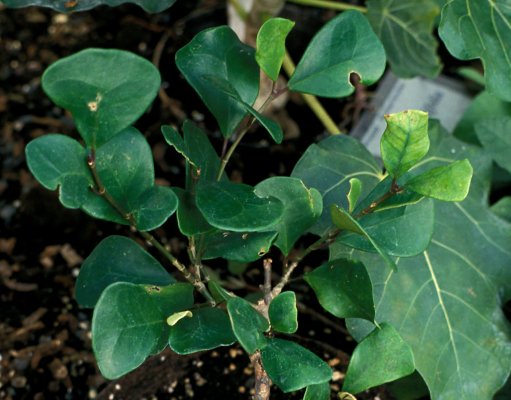
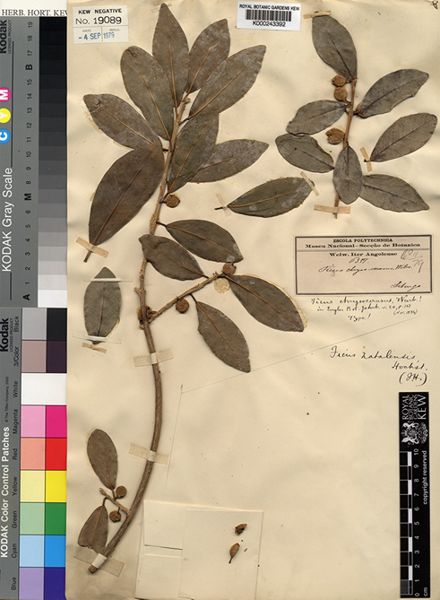
| Shrub or small to medium-sized tree up to 30 m tall, semi-epiphytic or secondarily terrestrial; bole short; bark greyish, fairly smooth, with white latex; crown spreading to sometimes semi-scandent or lianous; aerial roots hanging from branches, few or abundant; leafy twigs 2–5 mm thick, glabrous or sparsely minutely puberulous. Leaves spirally arranged, almost distichous, or nearly opposite, simple; stipules 2–10 mm long, glabrous or puberulous, caducous; petiole 0.5–3 cm long, glabrous; blade oblong to elliptical or obovate to broadly obtriangular, occasionally lanceolate, 2.5–10(–11) cm × 1–4.5(–8) cm, acute to obtuse at the base, shortly acuminate, subacute, rounded or emarginate at the apex, margin entire, thin leathery, both surfaces glabrous, lateral veins in 5–13 pairs, midvein usually not reaching the apex, tertiary venation reticulate or nearly parallel to the lateral veins. Inflorescence a fig, the flowers enclosed within, figs in pairs in the leaf axils or sometimes also just below the leaves, globose to ellipsoid or obovoid, 1.5–2 cm in diameter when fresh, 1–1.5 cm in diameter when dry, glabrous, reddish-orange or yellowish to brown at maturity, usually wrinkled when dry; peduncle 2–10 mm long; basal bracts 1.5–2.5 mm long, caducous, sometimes shortly persistent. Flowers unisexual; male flowers with 2–3 tepals and 1 stamen; female flowers with 3 tepals, seed flowers sessile and with style 1.5–2 mm long, gall flowers on pedicel up to 1 mm long and with style 0.5–1 mm long. Fruit ellipsoid, c. 1.5 mm long, developing within the fig; ‘gall fruits’ subglobose, c. 1 mm long. | |||
| show more data (12) | comments (0) |
| Ficus comprises about 750 species, distributed in tropical and subtropical regions, with a few species in warm temperate regions. About 100 species occur in Africa, 500 in Asia and Australia, and 150 in the Americas. Ficus natalensis is classified in subgenus Urostigma section Galoglychia subsection Chlamydodorae. It is easily confused with Ficus faulkneriana C.C.Berg, Ficus thonningii Blume and Ficus craterostoma Warb. ex Mildbr. & Burret, but can be distinguished by its pedunculate figs with caducous basal bracts. The close relation between Ficus natalensis and the latter 2 species is confirmed by molecular analysis. Within Ficus natalensis, 3 subspecies are recognized: subsp. natalensis (‘coastal strangler fig’), distributed in East tropical Africa and coastal South Africa; subsp. graniticola J.E.Burrows (‘granite-boulder fig’, ‘natal fig’), growing inland in Zimbabwe, probably also in western Mozambique and northern South Africa, differing from subsp. natalensis in its leathery, often grey-green leaves, the often truncate leaf apex and the larger figs which are yellow when ripe; and subsp. leprieurii (Miq.) C.C.Berg, distributed from Senegal to southern Sudan and southwards to eastern DR Congo, Zambia and to northern Angola, differing from subsp. natalensis in its often shrubby, scandent habit, obovate to obtriangular leaves and small figs. There is evidence for hybridization between Ficus natalensis subsp. natalensis and Ficus thonningii in Natal, and both species are pollinated by the wasp Elisabethiella stuckenbergi. On the other hand, Ficus natalensis subsp. natalensis and subsp. leprieurii are pollinated by different wasp species; the latter by Alfonsiella fimbriata. As the relation between fig species and pollinator species is usually very close and taxonomically relevant, the taxonomy of Ficus natalensis and Ficus thonningii may need revision. | |||
| show more data (2) | comments (0) |
| Ficus natalensis starts life as a soil-based seedling or as an epiphyte, later becoming a strangler and eventually replacing the original tree. Pollination is effectuated by several species of fig-wasps (Agaonidae). While mostly 1 fig species is associated with 1 wasp species and vice versa, 4 wasp species were found to visit a single Ficus natalensis tree in Uganda. In West Africa fruits ripen during the first half of the dry season, or during the beginning of the rainy season. | |||
| show more data (3) | comments (0) |
| Ficus natalensis occurs from sea-level up to 2200 m altitude in wet forest as well as in dry forest, thicket, and riverine and ground-water forest in woodland and savanna, often in rocky places. | |||
| show more data (13) | comments (0) |
| Large cuttings and seedlings can be used as planting material. Fruits dry without releasing the seed. They can be stored for some time provided insect attack is controlled, e.g. by adding ash. | |||
| show more data (6) | comments (0) |
| Ficus natalensis is an important agroforestry tree, for instance in banana plantations in Uganda. It coppices well. | |||
| show more data (1) | comments (0) |
| For cloth-making, a cylinder of bark is removed from the bole. After removal of the bark, the bole is covered with banana leaves, and sometimes plastered with cow dung, to stimulate recovery and new bark growth. It is said that well-managed trees can be harvested annually for up to 40 years, provided the cambium is not damaged. Regrown bark is reported to be of better quality than bark from the first harvest. | |||
| show more data (0) | comments (0) |
| show more data (1) | comments (0) |
| To make bark-cloth, the harvested cylinder of bark is softened with steam and intensively beaten with a mallet to remove unwanted material and to stretch the bark. A 50 cm wide piece of bark can yield a piece of cloth nearly 2.5 m wide after beating. After being beaten the cloth is left to dry in the sun, which also gives it a deep red-brown colour. The darkening can be stopped any time. After drying, the bark is moistened and kneaded until soft and pliable. | |||
| show more data (0) | comments (0) |
| Ficus natalensis is widespread and cultivated. It is not in danger of genetic erosion. | |||
| show more data (0) | comments (0) |
| Bark-cloth has lost most of its commercial importance, but is still produced. Continued interest from the curio and souvenir industry and handicraft world-wide ensure a small but steady demand. While the wood is fairly suitable for paper making, the suitability of Ficus natalensis as a plantation pulp species remains to be investigated. The growth rate and other factors determining production and economics have to be evaluated and taken into consideration. The important role of Ficus natalensis in African traditional medicine is not reflected by pharmacological research and investigation of its potential is urgently needed. | |||
| show more data (1) | comments (0) |
| • Arbonnier, M., 2000. Arbres, arbustes et lianes des zones sèches d’Afrique de l’Ouest. CIRAD, MNHN, UICN. 541 pp. • Berg, C.C., 1988. New taxa and combinations in Ficus (Moraceae) of Africa. Kew Bulletin 43(1): 77–97. • Berg, C.C., 1991. Moraceae. In: Launert, E. & Pope, G.V. (Editors). Flora Zambesiaca. Volume 9, part 6. Flora Zambesiaca Managing Committee, London, United Kingdom. pp. 13–76. • Burkill, H.M., 1995. The useful plants of West Tropical Africa. 2nd Edition. Volume 3, Families J–L. Royal Botanic Gardens, Kew, Richmond, United Kingdom. 857 pp. • Grace, O.M., Prendergast, H.D.V., Jäger, A.K. & van Staden, J., 2002. Bark medicines in traditional healthcare in KwaZulu-Natal, South Africa: an inventory. South African Journal of Botany 69(3): 301–363. • Katende, A.B., Birnie, A. & Tengnäs, B., 1995. Useful trees and shrubs for Uganda: identification, propagation and management for agricultural and pastoral communities. Technical Handbook 10. Regional Soil Conservation Unit, Nairobi, Kenya. 710 pp. • Neuwinger, H.D., 2000. African traditional medicine: a dictionary of plant use and applications. Medpharm Scientific, Stuttgart, Germany. 589 pp. • Ogunkunle, A.T.J., 2010. A quantitative modelling of pulp and paper making suitability of Nigerian hardwood species. Advances in Natural and Applied Sciences 4(1): 14–21. • Rabe, T. & van Staden, J., 1997. Antibacterial activity of South African plants used for medicinal purposes. Journal of Ethnopharmacology 56: 81–87. • Tabuti, J.R.S., Lye, K.A. & Dhillion, S.S., 2003. Traditional herbal drugs of Bulamogi, Uganda: plants, use and administration. Journal of Ethnopharmacology 88: 19–44. | |||
| show more data (12) | comments (0) |
| • Adriaens, M., 2005. Family medicinal plant gardens in the Rwenzori Region. Marianum Press Ltd., Entebbe, Uganda. 137 pp. • Beentje, H.J., 1994. Kenya trees, shrubs and lianas. National Museums of Kenya, Nairobi, Kenya. 722 pp. • Bekunda, M.A. & Woomer, P.L., 1996. Organic resource management in banana-based cropping systems of the Lake Victoria Basin, Uganda. Agriculture, Ecosystems & Environment 59: 171–180. • Berg, C.C., Hijman, M.E.E. & Weerdenburg, J.C.A., 1985. Moraceae (incl. Cecropiaceae). Flore du Cameroun. Volume 28. Muséum National d’Histoire Naturelle, Paris, France. 298 pp. • Burrows, J.E. & Burrows, S.M., 2003. Figs of southern and South-Central Africa. Umdaus Press, Pretoria, South Africa. 379 pp. • Coates Palgrave, K., 2002. Trees of southern Africa. 3rd Edition. Struik Publishers, Cape Town, South Africa. 1212 pp. • Compton, S.G., Grehan, K. & van Noort, S., 2009. A fig crop pollinated by three or more species of agaonid fig wasps. African Entomology 17(2): 215–222. • Hauman, L., Lebrun, J. & Boutique, R., 1948. Moraceae. In: Robyns, W., Staner, P., De Wildeman, E., Germain, R., Gilbert, G., Hauman, L., Homès, M., Lebrun, J., Louis, J., Vanden Abeele, M. & Boutique, R. (Editors). Flore du Congo belge et du Ruanda-Urundi. Spermatophytes. Volume 1. Institut National pour l’Étude Agronomique du Congo belge, Brussels, Belgium. pp. 52–176. • Ipulet, P., 2007. Uses of genus Ficus (Moraceae) in Buganda region, central Uganda African. Journal of Ecology 45(Suppl. 3): 44–47. • Kamatenesi-Mugisha, M. & Oryem-Origa, H., 2007. Medicinal plants used to induce labour during childbirth in western Uganda. Journal of Ethnopharmacology 109: 1–9. • Keay, R.W.J., 1958. Moraceae. In: Keay, R.W.J. (Editor). Flora of West Tropical Africa. Volume 1, part 2. 2nd Edition. Crown Agents for Oversea Governments and Administrations, London, United Kingdom. pp. 593–616. • Kokwaro, J.O., 1993. Medicinal plants of East Africa. 2nd Edition. Kenya Literature Bureau, Nairobi, Kenya. 401 pp. • Lovett, J.C., Ruffo, C.K., Gereau, R.E. & Taplin, J.R.D., 2006. Field guide to the moist forest trees of Tanzania. [Internet] Centre for Ecology Law and Policy, Environment Department, University of York, York, United Kingdom. http://celp.org.uk/ projects/ tzforeco/. Accessed July 2011. • Ramcharun, S., Baijnath, H. & van Greuning, J.V., 1990. Some aspects of the reproductive biology of the Ficus natalensis complex in southern Africa. Mitteilungen aus dem Institut für Allgemeine Botanik Hamburg 23a: 451–455. • Renoult, J.P., Kjellberg, F., Grout, C., Santoni, S. & Khadari, B., 2009. Cyto-nuclear discordance in the phylogeny of Ficus section Galoglychia and host shifts in plant-pollinator associations. BMC Evolutionary Biology 9: 248. • Rønsted, N., Salvo, G. & Savolainen, V., 2007. Biogeographical and phylogenetic origins of African fig species (Ficus section Galoglychia). Molecular Phylogenetics and Evolution 43: 190–201. • Rønsted, N., Weiblen, G.D., Clement, W.L., Zerega, N.J.C. & Savolainen, V., 2008. Reconstructing the phylogeny of figs (Ficus, Moraceae) to reveal the history of the fig pollination mutualism. Symbiosis 45(1–3): 45–55. • Sonibare, M.A., Sonibare, O.O., Akharame, O.E. & Soladoye, M.O., 2009. Chemical composition of essential oils of Ficus elasticoidies de Wild., Ficus ovata Vahl and Ficus natalensis subsp. leprieurii (Miq.) C.C. Berg from Nigeria. Journal of Essential Oil-Bearing Plants 12(3): 282–286. • Tabuti, J.R.S., Muwanika, V.B., Arinaitwe, M.Z. & Ticktin, T., 2011. Conservation of priority woody species on farmlands: a case study from Nawaikoke sub-county, Uganda. Applied Geography 31(2): 456–462. • van Wyk, B.E. & Gericke, N., 2000. People’s plants: a guide to useful plants of southern Africa. Briza Publications, Pretoria, South Africa. 351 pp. | |||
| show more data (4) | comments (0) |
| show more data (14) | comments (0) |
| • Hauman, L., Lebrun, J. & Boutique, R., 1948. Moraceae. In: Robyns, W., Staner, P., De Wildeman, E., Germain, R., Gilbert, G., Hauman, L., Homès, M., Lebrun, J., Louis, J., Vanden Abeele, M. & Boutique, R. (Editors). Flore du Congo belge et du Ruanda-Urundi. Spermatophytes. Volume 1. Institut National pour l’Étude Agronomique du Congo belge, Brussels, Belgium. pp. 52–176. | |||
| show more data (0) | comments (0) |
| |||||
| |||||||
| |||||
| Oyen, L.P.A., 2011. Ficus natalensis Hochst. [Internet] Record from PROTA4U. Brink, M. & Achigan-Dako, E.G. (Editors). PROTA (Plant Resources of Tropical Africa / Ressources végétales de l’Afrique tropicale), Wageningen, Netherlands. <http://www.prota4u.org/search.asp>. Accessed . | |||
| There are 136 book citations related to Ficus natalensis Hochst.. Click on "show more" to view them. | ||
| show more data | comments (0) |
| There are 193 citation in web searches related to Ficus natalensis Hochst.. Click on "show more" to view them. | ||
| show more data | comments (0) |
| There are 111 citation in scholarly articles related to Ficus natalensis Hochst.. Click on "show more" to view them. | ||
| show more data | comments (0) |
| There are 10 news article citations related to Ficus natalensis Hochst.. Click on "show more" to view them. | ||
| show more data | comments (0) |
| There are 25 citations in Afrirefs related to Ficus natalensis Hochst.. Click on "show more" to view them. | ||
| show more data | comments (0) |
| There are 10 Wikipedia citations related to Ficus natalensis Hochst.. Click on "show more" to view them. | ||
| show more data | comments (0) |
| General importance |  |
| Geographic coverage Africa |  |
| Geographic coverage World |  |
| Ornamental use |  |
| Forage/feed use | |
| Fruit use | |
| Auxiliary use | |
| Fuel use | |
| Medicinal use | |
| Essential oil and exudate use | |
| Fibre use | |
| Climate change | |
| Food security | |



 Comments (