Record display
 PROTA4U Homepage
| Select translation pop-up: |
|
|
PROTA4U Record display |
PROTA4U Homepage
|
| Bull. Mus. natn. Hist. nat., Paris, sér. 2, 19: 368 (1947). | |||
| show more data (6) | comments (0) |
| Apocynaceae | |||
| show more data (13) | comments (0) |
| 2n = 22 | |||
| show more data (1) | comments (0) |
| Diplorhynchus mossambicensis Oliv. (1881). | |||
| show more data (15) | comments (0) |
| Horn-pod tree, wild rubber (En). Jasmineiro de Africa, jasmineiro de Cazengo (Po). Mtogo (Sw). | |||
| show more data (5) | comments (0) |
| Diplorhynchus condylocarpon occurs from DR Congo and Tanzania south to South Africa, but is rare in Namibia and Botswana. | |||
| show more data (18) | comments (0) |
| Throughout its area of distribution, a decoction of the root bark of Diplorhynchus condylocarpon is used to treat indigestion, diarrhoea, fever, snakebites, infertility and venereal diseases. In Tanzania a root decoction is used to treat rectal prolapse, diabetes, testicle inflammation and is applied externally to treat sore eyes. It is also taken to facilitate giving birth. In Malawi a leaf infusion is used to treat headache and stomach problems, while a decoction of the root with salt is used to treat cough. The latex is smeared on cuts to heal them. In Zambia a root decoction is used to treat chronic cough, pneumonia and pulmonary tuberculosis. The body is washed with a root infusion to treat measles, and the infusion is also taken orally. Root powder is taken with food to treat anorexia and in porridge to treat pain in the digestive tract. The wood of Diplorhynchus condylocarpon is suitable for ornaments, furniture, fencing and firewood and to make charcoal. Diplorhynchus condylocarpon is a food plant of the edible caterpillar Brunaea alcinoe. In Zambia branches are cut as cattle feed. The bark fibre is used for weaving in a similar way as the bark fibre of baobab (Adansonia digitata L.). In DR Congo the latex is used to repair bicycle tyres and for trapping birds. In Namibia it is used as glue to stick feathers and metal tips to arrows. In southern Africa the latex is also smeared on hides of drums to improve the tone. | |||
| show more data (23) | comments (0) |
| Alkaloids are present in both the stem bark and root bark of Diplorhynchus condylocarpon, the latter being richer. These alkaloids belong to 3 main groups: yohimbine and its isomer β-yohimbine; nor-macusine B (tombozine or diplorrhyne), stemmadenine and condylocarpine; and 14-hydroxy-(–)-akuammicine (mossambine or diplorhyncine) and nor-fluorocurarine. Most of these compounds also occur in other members of Apocynaceae. An aqueous extract of the roots and stems is reported to be a useful sympatholytic. Ethanolic extracts of the roots did not show a significant antiplasmodial activity in vitro. | |||
| show more data (3) | comments (0) |
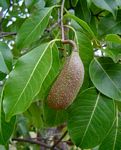
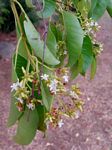
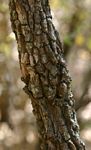
| Shrub or small tree up to 12(–20) m tall, with white or yellow latex; bole up to 50(–200) cm in diameter; bark smooth to rough, longitudinally fissured or reticulate, greyish to brownish or blackish. Leaves decussately opposite, simple and entire; stipules absent; petiole 1–2 cm long, hairy; blade obovate to elliptical, ovate or almost circular, 4–9 cm × 2–5 cm, base cuneate to obtuse, apex acute, acuminate, rounded or emarginate, leathery, glabrous to shortly hairy. Inflorescence a lax to congested thyrsoid cyme, terminal and in axils of the upper leaves; peduncle 0.5–4 cm long; bracts obscure, rounded. Flowers bisexual, regular, 5-merous, very sweet-scented; pedicel 0.5–2.5 mm long; sepals connate at base, ovate, acute; corolla tube cylindrical, 2–3 mm × 1–1.5 mm, constricted at throat, lobes narrowly oblong to narrowly ovate, c. 5 mm long, rounded to slightly acute, with many glandular hairs, with a scale between bases of lobes, white to creamy; stamens inserted near the middle of the corolla tube and included, anthers c. 1 mm long; ovary superior, consisting of 2 free, obovoid carpels, style slender, c. 1 mm long, pistil head almost cylindrical, woolly hairy. Fruit consisting of 2 obliquely oblong, widely spreading follicles 3–6.5 cm × 1–2 cm, coherent at the base, apex abruptly curved, woody, green or pale to dark brown, 2-valved, 4-seeded. Seeds obliquely oblong, 3.5–4.5 cm long, laterally compressed, dark brown, at apex with large transparent wing. Diplorhynchus comprises a single species. | |||
| show more data (0) | comments (0) |
| show more data (7) | comments (0) |
| show more data (2) | comments (0) |
| show more data (2) | comments (0) |
| Diplorhynchus condylocarpon occurs in dry deciduous woodland and on stony hillsides, up to 1700 m altitude. | |||
| show more data (7) | comments (0) |
| show more data (4) | comments (0) |
| Propagation can be done by means of seed, cuttings and wildlings. Cut trunks sprout easily from the base. Coppicing and pollarding are appropriate management techniques. | |||
| show more data (0) | comments (0) |
| Diplorhynchus condylocarpon is widespread in most of its area of distribution and is not in danger of genetic erosion. | |||
| show more data (0) | comments (0) |
| Diplorhynchus condylocarpon is a useful medicine in rural communities. In view of its many medicinal uses, further research into the pharmacological activities of Diplorhynchus condylocarpon may prove worthwhile. | |||
| show more data (0) | comments (0) |
| • Chilufya, H. & Tengnäs, B., 1996. Agroforestry extension manual for northern Zambia. Regional Soil Conservation Unit, Nairobi, Kenya. 120 + 124 pp. • Hedberg, I., Hedberg, O., Madati, P.J., Mshigeni, K.E., Mshiu, E.N. & Samuelsson, G., 1982. Inventory of plants used in traditional medicine in Tanzania. I. Plants of the families Acanthaceae-Cucurbitaceae. Journal of Ethnopharmacology 6(1): 29–60. • Leeuwenberg, A.J.M., Kupicha, F.K., Barink, M.M., Beentje, H.J., de Kruif, A.P.M., Plaizier, A.C. & Zwetsloot, H.J.C., 1985. Apocynaceae. In: Launert, E. (Editor). Flora Zambesiaca. Volume 7, part 2. Flora Zambesiaca Managing Committee, London, United Kingdom. pp. 395–503. • Neuwinger, H.D., 2000. African traditional medicine: a dictionary of plant use and applications. Medpharm Scientific, Stuttgart, Germany. 589 pp. • Plaizier, A.C., 1980. A revision of Adenium Roem. & Schult. and of Diplorhynchus Welw. ex Fic. and Hiern (Apocynaceae). Mededelingen Landbouwhogeschool Wageningen 80–12. Wageningen, Netherlands. 40 pp. | |||
| show more data (3) | comments (0) |
| • Chhabra, S.C., Mahunnah, R.L.A. & Mshiu, E.N., 1987. Plants used in traditional medicine in eastern Tanzania. 1. Pteridophytes and Angiosperms (Acanthaceae to Canellaceae). Journal of Ethnopharmacology 21: 253–277. • Chinemana, F., Drummond, R.B., Mavi, S. & de Zoysa, I., 1985. Indigenous plant remedies in Zimbabwe. Journal of Ethnopharmacology 14: 159–172. • Coates Palgrave, K., 1983. Trees of southern Africa. 2nd Edition. Struik Publishers, Cape Town, South Africa. 959 pp. • Gelfand, M., Mavi, S., Drummond, R.B. & Ndemera, B., 1985. The traditional medical practitioner in Zimbabwe: his principles of practice and pharmacopoeia. Mambo Press, Gweru, Zimbabwe. 411 pp. • Kokwaro, J.O., 1993. Medicinal plants of East Africa. 2nd Edition. Kenya Literature Bureau, Nairobi, Kenya. 401 pp. • Latham, P., 2004. Useful plants of Bas-Congo province, Democratic Republic of the Congo. DFID, London, United Kingdom. 320 pp. • Leger, S., 1997. The hidden gifts of nature: A description of today’s use of plants in West Bushmanland (Namibia). [Internet] DED, German Development Service, Windhoek, Namibia & Berlin, Germany. http://www.sigridleger.de/book/. Accessed March 2006. • Ndubani, P. & Höjer, B., 1999. Traditional healers and the treatment of sexually transmitted illnesses in rural Zambia. Journal of Ethnopharmacology 67: 15–25. • van Wyk, B.E. & Gericke, N., 2000. People’s plants: a guide to useful plants of southern Africa. Briza Publications, Pretoria, South Africa. 351 pp. | |||
| show more data (2) | comments (0) |
| show more data (1) | comments (0) |
| |||||
| |||||||
| |||||||||||
| |||||||
| |||||
| de Ruijter, A., 2006. Diplorhynchus condylocarpon (Müll.Arg.) Pichon. [Internet] Record from PROTA4U. Schmelzer, G.H. & Gurib-Fakim, A. (Editors). PROTA (Plant Resources of Tropical Africa / Ressources végétales de l’Afrique tropicale), Wageningen, Netherlands. <http://www.prota4u.org/search.asp>. Accessed . | |||
| There are 149 book citations related to Diplorhynchus condylocarpon (Müll.Arg.) Pichon. Click on "show more" to view them. | ||
| show more data | comments (0) |
| There are 124 citation in web searches related to Diplorhynchus condylocarpon (Müll.Arg.) Pichon. Click on "show more" to view them. | ||
| show more data | comments (0) |
| There are 103 citation in scholarly articles related to Diplorhynchus condylocarpon (Müll.Arg.) Pichon. Click on "show more" to view them. | ||
| show more data | comments (0) |
| There are 20 citations in Afrirefs related to Diplorhynchus condylocarpon (Müll.Arg.) Pichon. Click on "show more" to view them. | ||
| show more data | comments (0) |
| There are 1 Wikipedia citations related to Diplorhynchus condylocarpon (Müll.Arg.) Pichon. Click on "show more" to view them. | ||
| show more data | comments (0) |
| General importance |  |
| Geographic coverage Africa |  |
| Geographic coverage World |  |
| Ornamental use | |
| Forage/feed use | |
| Timber use | |
| Carbohydrate/starch use | |
| Fuel use | |
| Medicinal use | |
| Essential oil and exudate use | |
| Fibre use | |



 Comments (