Record display
 PROTA4U Homepage
| Select translation pop-up: |
|
|
PROTA4U Record display |
PROTA4U Homepage
|
| Sp. pl. 1: 208 (1753). | |||
| show more data (9) | comments (0) |
| Apocynaceae | |||
| show more data (13) | comments (0) |
| 2n = 40 | |||
| show more data (1) | comments (0) |
| Cerbera venenifera (Poir.) Steud. (1840). | |||
| show more data (39) | comments (0) |
| Sea-mango, tanghin, ordeal plant (En). Tanghin (Fr). | |||
| show more data (6) | comments (0) |
| Cerbera manghas is widely distributed from the islands of the Indian Ocean to tropical Asia, tropical Australia and the islands of the Pacific Ocean. In tropical Africa it has been found on Pemba Island (Tanzania), Madagascar, the Seychelles and Mauritius. | |||
| show more data (37) | comments (0) |
| The seeds of Cerbera manghas are used in traditional medicine in Madagascar to treat cardiac disorders. However they are very poisonous and were used until the middle of the 19th century as ordeal poison. In tropical Asia the seeds are used to treat scabies and itch, to prepare a hair tonic and as fish poison, the bark is used as a laxative and antipyretic and in the treatment of dysuria and ringworm, the flowers to treat haemorrhoids, and roots, bark and leaves to prepare a purgative. The wood is occasionally used in tropical Asia for mouldings, interior trim, fruit cases, core veneer, matches, shuttering, clogs, plain furniture and carving, and also for charcoal. Cerbera manghas is planted as an ornamental and the fibrous fruits, of which the skin and soft parts have decayed, are used in flower arrangements. | |||
| show more data (7) | comments (0) |
| Medicinal products of Cerbera manghas are not traded on the international market, but can be found on local markets in Madagascar. Small amounts of timber are exported from Papua New Guinea and the Solomon Islands to Japan. | |||
| show more data (0) | comments (0) |
| The seeds contain glycosides derived from the cardenolides tanghinigenin and digitoxigenin, such as cerberin, neriifolin, thevetin B and 2’-O-acetyl-thevetin B. The principal cardenolides contained in the bark and roots are gentiobiosyl-thevetoside and glucosyl-thevetoside along with other thevetosides derived from tanghinigenin. The amount of cardenolides in the leaves varies according to the season. Some of the cardenolides showed antiproliferative activity against human colon cancer, breast cancer, lung cancer and epidermoid carcinoma cell lines, as well as anti-oestrogenic activity. Cerberin acts on plain muscle preparations as a definite stimulant both with regard to tone and peristaltic movements. As such it behaves as a parasympatomimetic poison. It acts on both the rhythm and amplitude of the heart. In moderate doses cerberin has positive inotropic properties, but in high, toxic doses it produces a negative inotropic and chronotropic effect. Phytochemical investigations also revealed the presence of a series of lignans derived from olivil (cerberalignans) and monoterpenoids such as cerberidol. Ethanolic extracts of Cerbera manghas have shown selective activity against vesicular stomatis virus (VSV). Olivil, carinol and cycloolivil showed antioxidant activities. The wood is lightweight to medium-weight, with the white to pale yellow-brown heartwood not demarcated from the sapwood; grain is straight to slightly interlocked, texture fine and uneven. The shrinkage upon seasoning is moderate, and the wood works easily. It is not durable, highly susceptible to blue-staining fungi, and resistant to preservative treatment under pressure. | |||
| show more data (0) | comments (0) |
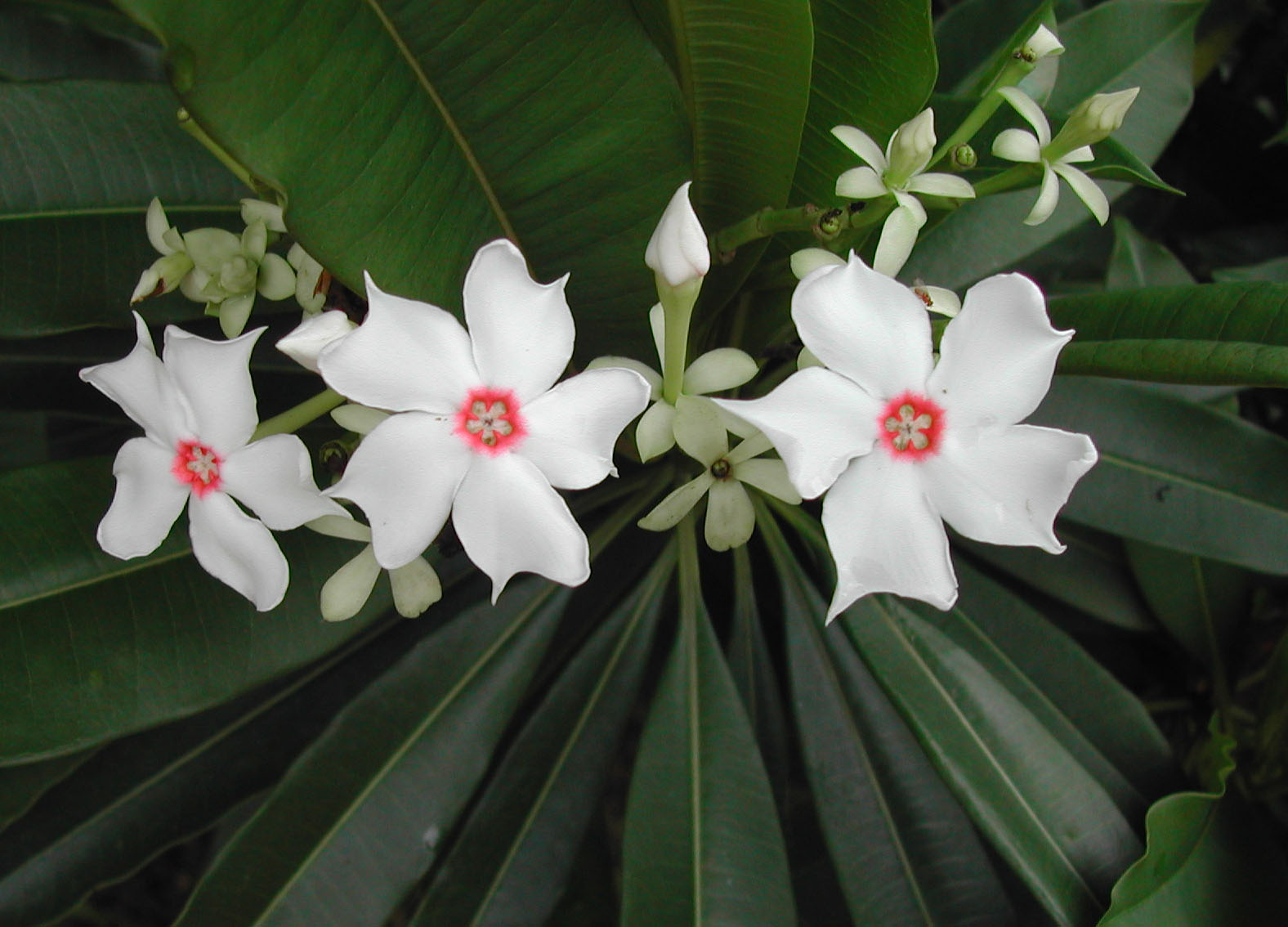
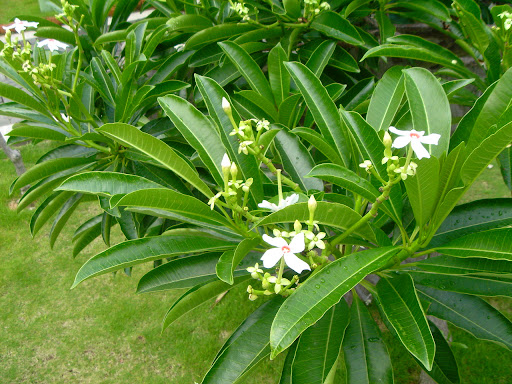
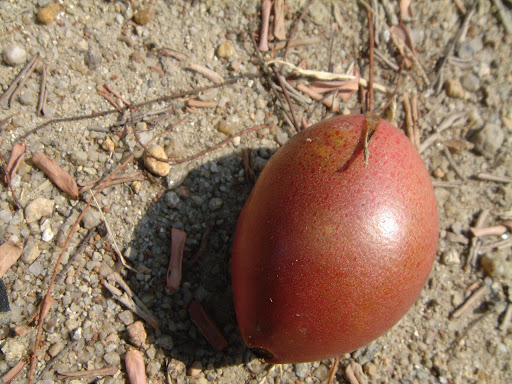
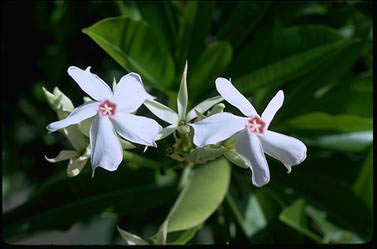
| Shrub or small to medium-sized tree up to 20(–25) m tall, with white latex in all parts, glabrous; bole up to 70 cm in diameter; bark thick, rough, peeling off, with large lenticels, grey to dark brown; branches thick and succulent, with many conspicuous leaf scars. Leaves arranged spirally, clustered at the ends of branches, simple and entire; stipules absent; petiole 1–4.5 cm long; blade narrowly obovate, 5–30 cm × 1–8 cm, cuneate at base, shortly acuminate at apex, leathery, pinnately veined with 15–40 pairs of lateral veins. Inflorescence a terminal cyme up to 25 cm × 15 cm, many-flowered; peduncle 1.5–12 cm long; bracts about as long as sepals, deciduous. Flowers bisexual, regular, 5-merous, fragrant; pedicel 0.5–3 cm long; sepals ovate or obovate, (0.5–)1–3.5 cm × c. 0.5 cm, spreading to recurved; corolla tube funnel-shaped, 1.5–5.5 cm long, widened at apex, pale green with white or pale yellow scales in the throat, hairy inside, lobes obliquely elliptical or obovate, 1.5–3 cm × 1–2 cm, spreading to recurved, white but pink at base; stamens inserted just below the top of corolla tube, included, covered by scales of corolla tube, anthers sessile; ovary superior, globose, consisting of 2 separate carpels, style long and slender, pistil head consisting of a 5-ridged basal part, a veil and a cone-shaped apex. Fruit consisting of 1 or 2 separate or basally fused, drupe-like, ellipsoid follicles 5–12 cm × 3–7 cm, rounded at both ends, dark red when mature, indehiscent, usually 1-seeded. Seed flattened orbicular, c. 2.5 cm in diameter, with small wing at apex. Seedling with hypogeal germination. Cerbera comprises 6 species occurring in tropical Asia, tropical Australia and islands of the Pacific Ocean; Cerbera manghas is most widespread. In tropical Asia Cerbera manghas has been much confused with Cerbera odollam Gaertn. The flowers of Cerbera manghas are pollinated by insects. The fruits, which are fibrous inside, float in water and can be distributed by sea currents; they are quite commonly washed up on shores. | |||
| show more data (0) | comments (0) |
| show more data (4) | comments (0) |
| show more data (1) | comments (0) |
| show more data (1) | comments (0) |
| In Madagascar Cerbera manghas is widespread, occurring in humid evergreen forest along the coast as well as in dry deciduous forest inland up to 150 m altitude. | |||
| show more data (5) | comments (0) |
| show more data (13) | comments (0) |
| Cerbera manghas should preferably be grown in full light in a fertile, moist but well-drained loam with additional leaf mould. The pulp of ripe fruits is removed to obtain the seeds, or the fruits are dried first, and then cracked to liberate the seeds. | |||
| show more data (0) | comments (0) |
| show more data (2) | comments (0) |
| Cerbera manghas is widespread and not under threat of genetic erosion. This is also the case in Madagascar, where it is still widespread. | |||
| show more data (0) | comments (0) |
| It is unlikely that Cerbera manghas will play an important role in future medicine because its cardenolides are very toxic and better alternatives are available, e.g. digoxin from Digitalis or ouabain from Strophanthus. The trees seldom grow to timber size, but the wood is useful for the production of veneer. Cerbera manghas has good prospects as an ornamental with beautiful flowers and fruit mesocarps. | |||
| show more data (0) | comments (0) |
| • Boiteau, P. & Allorge-Boiteau, L., 1993. Plantes médicinales de Madagascar. Agence de Coopération Culturelle et Technique, Paris, France. 135 pp. • Chang, L.C., Gills, J.J., Bhat, K.P., Luyengi, L., Farnsworth, N.R., Pezzuto, J.M. & Kinghorn, A.D., 2000. Activity-guided isolation of constituents of Cerbera manghas with antiproliferative and antiestrogenic activities. Bioorganic and Medical Chemistry Letters 10(21): 2431–2434. • Leeuwenberg, A.J.M., 1999. Series of revisions of Apocynaceae XLVII. The genus Cerbera L. Wageningen Agricultural University Papers 98–3. 64 pp. • Tran Dinh Ly, 1998. Cerbera L. In: Sosef, M.S.M., Hong, L.T. & Prawirohatmodjo, S. (Editors). Plant Resources of South-East Asia No 5(3). Timber trees: Lesser-known timbers. Backhuys Publishers, Leiden, Netherlands. pp. 154–156. • Tran Cong Khanh, 2001. Cerbera L. In: van Valkenburg, J.L.C.H. & Bunyapraphatsara, N. (Editors). Plant Resources of South-East Asia No 12(2): Medicinal and poisonous plants 2. Backhuys Publishers, Leiden, Netherlands. pp. 151–155. | |||
| show more data (47) | comments (0) |
| • Abe, F. & Yamauchi, T., 1977. Studies on Cerbera part 1: Cardiac glycosides in the seeds, bark and leaves of Cerbera manghas. Chemical and Pharmaceutical Bulletin Tokyo 25(10): 2744–2748. • Gurib-Fakim, A. & Brendler, T., 2004. Medicinal and aromatic plants of Indian Ocean Islands: Madagascar, Comoros, Seychelles and Mascarenes. Medpharm, Stuttgart, Germany. 568 pp. • Lee, S.K., Mbwambo, Z.H., Chung, H., Luyengi, L., Gamez, E.J., Mehta, R.G., Kinghorn, A.D. & Pezzuto, J.M., 1998. Evaluation of the antioxidant potential of natural products. Combinatorial Chemistry and High Throughput Screening 1(1): 35–46. • Markgraf, F., 1976. Apocynaceae. Flore de Madagascar et des Comores, famille 169. Muséum National d’Histoire Naturelle, Paris, France. 318 pp. • Neuwinger, H.D., 2000. African traditional medicine: a dictionary of plant use and applications. Medpharm Scientific, Stuttgart, Germany. 589 pp. • Tomlinson, P.B., 1986. The botany of mangroves. Cambridge University Press, Cambridge, United Kingdom. 413 pp. | |||
| show more data (14) | comments (0) |
| show more data (1) | comments (0) |
| |||||
| |||||||
| |||||||||||
| |||||||
| |||||
| Lemmens, R.H.M.J., 2006. Cerbera manghas L. [Internet] Record from PROTA4U. Schmelzer, G.H. & Gurib-Fakim, A. (Editors). PROTA (Plant Resources of Tropical Africa / Ressources végétales de l’Afrique tropicale), Wageningen, Netherlands. <http://www.prota4u.org/search.asp>. Accessed . | |||
| There are 4 study abstracts related to Cerbera manghas L.. Click on "show more" to view them. | ||
| show more data | comments (0) |
| There are 144 book citations related to Cerbera manghas L.. Click on "show more" to view them. | ||
| show more data | comments (0) |
| There are 198 citation in web searches related to Cerbera manghas L.. Click on "show more" to view them. | ||
| show more data | comments (0) |
| There are 112 citation in scholarly articles related to Cerbera manghas L.. Click on "show more" to view them. | ||
| show more data | comments (0) |
| There are 7 news article citations related to Cerbera manghas L.. Click on "show more" to view them. | ||
| show more data | comments (0) |
| There are 10 citations in Afrirefs related to Cerbera manghas L.. Click on "show more" to view them. | ||
| show more data | comments (0) |
| There are 14 Wikipedia citations related to Cerbera manghas L.. Click on "show more" to view them. | ||
| show more data | comments (0) |
| General importance |  |
| Geographic coverage Africa | |
| Geographic coverage World |  |
| Ornamental use | |
| Timber use | |
| Medicinal use | |



 Comments (