Record display
 PROTA4U Homepage
| Select translation pop-up: |
|
|
PROTA4U Record display |
PROTA4U Homepage
|
| Peters, Naturw. Reise Mossambique Vol. 6, Botanik 1: 24 (1861). | |||
| show more data (10) | comments (0) |
| Caesalpiniaceae (Leguminosae - Caesalpinioideae) | |||
| show more data (15) | comments (0) |
| 2n = 28 | |||
| show more data (0) | comments (0) |
| Bauhinia macrantha Oliv. (1871). | |||
| show more data (22) | comments (0) |
| Kalahari white bauhinia, wild coffee bean, coffee neat’s foot, camel’s foot (En). Bauhinia blanc du Kalahari (Fr). Chingando (Po). | |||
| show more data (5) | comments (0) |
| Bauhinia petersiana occurs in south-eastern DR Congo and Tanzania, and throughout southern Africa. | |||
| show more data (23) | comments (0) |
| The meal of pounded seeds of Bauhinia petersiana is eaten. The seeds are also eaten as nuts after roasting and are considered a delicacy in parts of Botswana. Roasted and ground seeds are used as a substitute for coffee. Unripe seeds can also be eaten. The pods are eaten either roasted (Namibia) or boiled (Zambia). Seed oil is extracted in Botswana for local use. In DR Congo the bark fibres are used to make rope and the roots to produce a dye. Bauhinia petersiana is widely browsed by livestock. In Zimbabwe, South Africa and the United States it is grown as an ornamental shrub. In much of its area of distribution the leaves of Bauhinia petersiana are boiled, the steam inhaled and the cooled-down liquid drunk to cure common cough. The Shona people of Zimbabwe take an infusion of the roots to treat dysmenorrhoea and female infertility. In South Africa the pounded leaves mixed with salt are boiled and the warm liquid is sprinkled on wounds to promote healing. A decoction of the macerated roots is drunk as a remedy for diarrhoea. | |||
| show more data (22) | comments (0) |
| show more data (1) | comments (0) |
| Dry seeds of Bauhinia petersiana contain per 100 g: water 6.8 g, energy 1554 kJ (371 kcal), protein 22.9 g, fat 13.1 g, carbohydrate 40.2 g, fibre 13.0 g, Ca 237 mg, P 317 mg, Fe 3.9 mg, thiamin 0.58 mg, riboflavin 0.2 mg and niacin 1.6 mg (Arnold, Wells & Wehmeyer, 1985). The principal fatty acids in the seed oil are linoleic acid (45%), oleic acid (26%), palmitic acid (16%) and stearic acid (7%). The roots and leaves contain tannins. | |||
| show more data (2) | comments (0) |
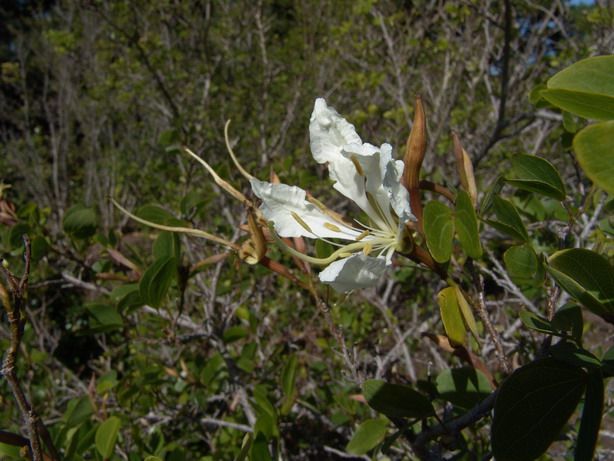
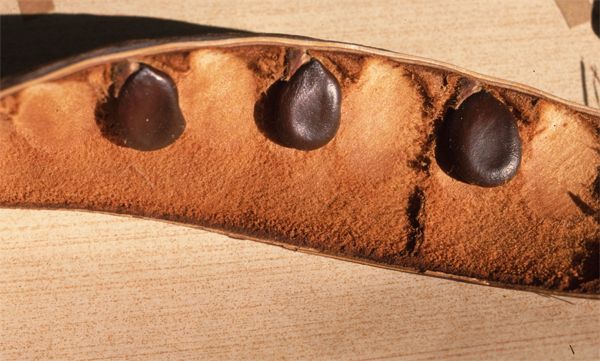
| Shrub or small tree up to 10 m tall; young branchlets pubescent and with many small orange glands or scales, some branchlets coiled apically, tendril-like. Leaves alternate, simple; stipules 3–5 mm × 1–2 mm, deciduous; petiole 0.5–3 cm long; blade 2–8 cm × 2–10 cm, 2-lobed to one-third to two-thirds down, lobes elliptical to ovate or rounded. Inflorescence an axillary, leaf-opposed or terminal raceme, 1–10-flowered. Flowers bisexual, almost regular, 5-merous; hypanthium (1.5–)2–5.5(–6.5) cm long; sepals linear to linear-lanceolate, 1.5–5 cm long; petals narrowly elliptical to ovate, 2–8.5 cm × 0.5–4 cm, white throughout or sometimes base of midrib pink; fertile stamens (4–)5(–6), slightly unequal in length, staminodes 4–5; ovary superior, slender, hairy, style 2–4 cm long. Fruit a linear-oblong to oblanceolate-oblong pod 10–24 cm × 1.5–5 cm, woody, dehiscent, 5–6-seeded. Seeds 1–3 cm × 0.5–2 cm, deep chestnut-brown to blackish. Bauhinia is a widespread tropical genus with about 250 species. In Bauhinia petersiana 2 subspecies are distinguished. Subsp. petersiana has 2–10-flowered inflorescences, appressed hairs at the lower side of the leaves, and it is distributed in the more eastern and northern parts of the area of the species. Subsp. macrantha (Oliv.) Brummitt & J.H.Ross has 1–3(–4)-flowered inflorescences and curved or spreading hairs at the lower side of the leaves, and it is found from southern Zambia and western Zimbabwe towards the south and west. Bauhinia petersiana does not possess root nodules and relies on soil nitrogen. | |||
| show more data (0) | comments (0) |
| show more data (14) | comments (0) |
| show more data (4) | comments (0) |
| show more data (3) | comments (0) |
| Bauhinia petersiana is found in open grassland, wooded grassland and woodland. In East Africa it is found at altitudes of 150–1850 m. In southern Africa it is found in dry localities, e.g. in the Kalahari with an annual rainfall of about 350 mm only, and it tolerates frost. | |||
| show more data (7) | comments (0) |
| show more data (4) | comments (0) |
| In the Kalahari the seeds of Bauhinia petersiana are harvested from April to July. For use as an ornamental Bauhinia petersiana is propagated by seed, cuttings or layering. The 100-seed weight is about 670 g. | |||
| show more data (0) | comments (0) |
| show more data (1) | comments (0) |
| There are indications that Bauhinia petersiana has disappeared completely from communal grazing land in southern Botswana, possibly as a result of increased grazing pressure. Two accessions from Botswana are stored in the Millenium Seedbank (Ardingly, West Sussex, United Kingdom), a single accession from Zimbabwe is kept by the Desert Legume Programme in the United States. | |||
| show more data (0) | comments (0) |
| Although Bauhinia petersiana has been considered a candidate for cultivation as a food crop for a long time, no attempts have been made to domesticate the species, nor to exploit or even explore its genetic variation. Efforts to conserve the southern populations, in situ or ex situ, are urgently needed to avoid loss of variation. | |||
| show more data (0) | comments (0) |
| • Arnold, T.H., Wells, M.J. & Wehmeyer, A.S., 1985. Khoisan food plants: taxa with potential for future economic exploitation. In: Wickens, G.E., Goodin, J.R. & Field, D.V. (Editors). Plants for arid lands. Proceedings of the Kew international conference on economic plants for arid lands. Allen & Unwin, London, United Kingdom. pp. 69–86. • Coates Palgrave, K., 1983. Trees of southern Africa. 2nd Edition. Struik Publishers, Cape Town, South Africa. 959 pp. • Gelfand, M., Mavi, S., Drummond, R.B. & Ndemera, B., 1985. The traditional medical practitioner in Zimbabwe: his principles of practice and pharmacopoeia. Mambo Press, Gweru, Zimbabwe. 411 pp. • Leger, S., 1997. The hidden gifts of nature: A description of today’s use of plants in West Bushmanland (Namibia). [Internet] DED, German Development Service, Windhoek, Namibia & Berlin, Germany. http://www.sigridleger.de/book/. Accessed April 2003. • von Koenen, E., 2001. Medicinal, poisonous and edible plants in Namibia. Klaus Hess Verlag, Göttingen, Germany. 336 pp. | |||
| show more data (18) | comments (0) |
| • Brenan, J.P.M., 1967. Leguminosae, subfamily Caesalpinioideae. In: Milne-Redhead, E. & Polhill, R.M. (Editors). Flora of Tropical East Africa. Crown Agents for Oversea Governments and Administrations, London, United Kingdom. 230 pp. • Brummitt, R.K. & Ross, J.H., 1982. A new combination for an African Bauhinia (Leguminosae, Caesalpinioideae): Bauhinia petersiana subsp. macrantha. Kew Bulletin 37(2): 236. • Dakora, F.D., Lawlor, D.W. & Sibuga, K.P., 1999. Assessment of symbiotic nitrogen nutrition in marama bean (Tylosema esculentum L.) a tuber-producing underutilized African grain legume. Symbiosis 27: 269–277. • Ketshajwang, K.K., Holmback, J. & Yeboah, S.O., 1998. Quality and compositional studies of some edible Leguminosae seed oils in Botswana. Journal of the American Oil Chemists Society 75(6): 741–743. • National Academy of Sciences, 1979. Tropical legumes: resources for the future. National Academy of Sciences, Washington, D.C., United States. 331 pp. • Neuwinger, H.D., 2000. African traditional medicine: a dictionary of plant use and applications. Medpharm Scientific, Stuttgart, Germany. 589 pp. • Ross, J.H., 1977. Fabaceae, subfamily Caesalpinioideae. In: Ross, J.H. (Editor). Flora of southern Africa. Volume 16, part 2. Botanical Research Institute, Department of Agricultural Technical Services, Pretoria, South Africa. 142 pp. • Story, R., 1958. Some plants used by the bushmen in obtaining food and water. Memoirs of the Botanical Survey of South Africa No 30. 113 pp. • van Wyk, B.E. & Gericke, N., 2000. People’s plants: a guide to useful plants of southern Africa. Briza Publications, Pretoria, South Africa. 351 pp. • Watt, J.M. & Breyer-Brandwijk, M.G., 1962. The medicinal and poisonous plants of southern and eastern Africa. 2nd Edition. E. and S. Livingstone, London, United Kingdom. 1457 pp. | |||
| show more data (5) | comments (0) |
| show more data (2) | comments (0) |
| |||||
| |||||||
| |||||||||
| |||||||
| |||||
| Bosch, C.H., 2006. Bauhinia petersiana Bolle. [Internet] Record from PROTA4U. Brink, M. & Belay, G. (Editors). PROTA (Plant Resources of Tropical Africa / Ressources végétales de l’Afrique tropicale), Wageningen, Netherlands. <http://www.prota4u.org/search.asp>. Accessed . | |||
| There are 1 study abstracts related to Bauhinia petersiana Bolle. Click on "show more" to view them. | ||
| show more data | comments (0) |
| There are 200 book citations related to Bauhinia petersiana Bolle. Click on "show more" to view them. | ||
| show more data | comments (0) |
| There are 199 citation in web searches related to Bauhinia petersiana Bolle. Click on "show more" to view them. | ||
| show more data | comments (0) |
| There are 110 citation in scholarly articles related to Bauhinia petersiana Bolle. Click on "show more" to view them. | ||
| show more data | comments (0) |
| There are 1 news article citations related to Bauhinia petersiana Bolle. Click on "show more" to view them. | ||
| show more data | comments (0) |
| There are 24 citations in Afrirefs related to Bauhinia petersiana Bolle. Click on "show more" to view them. | ||
| show more data | comments (0) |
| There are 4 Wikipedia citations related to Bauhinia petersiana Bolle. Click on "show more" to view them. | ||
| show more data | comments (0) |
| General importance |  |
| Geographic coverage Africa |  |
| Geographic coverage World |  |
| Cereals and pulses | |
| Ornamental use | |
| Forage/feed use | |
| Carbohydrate/starch use | |
| Medicinal use | |
| Stimulant use | |
| Food security | |
| Conservation status | |



 Comments (